Since Boston, trailblazing marathoner Kathrine Switzer writes her own story

Kathrine Switzer’s passion for journalism and women’s sports guided her through her time at SU, before her trailblazing Boston Marathon race. Courtesy of SU Athletics
Get the latest Syracuse news delivered right to your inbox. Subscribe to our sports newsletter here.
Growing up, Kathrine Switzer had a dream. One day, when she was in elementary school, Switzer revealed her grand ambition to her father, Homer: She wanted to be a cheerleader.
Of course she did. The cheerleaders were pretty, popular and always dated the captain of the football team. What else was there to ask for?
“Wasn’t that every little girl’s dream?” Switzer said.
It’s hard to imagine a world where Switzer stopped herself at that goal. Decades later, the 79-year-old has racked up a myriad of accomplishments, most notably becoming the first woman to complete the Boston Marathon in 1967, when she was a 20-year-old journalism student at Syracuse University.
She’s been a broadcaster at the Olympics. She’s established over 400 races across the world and run in hundreds herself. She has a nonprofit named for her bib number during her historic marathon, 261 Fearless — the same number that was raised to the JMA Wireless Dome rafters on Feb. 8.
“Kathrine Switzer is a trailblazer whose courage and determination changed the landscape of women’s athletics forever,” said Syracuse Director of Athletics John Wildhack in a press release.
But before that, before the recognition and the noise, before the number 261 had any meaning, Switzer wanted to be a cheerleader. Then, she wanted to be a journalist, focusing on women’s sports in high school, since they didn’t attract as much coverage.
That mindset became a theme throughout Switzer’s life. No one else was doing it, but why shouldn’t she be the first?
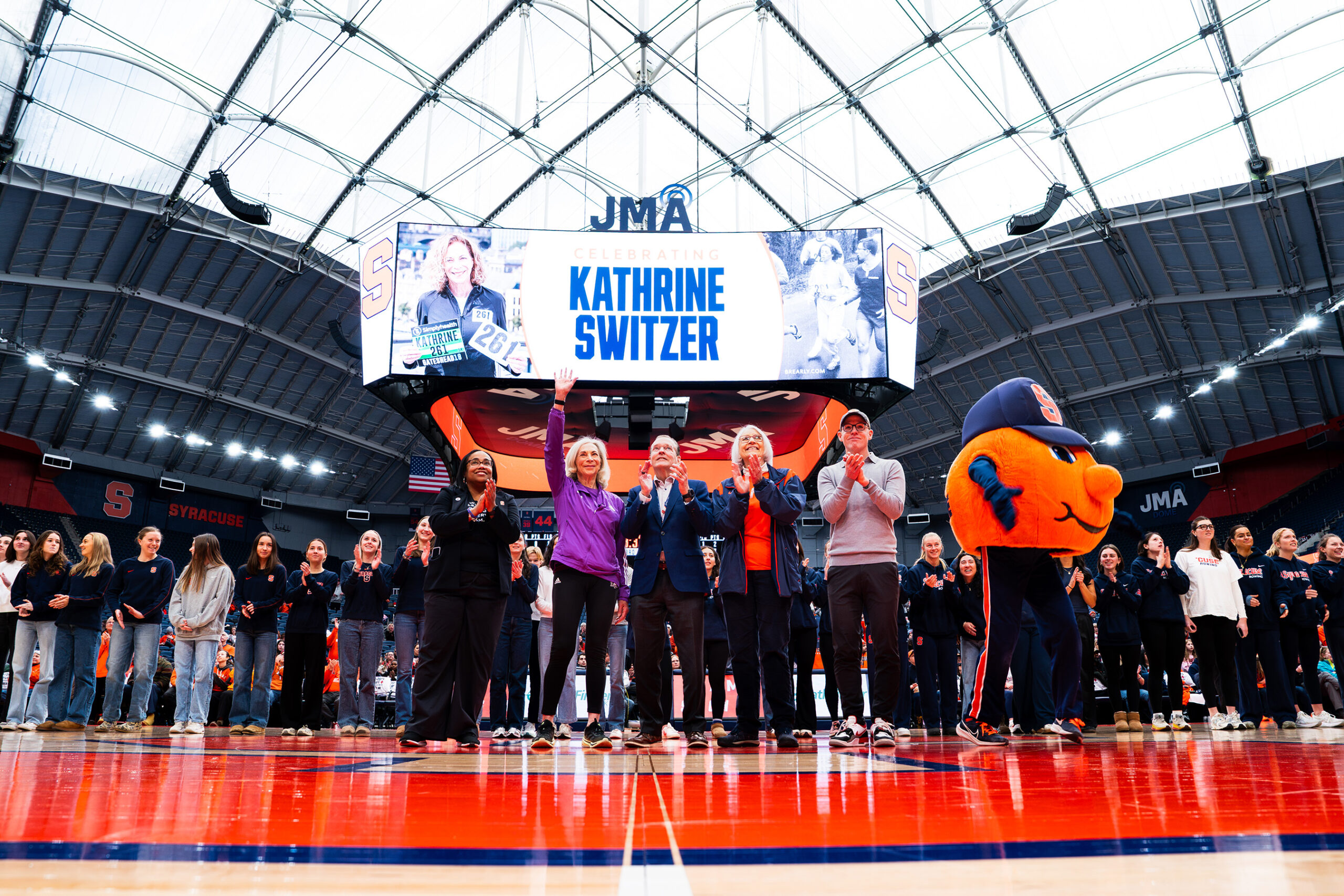
Kathrine Switzer waves to the JMA Wireless Dome crowd. Switzer’s No. 261 bib was raised to the Dome’s rafters at halftime of Syracuse women’s basketball 84-65 loss to Louisville on Feb. 8. Courtesy of SU Athletics
When she arrived at Syracuse, Switzer began working at The Daily Orange, where she fondly remembers working to make 5 p.m. deadlines with space heaters turned up to stave off the frigid Syracuse winters. Switzer began working for its sports section, covering the SU men’s cross country team.
But Switzer was eager to run herself. When she arrived on campus for her junior year, there were no women’s sports — running or otherwise.
So, she took matters into her own hands and approached the men’s cross country head coach to see if she could run with the team. It was against NCAA rules, the head coach told her, but he said she was welcome to train with them.
Switzer left his office satisfied. That was all she really wanted. But as the door swung shut, she heard him deliver a stinging blow.
“I guess I got rid of that one,” Switzer recalled him saying between laughs with his colleagues.
“I didn’t know what to do,” Switzer said. “And then I said, ‘You know what? You show up. You either show up, or you go away. And he said I was welcome, so I’m gonna show up.’”
Switzer began running with the cross country team under Arnie Briggs’ tutelage. Briggs, a volunteer coach with the program, had run the Boston Marathon 15 times. He encouraged Switzer to run the race that changed the course of her life.
In 1966, when the fall became an unforgiving winter, the rest of the team moved indoors. Switzer and Briggs, however, opted to remain outdoors and spent hours running through Syracuse’s back roads through snow, slush and sub-freezing temperatures. Switzer ran over 100 miles a week.
“I think there were nine yards of snow that year,” Switzer said. “It really made me tough.”
To pass the time, Briggs told Switzer countless stories of his Boston Marathons. Eventually, Briggs’ stories helped make up Switzer’s mind: She wanted to sign up.
Ironically, her journalistic passion inadvertently became a key part of her marathon participation.
When Switzer was born, her father accidentally misspelled her first name, Kathrine, leaving out the “e” in the traditional spelling of “Katherine.” It wasn’t really an issue until she became a journalist.
“Every time I signed my copy in the high school newspaper, the typesetter in those days would change and put the ‘e’ in. And I got really, really tired of that,” Switzer said.
She spent her high school years reading sportswriters who used their initials. In high school, she relished authors like J.D. Salinger, E.E. Cummings and T.S. Elliot.
Fast forward to a few years later, and a 20-year-old Switzer stood before an entry form for the Boston Marathon. She signed it with her initials — “K.V. Switzer” — taking inspiration from her favorite storytellers.
“Obviously, the officials thought it was from a guy,” Switzer said.
So, with her official entry, Switzer, Briggs, her then-boyfriend Tom Miller and fellow runner John Leonard drove to Boston. The only person back at SU who knew was one of her professors: Dr. Edmund Arnold. Switzer had a big test in Arnold’s graphic arts class that day, and she asked to take it another day. Arnold agreed to keep her secret, and kept his promise until noon on the day of Switzer’s would-be exam.
“At this moment, the gun is going off in Boston,” Arnold told his class. “One of your classmates is running the Boston Marathon.”
Upon hearing the news, Switzer recalled hearing that Ken Rudnick — a former D.O. editor — jumped out of his seat and began exclaiming in disbelief.
During the marathon, Switzer was physically assaulted by race organizer Jock Semple. It took Switzer four hours and 20 minutes to finish the marathon on that first run, a time she’s since smashed. When she returned to campus, Rudnick sat her down.
“Well, come on,” she recalled Rudnick saying. “Five o’clock deadline. You’re gonna write the story and give us a first-person piece.”
So, she did, telling her own story for the first time. The Boston Marathon served as an introduction to the rest of Switzer’s life.
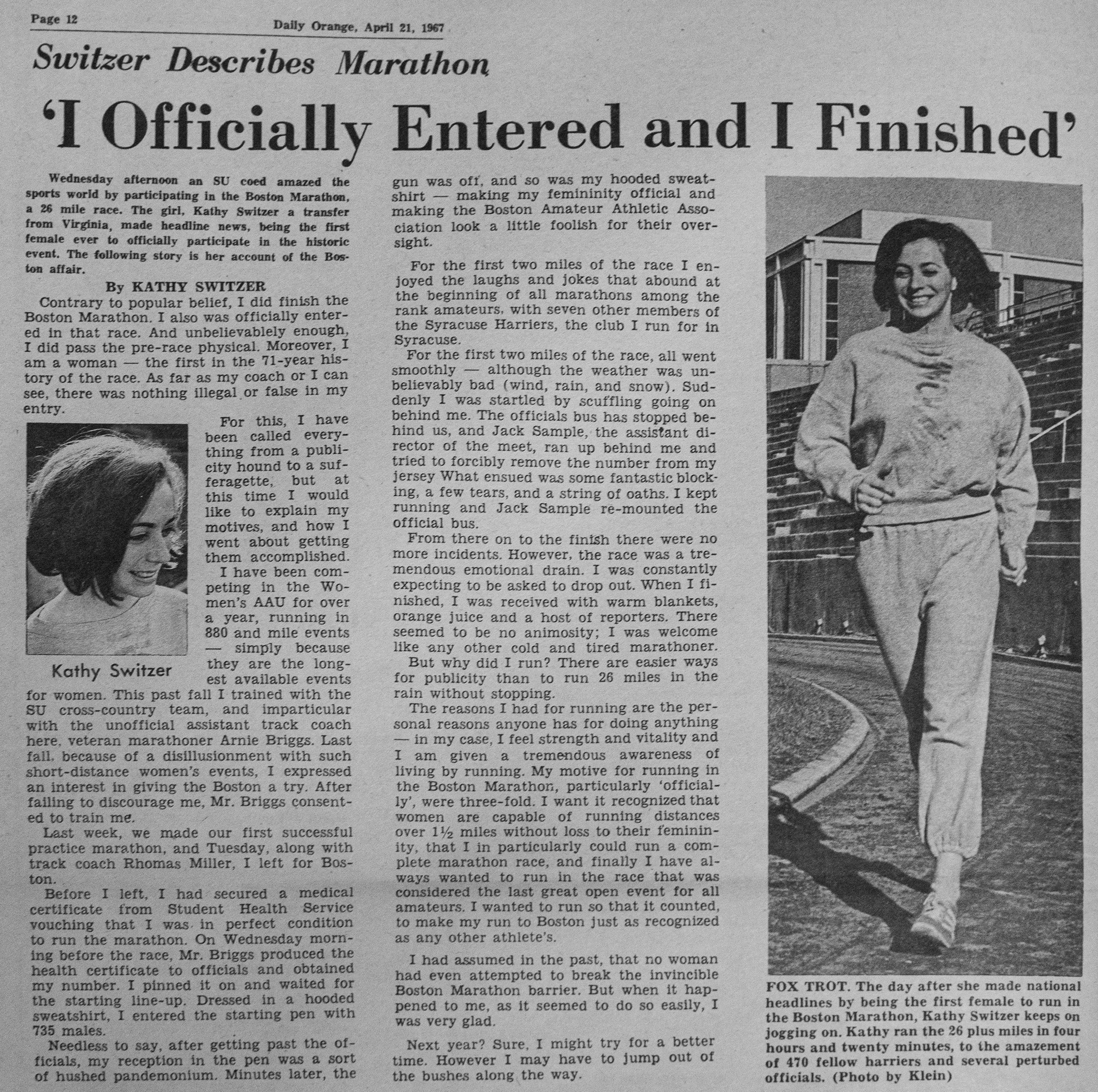
The article Kathrine Switzer wrote for The Daily Orange after the 1967 Boston Marathon, recounting her trailblazing run. Switzer was a journalism student at Syracuse, and covered cross country for The D.O. Daily Orange File Photo
She continued to run marathons, running a 10k each morning before going to class — where she worked to earn her master’s degree in public relations at SU. Once again, Switzer focused on carving her own path and creating opportunities for herself.
It was 1972, and the Munich Olympics were approaching. She had no idea how she was going to get there, but her mind was made up: She was going, no matter what.
The New York Times already had Olympic correspondents lined up. But the New York Daily News didn’t. So, Switzer walked into the Daily News building and confronted its sports editor — Bob Smith — directly.
“Why don’t you hire me?” she asked.
Smith pulled out a piece of copy, placed it in front of Switzer and, as a test, told her to write a story on it.
So, Switzer did. Smith read it and told Switzer he enjoyed it. But the credentials were closed — she wouldn’t be able to go to the Olympics after all.
“That’s no problem,” Switzer replied. “I’m gonna get in the village.”
Smith, perplexed, asked her how she planned on accomplishing that.
That wasn’t his issue to worry about. When she arrived in Munich, Switzer put on her sweatsuit, knowing no one was going to stop her, and ran into the village every day. She acted with the confidence of an athlete to blend in. She kept the copy she wrote on rolled up in her sleeve and gave it to some friends at the Associated Press, who sent it to the Daily News.
Then, Palestinian terrorists invaded the Olympic Village, killing several members of the Israeli Olympic team and taking more hostage.
“I guess I could say it was one of the saddest days of my life, and it was the end of the golden dream,” Switzer said. “And, of course, that fueled me even more.”
Switzer interviewed Olympians who had been stranded in Germany and impacted by the crisis. She spoke to war reporters who witnessed terrorists climbing the fence into the Olympic Village. She learned how to report on the ground and had to accept that there was still a long way to go in the fight for women’s equality.
“It was a really hard lesson for me as a journalist, but a really good lesson,” Switzer said. “You’re never gonna get those stories unless you go. You got to be on the spot. You’ve got to be persistent.”
That experience taught her that some things just have to be done, no matter how daunting they seem. To run a marathon, you need to sign up. To cover the Olympics, you need the courage to walk into a newsroom and ask.
Switzer hit her stride, winning the women’s division of the New York City Marathon in 1974, finishing 59th overall with a time of 3:07:29. She ran the Boston Marathon again in 1975, finishing with her personal best time of 2:51:37. She proved — 39 additional times — that women can run marathons, too.
Switzer knew that running could empower women to learn the same lessons that she had, teaching them how to make choices, gain control of their lives and live fearlessly.
You’re never gonna get those stories unless you go. You got to be on the spot. You’ve got to be persistent.Kathrine Switzer, former Syracuse student
So, she founded the Syracuse Track Club in 1969, fighting countless structural obstacles to create change within the sport of running. Fifteen years later, she accomplished what she called “the biggest goal of her life,” spearheading a movement to get the women’s marathon into the Olympics.
“You can’t complain about it. You’ve got to get in there and do something about it,” Switzer said.
Now, 261 Fearless carries on her legacy, operating in 12 countries. In the summer of 2025, a cohort of Afghan refugees escaped the Taliban and joined the club in Vienna, Austria. When she visited, Switzer hoped to photograph at least one of them in an effort to share their stories. Imagine her surprise when all of them — 15 in total — showed up, fresh off their miraculous escape.
“Everything I’ve done is nothing compared to what those women have gone through,” Switzer said. “And if I, in any way, can empower them … that kind of stuff is where I’ve always wanted to go. And I never thought I could do that in my lifetime.”
With the benefit of hindsight, it’s clear Switzer never could have been a cheerleader. But decades ago, just a young girl standing before her father, she didn’t know what else to dream of.
“Oh, honey,” she recalled her father telling her. “You don’t want to be a cheerleader. Cheerleaders cheer for other people. You want people to cheer for you.”
Confused, she looked to her father and asked what he meant.
“The game’s on the field,” he told her. “Not on the sidelines.”
When she was running that first race in Boston, Switzer said there were only a few spectators around. It was a cold day with sleet and snow and wind — hearkening back to the hours she’d spent training on those Syracuse back roads. But the few who gathered to watch ended up witnessing history.
“Come on, honey,” Switzer recalled a spectator telling her as she ran, grasping onto the fence and falling to her knees. “Do it for all of us.”
Since that day in Boston, Switzer has never been on the sidelines of her story. It’s not really her style. Instead, she’s written every chapter of her own story, rewriting the rules for countless women in the process.