ICE concerns, calls for transparency consume University Senate open forum
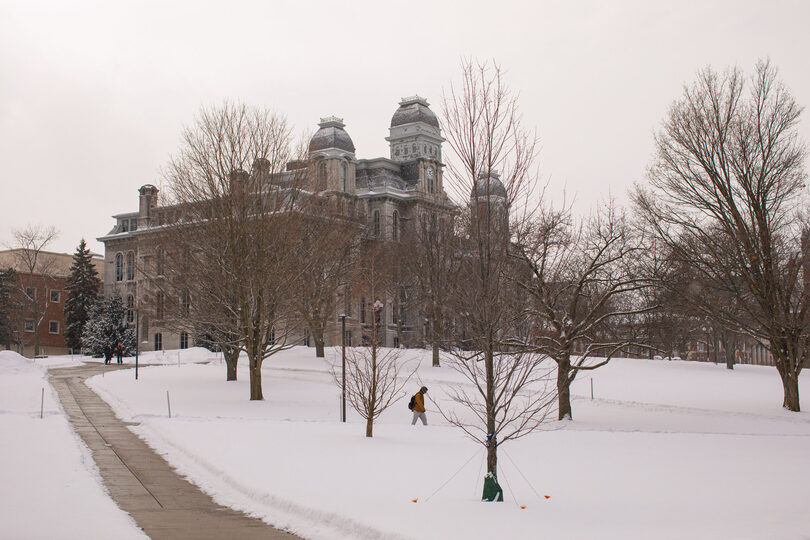
Syracuse University Senate held its annual open forum, during which attendees asked lots of questions regarding ICE and campus transparency. Avery Magee | Photo Editor
Get the latest Syracuse news delivered right to your inbox.
Subscribe to our newsletter here.
UPDATE: This story was updated at 5:30 p.m. EST on Sunday, Feb. 15, 2026.
Attendees at Syracuse University Senate’s annual open forum had lots of questions about immigration enforcement and SU’s commitment to diversity. Few were answered.
At this year’s forum, attendees raised concerns — mostly in the form of questions — related to U.S. Immigration and Customs Enforcement, following false reports Monday that ICE agents were seen on campus.
The open forum, held in lieu of the senate’s monthly meeting, is not structured as a question-and-answer session. Unlike regular meetings, there is no one designated to answer attendee questions. Instead, it serves as a space for the university community to voice issues they want the senate to prioritize in the coming year.
Michael Bunker, chief of SU’s Department of Public Safety, answered a handful of ICE-related questions early in the meeting. He said DPS has investigated multiple recent reports of ICE activity in the area, but there has been no evidence to substantiate them.
“We’ve had three reports recently that come into the Department of Public Safety,” he said. “All three of those we’ve been able to look into and have not seen ICE in the area.”
Bunker said the reports came from the Westcott neighborhood, Salt City Market area and Harrison Street corridor. DPS worked with the Syracuse Police Department and the Onondaga County Sheriff’s Office, reviewed camera footage and sent personnel to the reported locations, he said.
He also addressed a Monday incident that involved two U.S. Marshals investigating an unrelated federal matter on campus. Their presence, he said, was “quite alarming” to those who were on campus that day.
DPS confirmed the marshals were present for “a legitimate, non-ICE related issue,” he said, adding he contacted their supervisor to express concerns about the fear their appearance incited.
Still, several senators questioned why DPS never sent an official campus alert to quickly dispel rumors. They suggested using the university’s Orange Alert system to push out notifications for students and faculty. Bunker did not respond to the suggestion.
Senator Crystal Bartolovich, an associate professor of English, said some students emailed faculty saying they would not attend class due to the perceived ICE presence.
“A lot of students wrote to professors and said, ‘I’m not coming to class because there’s ICE on campus,’” Bartolovich said. “It would have been helpful to have that dispelled quickly to the students, so that they could go to class and be reassured.”
Harvey Teres, an English professor, said, “pertinent questions have been asked, and not all have been answered” — specifically regarding whether a policy exists to alert students about ICE’s presence.
Graduate and international student leaders described ongoing anxiety among students, particularly those on visas.
Jean Molly Ameru, a doctoral student in inclusive special education at SU, said graduate student representatives were asked why the university had not released a campus-wide statement clarifying if ICE was present.
“I would like to understand what role the university plays in effectively communicating such incidents to students so that the grad leaders are able to relay that very information,” she said.
Ling Gao LeBeau, who works in the College of Arts and Sciences and the Maxwell School’s Office of Student Success, said international students continually express fear about federal agents arriving on campus.
“Every day I have students … that are so scared,” LeBeau said, recounting concerns about traveling out of state. “I think we do need to do something as a university.”
Several senators raised concerns on behalf of international students on campus, especially after multiple staff members from the Center for International Students did not return for the fall semester.
Senator Phillip Arnold, a professor in the Department of Religion, said the department’s graduate students feel safer on campus than at their off-campus housing.
“Are there some other sorts of documents other than visas and passports that the university can give to international students?” he asked.
Other faculty members connected the discussion to broader campus climate concerns.
“I’m wondering what the administration is doing to counteract this public erasure of its commitment to racial equity,” said Coran Klaver, an associate professor and co-chair of the Senate Committee on Intersectional Equity for Race, Ethnicity, Sexuality, Gender Identity and Disability.
Michele Combs, lead archivist at the Special Collections Research Center, said the “Dear Colleague” letter sent by the Trump administration was the “impetus” for recent changes at SU, including revisions to the IDEA requirement, core competency descriptions and the renaming of the Office of Diversity, Equity, Inclusion and Accessibility to the Office of People and Culture. She added that the letter was later dropped by a federal judge.
She said the university may have been “a little hasty” in removing language and renaming offices, urging administrators to be more cautious before taking a “leap to comply.”
Meredith Bruster, a public administration graduate student, asked for more “transparency” around the presence of Flock Safety cameras on campus, including whether SU still has a contract with the company. This week, the city of Syracuse voted to replace Flock license plate readers with units from Axon Enterprise, after months of scrutinizing Flock and its ties to ICE.
“Transparency is absolutely paramount,” Bruster said. “We shouldn’t have to come to a senate meeting that’s capped at 500 people to learn about why the marshals were on campus.”
Julie Hasenwinkel, the associate provost for academic programs, addressed a question about updates to the First Year Seminar curriculum. She said a working group implemented changes to the class during the fall semester, but they brought “no significant changes” to learning outcomes.
While Chancellor Kent Syverud and Provost Lois Agnew spoke at last year’s open forum, and frequently answer questions at other senate meetings, they did not speak during Wednesday’s discussion.
As with other open forums, the Agenda Committee is set to review the topics discussed in Wednesday’s meeting and determine if any of the issues apply to senate committees.