

B
efore Syracuse University built the National Veterans Resource Center, campus leaders were striving to make the university a premier institution for veterans and military-connected students.
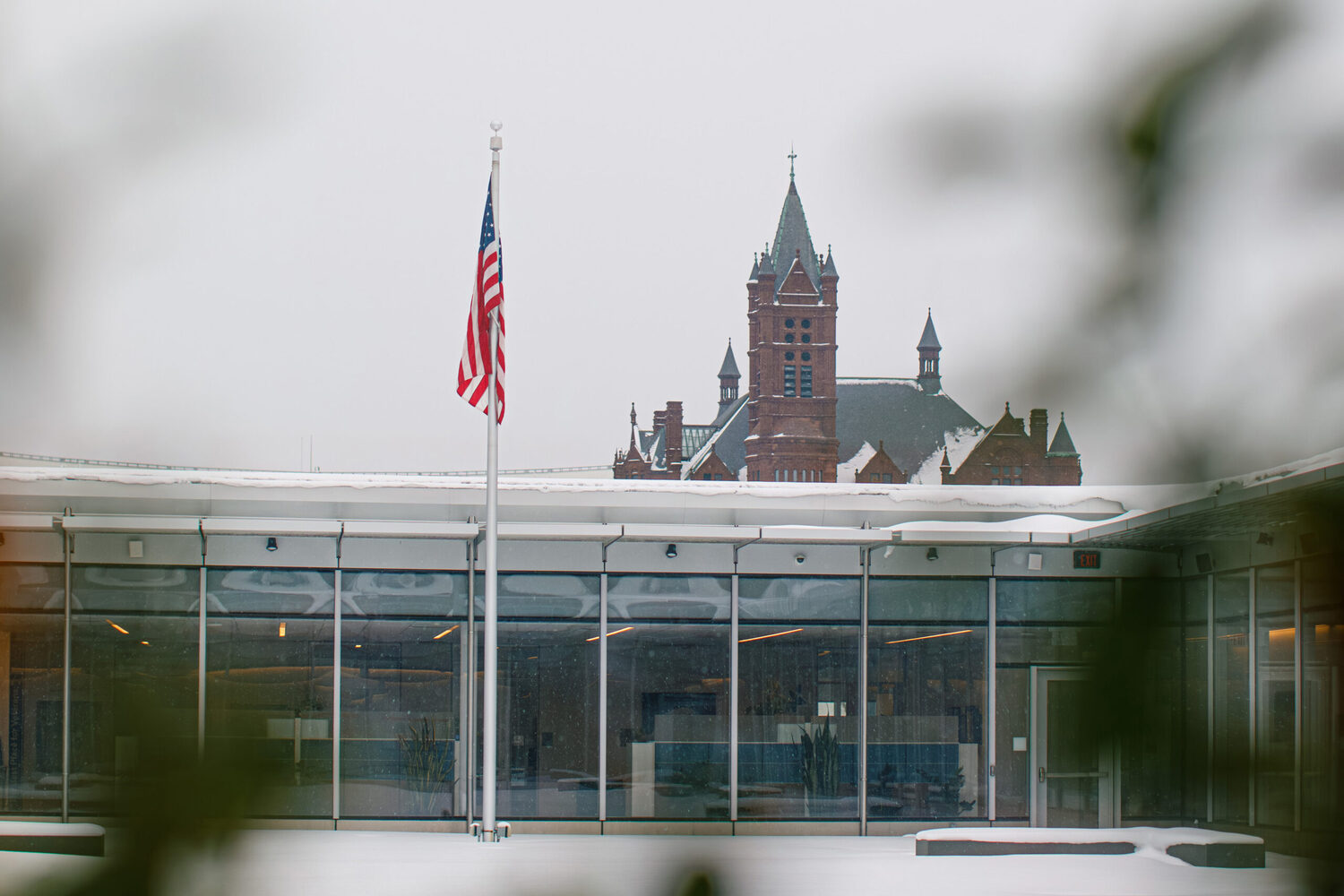
The gleaming, $62 million center punctuates SU’s commitment to that goal in a way that its many off-campus military endeavors do not. Its bright glass exterior, accessibility-centric design and intricate wooden interior make it stand out on Waverly Avenue.
Like most buildings, the NVRC began with a set of blueprints.
Mike Haynie, a retired United States Air Force officer and current vice chancellor for strategic initiatives and innovation, commissioned an architect friend to make renovation plans for the Hoople Building, which sat where the NVRC stands today.
He delivered them to SU Chancellor Kent Syverud.
“I’ll take it on me to go raise some money — what do you think about renovating?’” Haynie remembered asking Syverud. “And he looked at these pictures, and then he crumpled them up and threw them away in front of me.”
Haynie recalled Syverud replying, “Mike, if we’re going to do this, we should do this.”
After years of construction, the complex, named for donors Daniel and Gayle D’Aniello, was officially dedicated in 2021. The building houses SU’s military and veteran offerings, including two marquee institutions — the D’Aniello Institute for Veterans and Military Families and the Office of Veteran and Military Affairs.
Syverud’s commitment to the military at SU began on day one of his role. In his inauguration speech on April 11, 2014, he declared: “I believe Syracuse University must once again become the best place for veterans.”
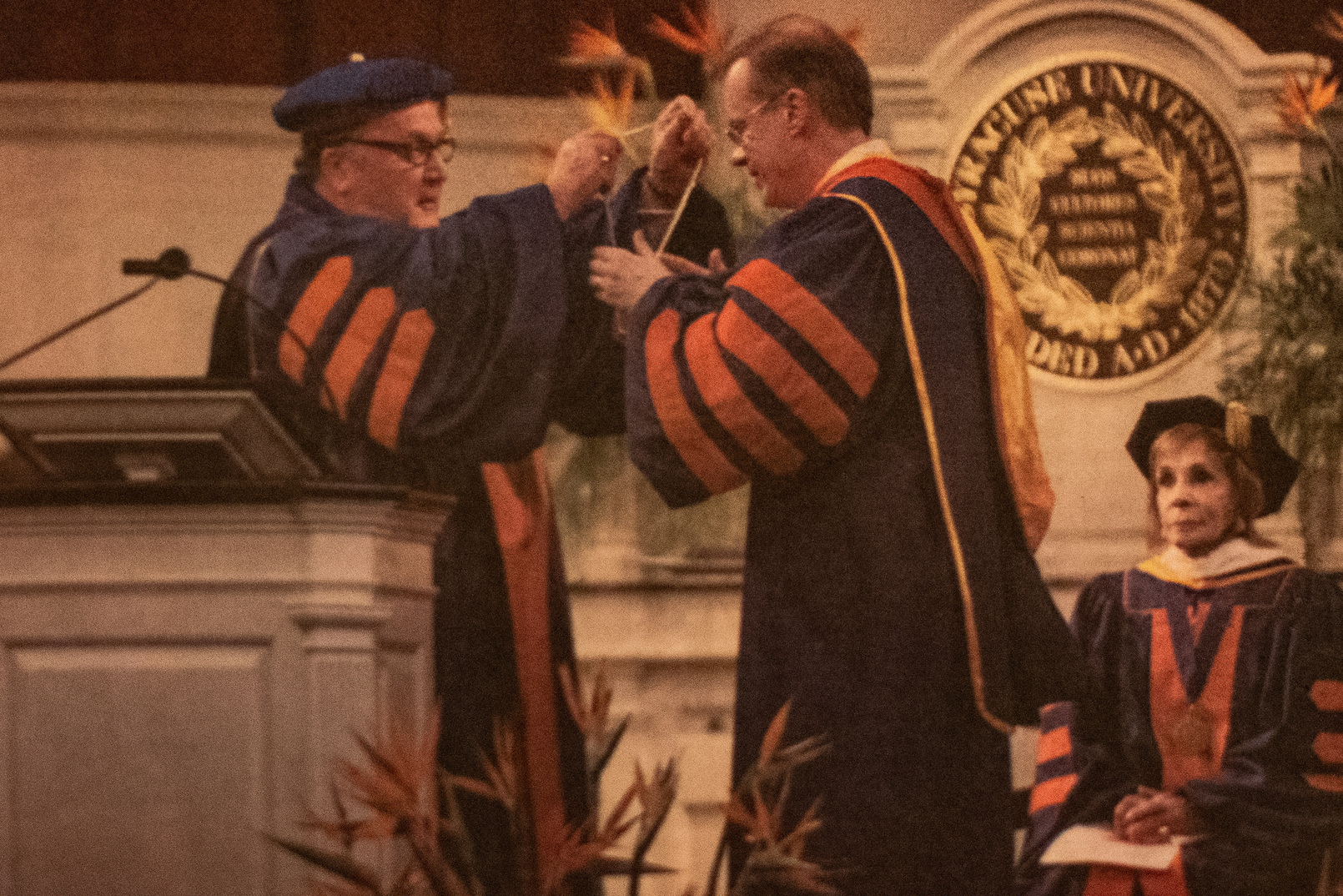
Kent Syverud is inaugurated as Syracuse University chancellor on April 11, 2014. Daily Orange Archive
Syverud confirmed in January he accepted the presidency role at the University of Michigan, after announcing in August he would depart from SU.
The Chancellor Search Committee is searching for a new university leader who will “embrace and advance Syracuse’s longstanding commitment to veterans and military-affiliated individuals,” among many other requirements. D’Aniello, a U.S. Navy veteran and SU life trustee, sits on the committee.
“It’s also a time of transition,” Haynie said. “We don’t know if that person will have the same level of commitment to this as Kent does.”
Syverud’s public commitment affirmed a cause many on campus were already working toward.
“I hate to use military terms, but there’s something beautiful about clarity of mission and unity of effort,” said Dwayne Murray, deputy director of OVMA. “We’re all working to that common goal.”
Murray, an SU grad who served in the Army for over 30 years, said the very existence of the NVRC building is a testament to the university’s commitment to improve its military offerings.
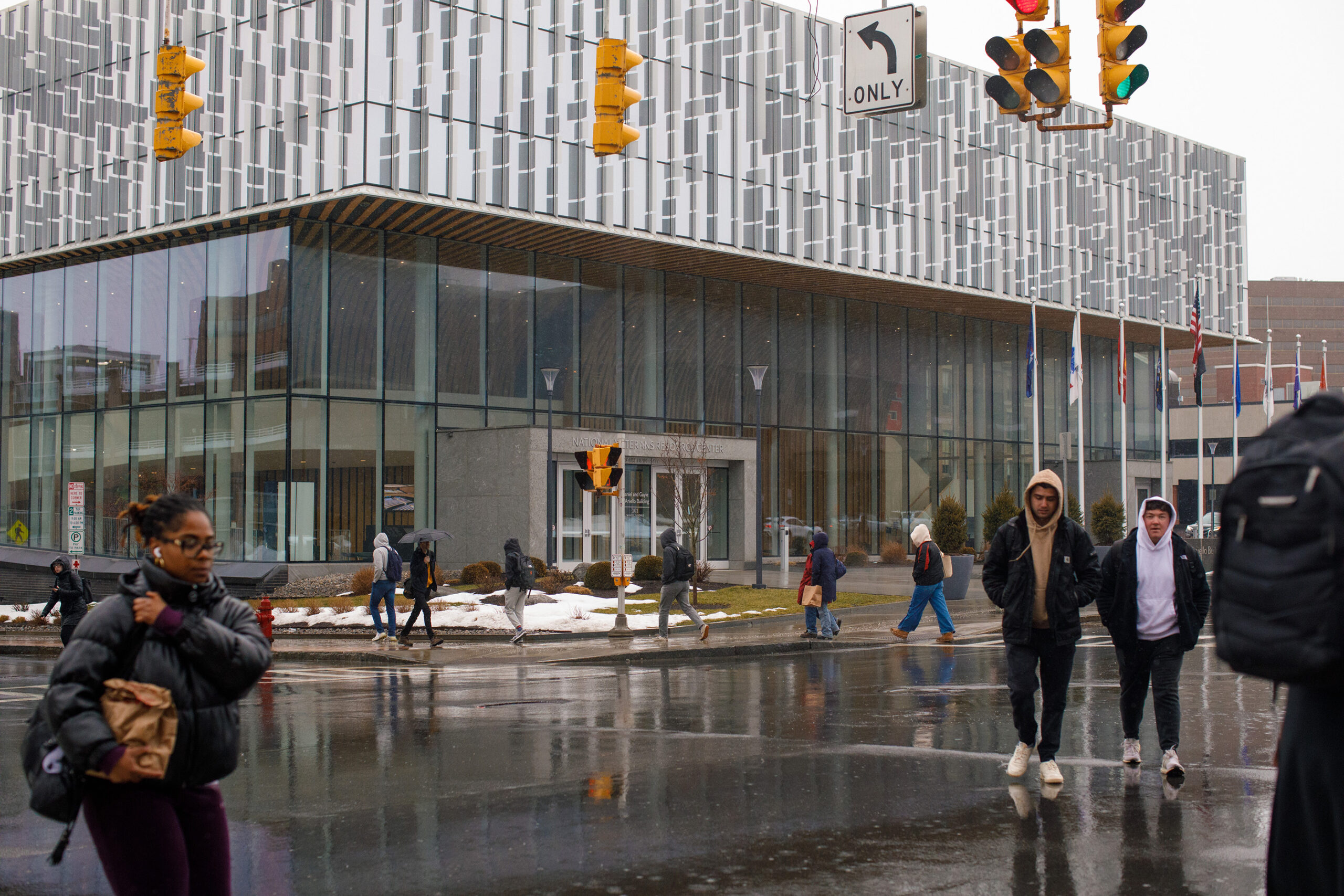
After years of construction, the National Veterans Resource Center was dedicated to donors Daniel and Gayle D’Aniello in 2021. Avery Magee | Photo Editor
Haynie was working on building out SU’s military infrastructure long before the Hoople blueprints. He began as an entrepreneurship professor at the Whitman School of Management in 2006, inspired by his time at the Air Force Academy in Colorado Springs.
At the time, the U.S. was at war in Iraq and Afghanistan. Veterans who returned with disabilities were especially interested in owning their own small businesses, Haynie said.
Haynie launched the Entrepreneurship Boot Camp for Veterans with Disabilities with financial support from Martin Whitman and a poster he made using a random ROTC cadet photo in PowerPoint. EBV expanded, with SU as its national host, to colleges like Texas A&M University, University of Connecticut and Louisiana State University.
After a 60 Minutes segment brought national attention, Haynie launched another program: Veteran Women Igniting the Spirit of Entrepreneurship. V-WISE, a four-week online program, has hosted conferences in cities like Atlanta, Chicago and Houston.
In 2011, the non-credit Veterans Career Transition Program was offered free to post-9/11 veterans through the School of Information Studies.
Inspired by those successes, Haynie realized there was a much bigger opportunity.
“Nowhere else in the U.S. did there exist an academic institute focused on the social and economic wellness concerns of vets and their families,” Haynie said. “How come nobody else in the country has gone big on this?”
Haynie booked himself a few minutes with then-Chancellor Nancy Cantor. SU should be the first school to establish a military-focused institute, he urged her in 2011. Cantor’s answer, simply put, was that SU didn’t have the money.
So Haynie leveraged SU’s existing relationship with JPMorgan Chase & Co., landing a 10-minute meeting with its chief operating officer. He pitched the partnership as an opportunity for the bank to “repent” for wrongfully foreclosing servicemember homes.
Seven million JPMorgan dollars, three faculty, a student employee and a handful of programs marked the launch of the IVMF — an interdisciplinary academic institute focused on veterans and their families.
“My only regret from that meeting was I didn’t ask for enough,” Haynie said.
Today, the institute has around 120 full-time staff. This year, it will put somewhere between 22,000 and 24,000 veterans through programs across the country, he said.
“Next thing you know, I’m sitting in Hendricks Chapel for Kent’s installation as chancellor,” Haynie said. “He gives this speech where he lays out four priorities, and one of the four was to be a national exemplar for how we engage veterans and military families.”
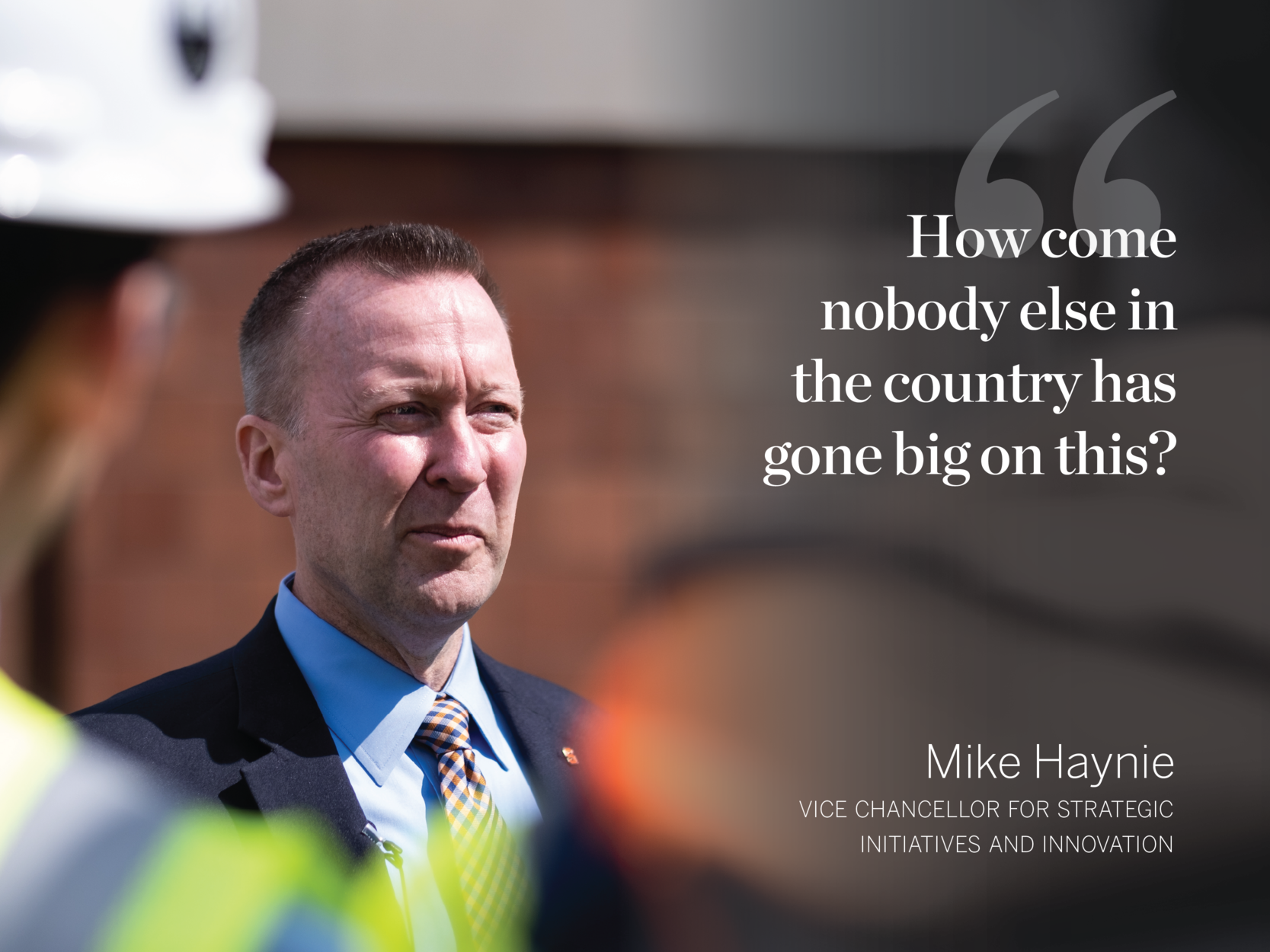
Mike Haynie at the National Veterans Resource Center construction site in May 2019. Dan Lyon | Daily Orange File Photo
In 2015, Haynie was named vice chancellor of veterans and military affairs to oversee the creation of the OVMA and quickly began to see positive outcomes.
Since then, SU’s military-connected and veteran student enrollment has increased 300%. SU has seen 1,800 student veteran graduates and 3,200 military-connected graduates since 2014.
Military Times recognized SU as the year’s best private university for veterans several times since 2017, frequently ranking it in the top 10%. In that time, 15 Pat Tillman scholars — a program that invests in veterans and their spouses — have studied at the university.
“What really stands out to me about SU is the intentional support network that builds camaraderie from peer mentorship to dedicated staff and resources that understand the unique transition from military to student life,” Manuel Villavicenciosolano, the community outreach coordinator for the Student Veteran Organization, wrote in a statement to The Daily Orange.
Few colleges have as much military-specific support as SU, said Charlie Poag, the communication manager at the IVMF, a U.S. Marine Corps veteran and graduate of the Newhouse School of Public Communications. Infrastructure like Veteran Career Services and the Office of Veteran Success help military-connected students find jobs and process benefits.
SU certifies over 700 students’ Department of Veterans Affairs benefits annually and boasts a 100% undergraduate job placement rate for student veterans seeking employment assistance, he said.
SHoP Architects, the group behind the Barclays Center and YouTube’s headquarters, designed the 115,000 square foot NVRC to accommodate veterans with disabilities. Stairless common areas with railings and braille throughout make the building accessible.
Beyond those services, the NVRC also anchors the university’s U.S. Army and Air Force Reserve Officer Training Corps programs. Classroom 018 purposefully brings non-military students into the center to learn alongside military populations.
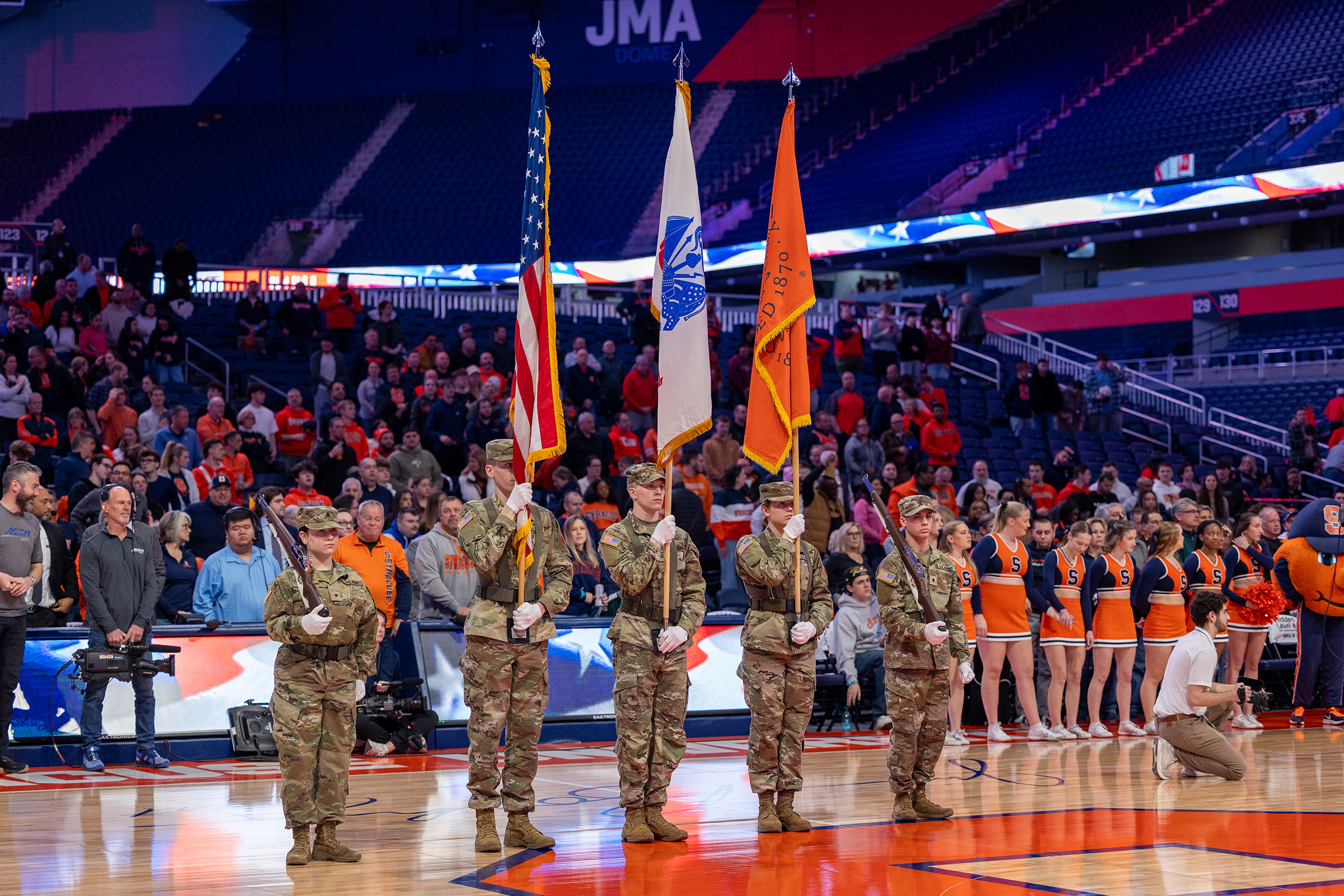
Members of the Army Reserve Officers’ Training Corps color guard lead the pre-game festivities before Syracuse men’s basketball takes on Virginia Tech at the JMA Wireless Dome on Jan. 21, 2026. Eli Schwartz | Asst. Photo Editor
ROTC, led by Lt. Col. Matthew Coyne and Lt. Col. Michael Skarda, has seen its highest enrollment in the last 20 years and nearly 400 cadets commissioned since 2014.
Syverud made his inaugural promise keenly aware of SU’s “glorious past” — which stretches as far back as 1903. William Herbert Johnson, who fought in the Spanish-American War, likely became SU’s first veteran graduate, in addition to being the College of Law’s first Black alum.
Others, like Floyd “Ben” Schwartzwalder, best remembered as Syracuse football’s national title-winning coach from 1949-1973, served in WWII. As did Martin Whitman, the namesake of SU’s School of Management.
Eileen Collins, the first woman astronaut to both pilot and command a U.S. space shuttle mission, graduated from SU and its Air Force ROTC.
Wilmeth Sidat-Singh played basketball and football before becoming a Tuskegee airman. Before he died in a training mission in 1943, he was one of the first Black university athletes.
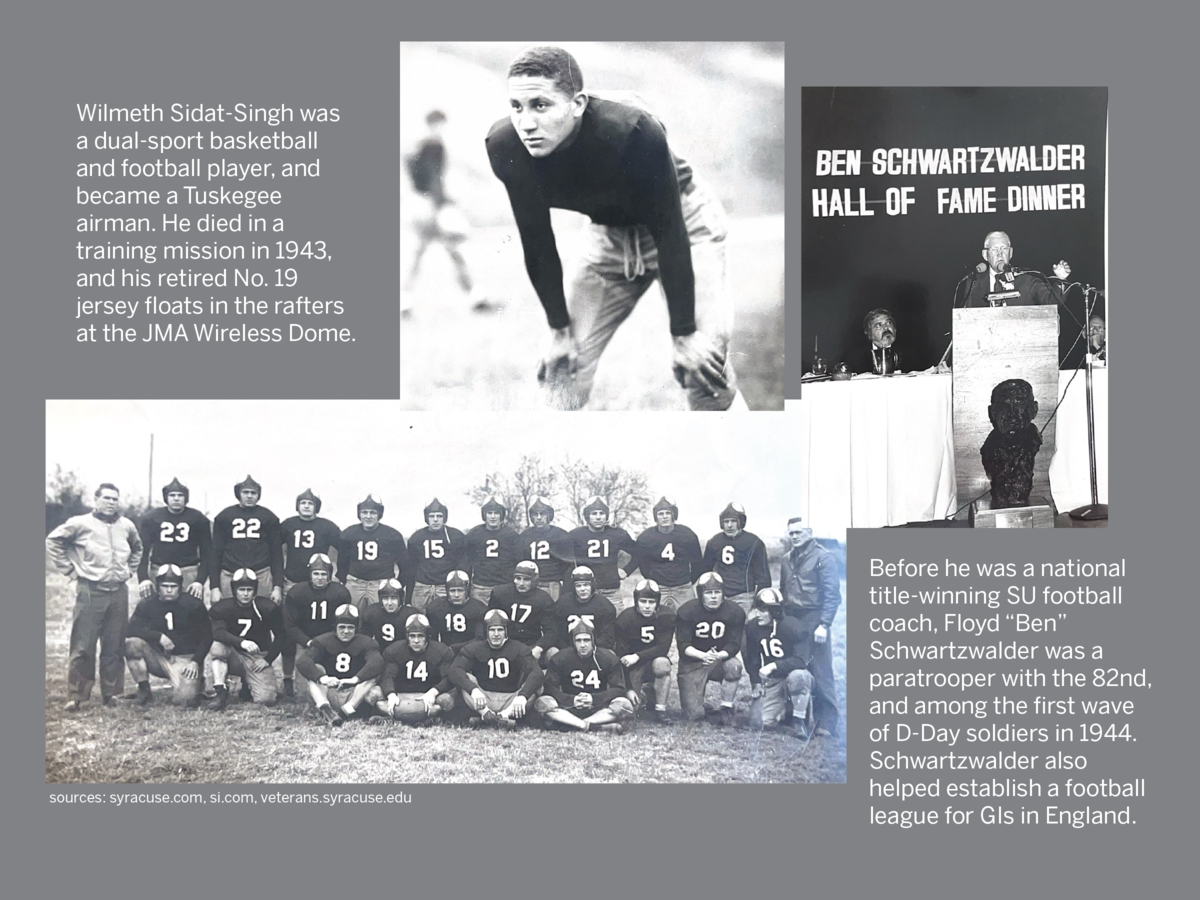
An assortment of archive photos of Wilmeth Sidat-Singh and Floyd “Ben” Schwartzwalder. Courtesy of Bird Library Special Collections Research Center; Sophia Burke | Digital Design Director
Much of SU’s military history dates back to World War II, during which President Franklin D. Roosevelt assembled a small group of college and university leaders, among them then-SU Chancellor William Tolley.
Roosevelt — who told fireside chat listeners he was “laying plans for the return to civilian life of our gallant men and women in the armed services” — tasked this group to create what would become the GI Bill.
After the war, Tolley invited veterans, regardless of educational background, to SU. In a 1945 report for Syracuse-Onondaga Post-War Planning Council, Tolley advocated for programs allotting “necessary provisions for veterans wishing to resume uninterrupted educations.”
“Most people don’t realize, we exist as the school that people know because of a decision Chancellor Tolley made after World War II,” said Haynie, who uses Tolley’s desk today.
Throughout World War II, Tolley — who received 15 SU credits through the Student Army Training Corps during World War I — spoke about the warfront and the key role he believed American universities played in guiding the country back to post-war society.
“While the war has reduced our enrollment, it has greatly increased our responsibilities,” Tolley wrote in 1943, also claiming SU became one of the 21 largest colleges in the nation.
In 1946, SU admitted 9,464 veterans, almost doubling the school’s student body. The year after, SU led New York state for veteran enrollment, ranking 17th in the U.S.
Haynie leaned on such history when he lobbied Cantor for the IVMF in the early 2010s.
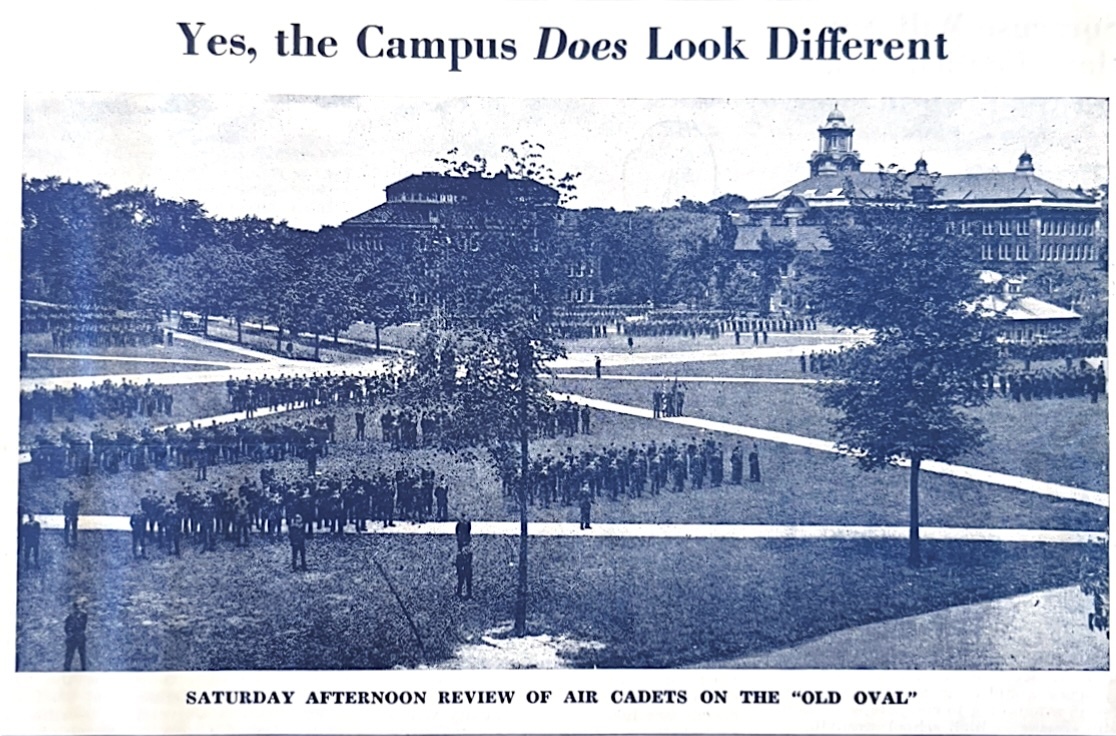
During the GI bulge, Syracuse University’s student body nearly doubled by dint of enrolling World War II returnees. Courtesy of Bird Library Special Collections Research Center
“As these programs that we had built were getting all this attention, and I started getting letters, not emails, letters from alums who came to this university after World War II because of Tolley,” Haynie said. “That history became the basis for my pitch.”
Haynie’s belief that institutions should assume responsibility for the nation’s decision to fight in wars echoed Tolley’s decades earlier.
“I think I can say in full confidence that no college or university in America has dedicated itself more completely to the war,” Tolley wrote in an August 1943 edition of the university’s alumni newsletter.
Several university programs continue the commitment. Whitman’s Defense Comptrollership Program has ushered through over 2,000 graduates since its founding in the 1950s. Newhouse’s Advanced Military Visual Journalism program has taught over 1,100 active-duty personnel serving as combat photographers and military journalists since 1963.
Stacy Pearsall, the only woman to win the National Press Photographers Association’s military photographer of the year award twice, is a graduate of Newhouse’s program. Her “Veterans Portrait Project” photos adorn the NVRC walls.
During the Vietnam War, national resentment toward the military crept onto campus. Students questioned the role of ROTC. In 1970, faculty followed a national trend and voted to remove ROTC, but then-Chancellor John Corbally preserved the corps on campus.
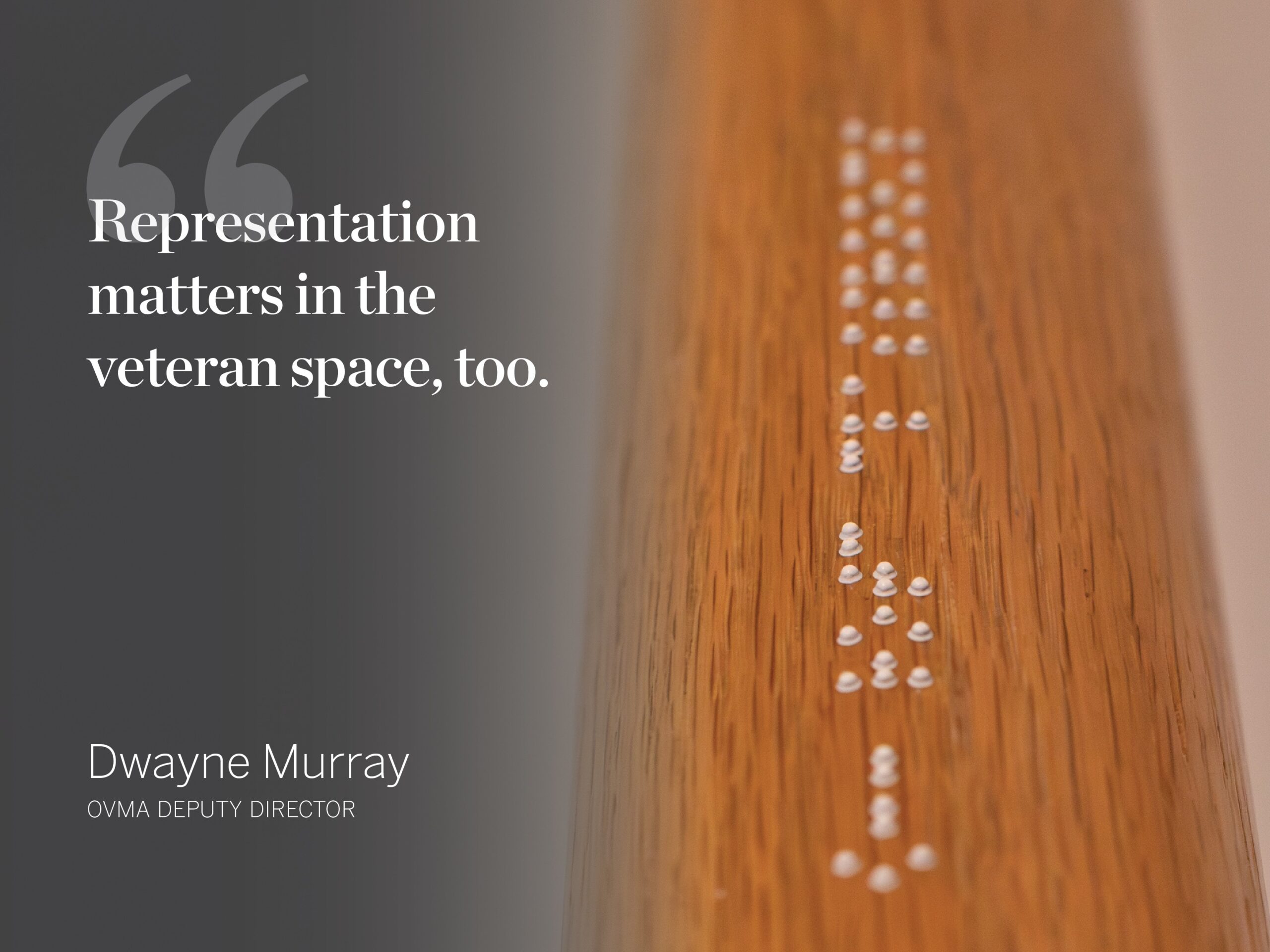
The National Veterans Resource Center was designed to be accommodating, with stairless common areas with railings and braille throughout. Avery Magee | Photo Editor
Murray met his wife, also an SU alum, while on active duty in South Korea. Even as the U.S. experienced difficulties in times of war, he said SU opens the door to veterans and facilitates difficult conversations — like those that accompanied Vietnam and contemporary conflicts.
“We talk about representation in other affinities,” Murray said. “Representation matters in the veteran space too.”
Over the past few years, the university has simultaneously expanded its off-campus infrastructure and created a visible on-campus footprint with projects like the NVRC.
Next month, Syverud will partake in his final Chancellor’s Review and Awards Ceremony at SU. The event, an annual tradition established by Chancellor James Day in 1917, includes a formal inspection of cadets by the chancellor.
Syverud, whose photograph and “best place for veterans” quote are enshrined on the ground floor of the NVRC, falls in a long line of chancellors who championed military efforts at SU.
Published on February 19, 2026 at 4:24 am