Opinion: House music’s mainstream rise gentrifies the culture that built it
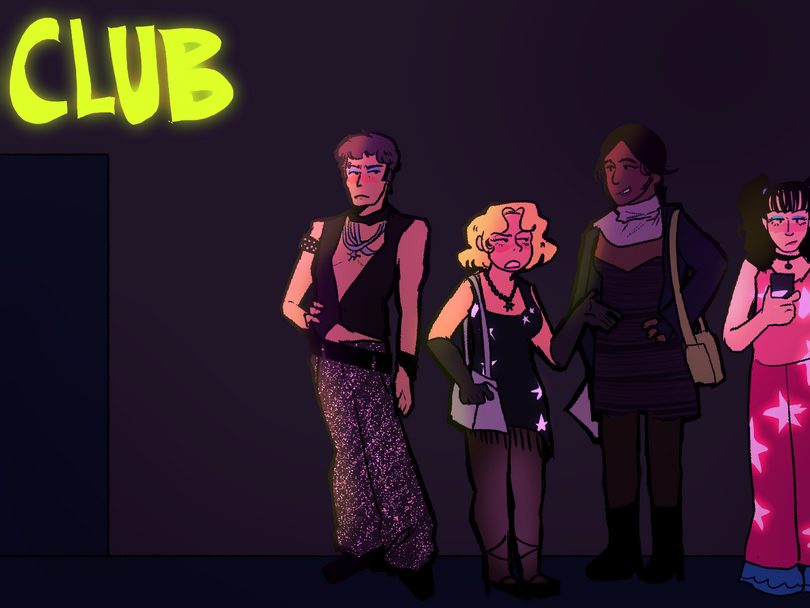
House music is booming on college campuses, but its popularity comes with rising costs and a growing distance from its Black and queer roots. Our columnist argues that as the genre goes mainstream, it risks gentrifying the very culture that built it. Jay Cronkrite | Contributing Illustrator
Get the latest Syracuse news delivered right to your inbox.
Subscribe to our newsletter here.
On Feb. 22, the Winter Olympics closed out with a performance from Major Lazer, an American Electronic Dance Music group, just a couple of months after the group dropped in on a random University of Southern California fraternity party.
Back in October, John Summit, who got his start DJing parties for Delta Tau Delta at the University of Illinois, sold out the 38,000-seat Folsom Field at the University of Colorado Boulder.
This follows an eventful year for the former campus DJ, Disco Lines, whose remix of the Tinashe song “No Broke Boys” peaked at No. 36 on the Billboard Hot 100 this past November. That same week, popular DJ Kettama played a set at a Boulder fraternity.
This recent surge in bookings for major dance music acts, and the way they intersect with campus life, point to a real cultural force at work. It’s the same force behind the frat flick, discourse over straight men wearing pashminas at raves and the backlash when Summit lost hundreds of followers after booking a Pride event.
It’s clear that house music is having a moment right now, especially on college campuses.
But, over the past several years, the genre has departed from its roots — evolving from a small form of working-class expression in Black and queer spaces into a multibillion-dollar industry. It has become a mainstream draw, attracting predominantly straight and white DJs and audiences, even as rising costs push much of Generation Z out of the scene.
Though house music appears to be booming on college campuses, many outside that bubble are confronting a fading club culture and an increasingly gentrified dance music scene in the United States and abroad.
The genre’s primary audience shifting over time is nothing new. In the U.S., the transfer of a genre from its Black roots to a largely white audience is a recurring problem. But with house music’s recent wave of popularity, it’s worth examining what happens when a genre and its scene undergo this kind of demographic change and what the consequences might be.
Emerging from disco in the early 1980s, house music and the club culture that formed around it were born in Chicago gay nightclubs, shaped by early DJs like Frankie Knuckles and Jessie Saunders. More than 40 years later, the tides have turned. A 2025 study found that Black patrons are more likely to be denied entry to and overcharged at Chicago nightclubs.
In the U.S., the transfer of a genre from its Black roots to a largely white audience is a recurring problem.Ben Newman, Columnist
There has also been a surge of women speaking out about straight men encroaching on club spaces, alongside growing complaints from industry insiders that there is less room for female and nonbinary artists to truly break through.
Beyond the identity politics shaping the dance music scene, the demographic shift and rising costs are pricing out many otherwise eager participants. From within the industry, DJs and promoters alike have described the strain that comes when a genre built for the underground turns mainstream, such as higher booking fees and the steady closure of venues.
Classism in club culture has sparked its own field of inquiry, from extensive think pieces debating whether dance music has become too bourgeois to entire academic papers devoted to the question.
One study published in 2023 traced classism in club culture to several factors, including the attitudes of clubgoers, staff and venues, the erosion of values that defined early dance music and elitism in booking practices.
When you look at where popular house music acts perform today, it’s clear how far the genre has come from its origins in Chicago gay clubs. Many of the venues that now host house music are increasingly difficult for regular people to access.
Beyond the frat bookings, acts like Disco Lines and Kaytranada have played shows at the popular Hamptons swanky beach club, Surf Lodge, where table costs climb into the thousands. In New York City, clubgoers have complained of rising entry fees, and many nightclubs have adopted dynamic pricing models that make it increasingly difficult to see a DJ.
The last thing I’m trying to do is gatekeep. Part of what makes dance music so powerful is its unifying, crowd-oriented effect. But as more people enjoy house music, performers, venues and industry professionals must find a way to ensure it remains exactly that — for everybody.
Out in the real world that could manifest in a lot of different ways. DJs could be more intentional about the audiences and venues they perform for. Venues and booking agents could also work to deflate increasing ticket prices.
At Syracuse University, where EDM has carved out a visible presence on campus, this could mean taking a closer look at personal biases and making sure any beliefs or practices that run counter to house music’s history are addressed.
Ben Newman is a sophomore majoring in advertising. His column appears bi-weekly. He can be reached at ibnewman@syr.edu.