SU’s Salaam Shalom brings students together to study Hebrew, Arabic connection
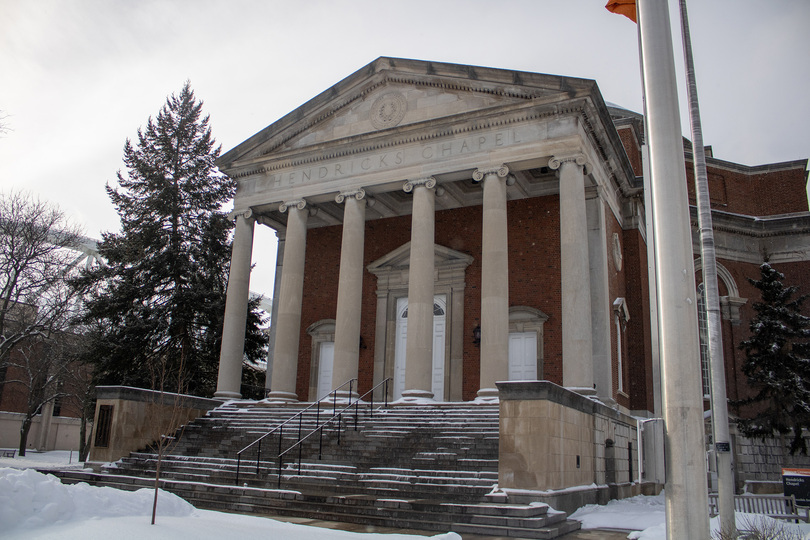
Now in its second semester, SU's new Salaam Shalom interfaith language program gathers students to study Hebrew and Arabic's common roots. Leonardo Eriman | Daily Orange File Photo
Student Press Freedom Day is a reminder of the vital role student journalists play in holding institutions accountable. The money raised between now and March 6 will go directly toward supporting our independent newsroom. Donate today.
Once a month, Jewish, Muslim and language-curious students gather at Hendricks Chapel to eat falafel and hummus while learning to write each other’s languages.
Salaam Shalom, an interfaith language program co-led by Hendricks Rabbi Natan Levy and Imam Hamza Gürsoy, connects Syracuse University students across different religions to study Hebrew and Arabic, Judaism and Islam – exploring the common roots between the two languages. Now in its second semester, Salaam Shalom meets once a month for four 90-minute sessions blending language instruction with cultural exchange.
“I was very surprised — not even just the words, but also the structure of the languages, their origin and how they’re all connected historically,” said Elyas Layachi, a junior studying inclusive adolescent education and mathematics. “It just makes me so interested.”
Levy, who began his role at Hendricks seven months ago, said the program emerged from early conversations with Gürsoy about how many similarities the two languages share, as well as Levy’s desire to learn Arabic.
The two realized names like “Abraham” and “Ibrahim” have similar roots, and these overlaps run deeper than either expected. What started as a private exchange between the two quickly became something they wanted to open up to students.
Hamza said his experience with Arabic and Turkish showed him that it is easy to find similarities in language, which can translate to shared values.
“Everything begins with language,” Hamza said. “When I sat down and talked with Rabbi Natan and this program began to take shape, we decided to have a common language class.”
Each session of Salaam Shalom begins with food and conversation before transitioning into an hour of language learning. Levy and Gürsoy teach Hebrew and Arabic in tandem before breaking students into small groups to teach the languages and discuss religion with one another. Currently, about 15 students participate, including Jewish students, Muslim students and those purely drawn by an interest in language.
Layachi, who speaks Arabic, French and English at home, said he’s been to every session since Gürsoy first encouraged him to attend in the fall. He was the only Muslim student at the most recent session, while many others were at events for Ramadan, but said the dynamic gave him an unexpected opportunity to share his culture more directly with the group.
“It was nice to have that one stage to really share about the nicheness of my culture and my dialect in Arabic,” he said. “Everyone in that room is very accepting, and their passion toward wanting to learn more about me made me feel really comfortable and valued.”
The sessions extend beyond vocabulary drills, often drawing comparisons between religious practices like Ramadan and Yom Kippur, Layachi said. These conversations are seen as just as valuable as the language lessons themselves.
“Having those discussions and comparisons can really help eliminate a lot of negative stereotypes that surround whatever culture is being discussed,” he said. “It can lead to more empathy and understanding in general.”
Senior Erika Steinhart, a member of Hillel, SU’s Jewish campus organization, said the program carries meaning beyond linguistics. She said attending feels especially important given the political climate following the Oct. 7, 2023 attacks, and she’s always felt a stronger kinship with Muslim communities rather than Christian ones, despite assumptions that people might make.
Attending sessions has also shifted how Steinhart thinks about unfamiliar religious practices, she said. She recalled dismissing Ramadan as “cruel and confusing” when she was a child, only to sit across from Layachi years later and see it entirely different.
“To go from being eight and thinking, ‘This is awful, this is cruel,’ to being 22 and thinking, ‘No, this is beautiful, just as beautiful as my own religion,’ it really helps me appreciate how much I love this world,” Steinhart said.
Levy said the program taps into something interfaith programming sometimes cannot: students’ eagerness for education. Framing the sessions as a language class, he said, draws in people who might have otherwise never attended an interfaith event.
He said small linguistic discoveries carry emotional impact. Realizing the Arabic word “Allah” and the Hebrew “Elohim” share the same roots, for example, tends to stop students in their tracks.
“Students’ eyes light up the first time they experience that,” Levy said. “They walk out of here talking to each other, and that feels like a real seed for growth.”
Levy said there are no concrete plans yet for next semester, but he hopes the program continues and expands.
“It’s a great opportunity for students, and attending as a student has been a great opportunity for me,” he said. “I really appreciate having that space to share with other people.”