Faculty members express artistic freedom in ‘Ecosystem of Belonging’ exhibit
To balance out teaching and maintaining their artistic endeavors, the “Ecosystem of Belonging” exhibit brings in faculty members to showcase their own pieces of work. Creative arts therapy assistant professor Rochele Royster used dolls to portray the number of victims who died due to gun violence in Chicago from 2015 to 2017. Taite Paradise | Staff Photographer
Student Press Freedom Day is a reminder of the vital role student journalists play in holding institutions accountable. The money raised between now and March 6 will go directly toward supporting our independent newsroom. Donate today.
Dolls, dresses and video screens filled the Warehouse Gallery. The space had a quiet and intimate feel, giving the visitors a chance to fully immerse themselves in the artwork. Paintings and dolls dressed the walls, and pieces of fashion occupied the center as voices from videos quietly played.
“Hopefully (the exhibit) gives us time to have reflection, but also admiration for each other, what we’re all doing here, and create community,” said Lauren Baker, the exhibit’s operations coordinator and curator.
The “2026 Faculty Survey: Ecosystem of Belonging” exhibit is the second annual exhibit showcasing art from faculty of the College of Visual and Performing Arts. This year’s show, which runs from Jan. 27 through Thursday, featured fewer members than its inaugural show, giving each artist more room to show a greater series of works and fully recognize them, Baker said. The exhibit includes art from 10 VPA professors from a variety of departments.
Baker worked with two students to come up with the theme for the exhibit. The students saw the faculty as a system working together, showing how different facets of their professions interact. The theme showcases how the artists work together in creating this ecosystem and how it interacts with the community.
Baker said they see the faculty gallery as a means for connection; they admire how the gallery showcases a variety of works from different departments, specialities and perspectives. It fosters a sense of community by collaborating between departments, they said.
“This gallery is a real place for us to cross-pollinate, mix and understand what’s important to one another, and have an appreciation for things that are going on,” Baker said.
VPA classes came to the exhibition to learn how to put on an exhibit and what it’s like to participate in one. Baker said they want the exhibit to serve as a “teachable moment.”
Last semester, Baker invited Li “Lily” Jiang, an assistant professor at the School of Design, to speak with their museum studies students about her work on previous studio and design pieces.
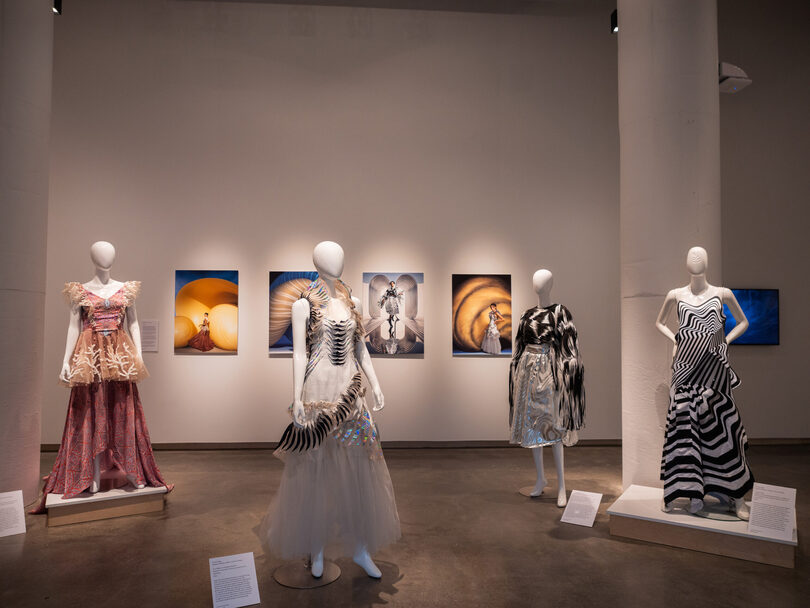
After the class, Baker asked Jiang to participate in this year’s faculty show. Jiang and Baker picked four of Jiang’s dresses to show. Jiang’s work explores environmental issues through fashion design and technology.
In one of her dresses, Jiang used two different colors of coral to represent water pollution, contrasting the vibrant color of healthy coral with the dull color of a decaying one. In another piece, Jiang also wanted to bring in themes of a nautilus shell. Nautilus shells have become scarce in the ocean as people buy and sell them for decor and jewelry, Jiang said.
“I try to use this design piece to show the beauty of the nautilus shell, and in the meantime, to let people understand why I created this piece and why there are some things we need to be aware of,” she said.
Jiang also incorporates artificial intelligence software for photoshoots of each of her designs. She said working with AI aligned with the purpose of her art and the exhibition.
“For me, it’s to represent the ecosystem. It’s the connection between traditional hand craftsmanship with new technology,” Jiang said.
Jiang said her purpose in creating these garments was not just for fashion, but to show visitors that there is a level beyond just the aesthetics of fashion design.
“Students can understand how we use the design work to present some serious issues. It’s not just about appearance or trends,” she said.
Professor Rochele Royster’s work is also displayed in the exhibit. Her art involves concepts of community and collective expression. One of Royster’s pieces is found in the entrance of the exhibit, with a plethora of dolls covering the wall from the floor to the ceiling.
Royster began the “Dolls4Peace” project in Chicago to honor those who have died from gun violence from 2015 to 2017. She was a public school teacher at the time and had lost a student to gun violence. So, she wanted to start this project to help students deal with the trauma. They’ve made over 1,600 dolls, each standing for the victims, Royster said.
Royster typically lets the curator decide how to present the dolls, she said, and felt pleased with how Baker decided to wrap the dolls around the wall. For Royster, having the opportunity to showcase her work gives her a sense of balance between her artistic freedom and her occupation as a professor.
“We teach students, but we also have to continuously feed our own artistic beings,” Royster said.
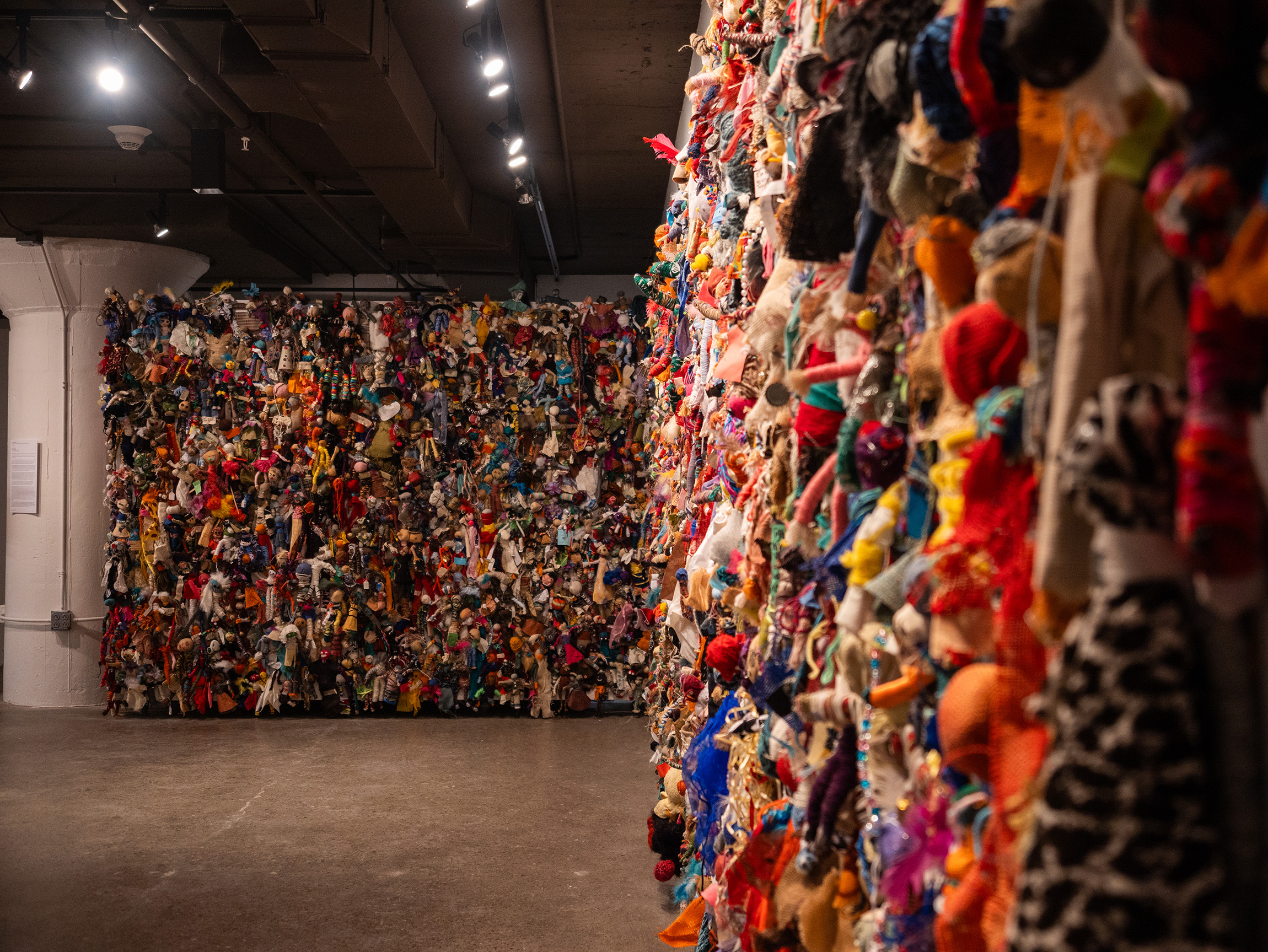
Creative arts therapy assistant professor Rochele Royster started her project “Dolls4Peace” in 2015, documenting the number of victims who died due to gun violence in Chicago from 2015 to 2017. She’s made over 1,600 dolls, each representing the victims. Taite Paradise | Staff Photographer
Another piece of Royster’s work is the “Living Freedom Jacket,” which represents ideas of freedom and what it means to community members when this freedom is hindered, she said. She had Syracuse community members write and draw what freedom meant to them and turned each into a quilt patch. Then, Royster combined all of the quilt patches into the jacket, which sits on a mannequin in the faculty show.
Both of Royster’s pieces allow community members to partake in them, highlighting the importance of showcasing voices in society through art.
“I would say the voice of the people, how important it is and how art can amplify that voice,” Royster said of what she hopes viewers get out of seeing her pieces.
Having art from different professors displaying their specialized crafts enriches the understanding between the artist and the audience, Royster said. The exhibit not only highlights the faculty’s talents, but also different races and genders.
“Seeing the artwork that we produce really represents where we’re from, what we’re seeing. So when you’re displaying that, you’re displaying different aspects of who we all are,” Royster said.