Opinion: Amid U.S. doctor shortage, new graduates are left unmatched
Medical school enrollment has surged, but residency positions haven’t kept pace. Until Congress expands federally funded training spots, our columnist asserts the physician shortage will only worsen. Leonardo Eriman | Daily Orange File Photo
Get the latest Syracuse news delivered right to your inbox.
Subscribe to our newsletter here.
On March 20 at noon, thousands of medical students will hold their breath before ripping open envelopes or refreshing their emails. Match Day marks the moment when medical students learn where they’ll begin their residency, and for some, what kind of doctor they will become.
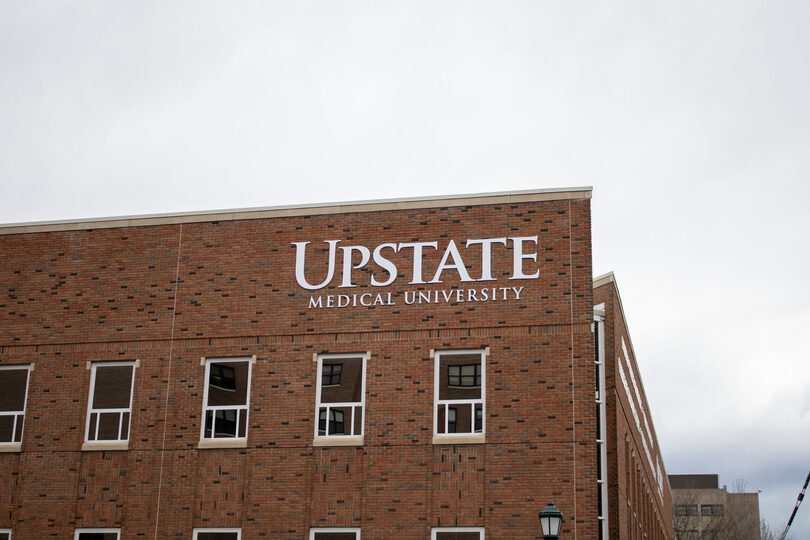
This year, hopeful medical students and their friends and families will gather at State University of New York Upstate Medical University and rip open their envelopes together. It’s exciting, but it can also be terrifying and disappointing.
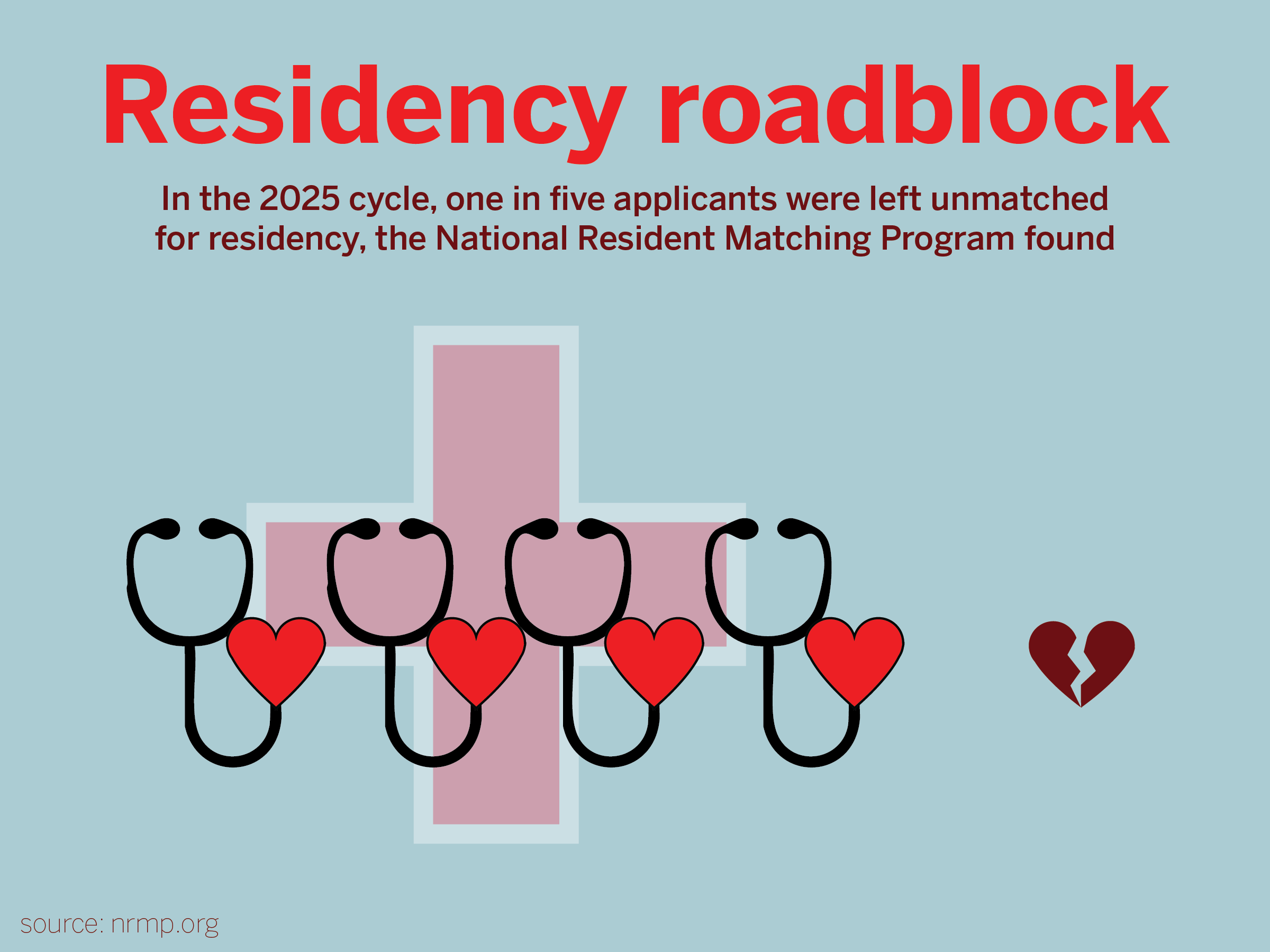
Match Day is a longstanding celebration, but the tension begins days earlier. At 10 a.m. on March 16, students learn whether they matched at all. In 2025, 9,541 applicants went unmatched, including 2,409 soon-to-be graduates of United States schools awarding Doctor of Medicine and Doctor of Osteopathic Medicine degrees.
Many people don’t realize that graduating from medical school doesn’t guarantee a job or an avenue to continue training. The U.S. is facing a critical physician shortage. Every unmatched, fully trained medical graduate is a preventable loss to a health care system that can’t afford to waste talent, education or initiative. The cap on residency positions is both artificial and arbitrary.
In 1997, Congress passed the Balanced Budget Act, which froze the number of federally funded residency positions. Although hospitals can seek alternative funding through Medicare, Medicaid or hospital revenue or grants, growth has been slow and unsteady. In 2020, Congress approved 1,000 additional residency positions nationwide. Since 1997, congressional action has been woefully insufficient, unable to meet the demand for physicians.
By 2036, the U.S. is projected to face a shortage of up to 86,000 physicians. The population is expected to grow by 8.4%, while the population over age 65 is projected to grow by 34.1%. That age group includes 20% of the physician workforce, intensifying the strain on the system.
 Zoey Grimes| Design Editor
Demand is vastly outpacing supply, leaving many patients without access to care.
Since 2000, 60 new medical schools have been accredited in the U.S., including 33 allopathic MD programs and 27 osteopathic DO programs, in the hopes of helping mitigate this shortage. Established medical schools are also expanding their class sizes each year. In 2025, total enrollment at U.S. MD-granting schools surpassed 100,000 students. By comparison, the number of residency positions available has only risen an average of 1% annually.
This bottleneck leaves thousands of qualified, ambitious student doctors without a job, unable to obtain a medical license and practice. In New York, physicians must complete one year of accredited postgraduate residency training to qualify for licensure. Without this year of experience, they can’t practice medicine.
Medical schools are fully aware of the imbalance. Seventy-five percent of medical school deans report concerns about the availability of residency slots, and 44% worry that their own incoming classes won’t secure training positions. Schools can’t responsibly continue to increase enrollment without ensuring there are residency spots on the other side.
Enrollment has grown, but training spots haven’t kept pace. As a result, further expansion is likely to slow. In 2006, the Association of American Medical Colleges called for a 30% expansion in medical school enrollment to help fend off the physician shortage. This goal has been met, but without a corresponding increase in residency positions, more and more students are facing a dead end.
Coming to this country with a medical degree is also not a guarantee of clinical practice. International medical graduates, who are necessary to the functioning of the U.S. health care system, face the same uncertainty. Many must reapply, repeat training or consider leaving medicine altogether if they fail to match. Each lost physician exacerbates an already fragile workforce.
Match Day should be one of the most exciting milestones of medical school. But for many students, the week will be consumed by disappointment.
Thousands of trained medical graduate students are ready to practice, but won’t. Passing the Resident Physician Shortage Reduction Act of 2025 would add 14,000 Medicare-funded residency positions over seven years. Passing H.R. 3890 won’t immediately fix the physician shortage overnight, but it would let trained doctors step in and care for patients.
Samantha Ballas is a medical student. She can be reached at ballass@upstate.edu.