

N
atasha Adair couldn’t care less about the clock. It’s 11:09 a.m. on a frigid January morning, nine minutes past the start of a coaches’ meeting before Syracuse’s upcoming matchup against Cal, and she’s been rolling for over an hour. Sitting in the Carmelo K. Anthony Basketball Center, she can’t stop waxing poetic about her life. Because why would she?
When you’ve had a coaching career that’s spanned four decades, six programs and taken you coast-to-coast, you want to talk about it.
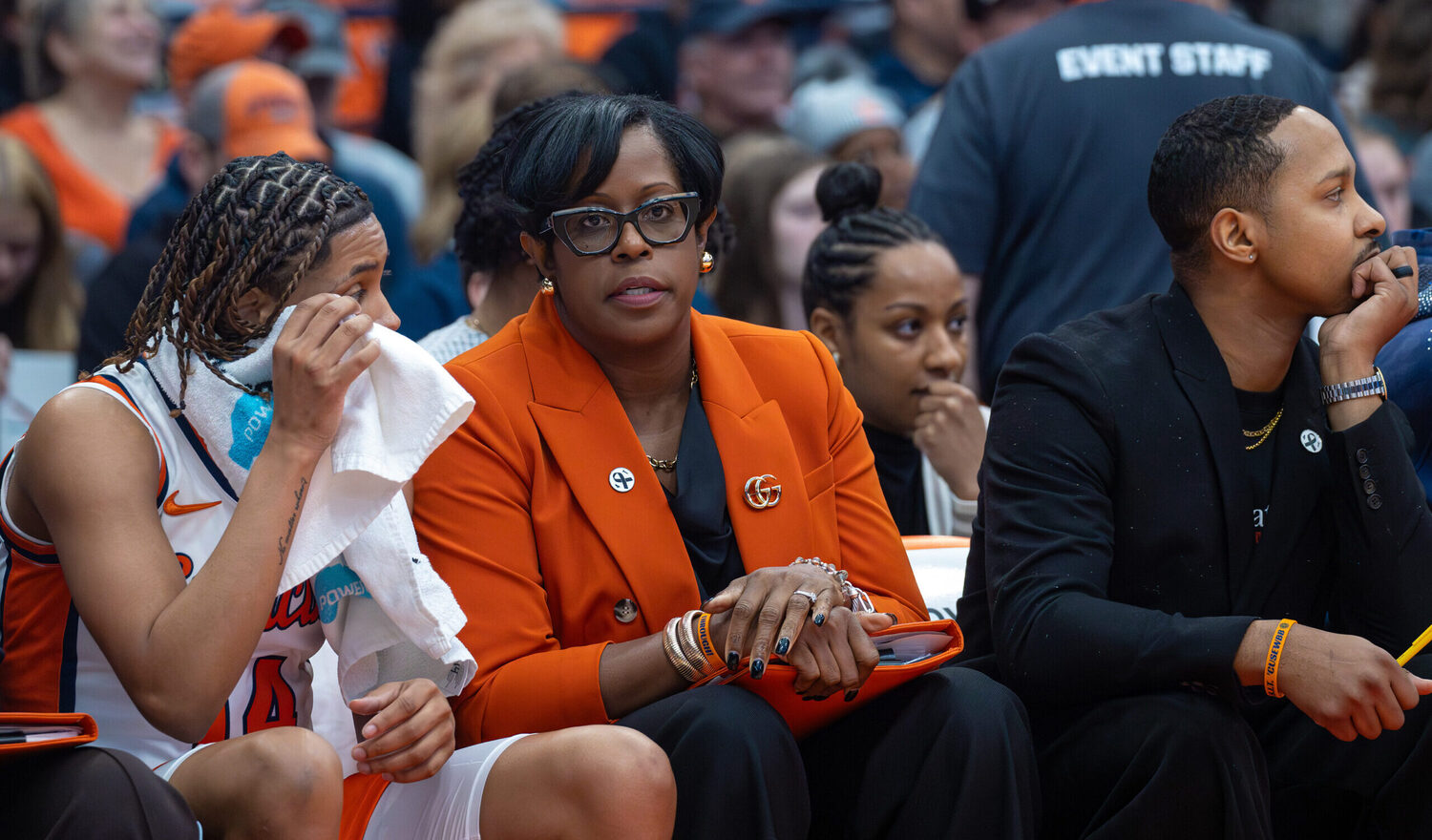
So, she tells her story. She weaves in notes of triumph; how she got into coaching by chance and hit her pinnacle decades later, leading Delaware back to the NCAA Tournament. She weaves in notes of tribulation; how she left UD to go 29-62 in three seasons at Arizona State, fighting for support that never came. And she weaves in notes of redemption; how Felisha Legette-Jack plucked her out of unemployment to be Syracuse’s “second head coach” this past offseason.
“How long is your therapy session?” SU assistant coach Khyreed Carter yells out from across the court, midway through her reflection on her time at Delaware.
You want a real answer? Maybe forever. Multiple people tell her to wrap this story up along the way, but she’s not planning on cutting this short. Because the most important thing to know about Natasha Adair is that, once she starts something, she doesn’t stop until it’s finished. That’s why she’s at Syracuse, after leading different programs for 13 years, taking a step back to move forward in her career as SU’s associate head coach.
“The title may be different, but I think the experience, opportunity, the players,” Adair begins, stammering as she collects her thoughts. “I love coaching and teaching. And if this is the opportunity that allows me to get back to that, that hasn’t happened in a long time.”
No one, including Adair, knows how this ride will end. But it’s a fitting denouement. To be frank, she didn’t even mean for it to begin.
I absolutely wouldn’t change a thing.Natasha Adair, Syracuse women’s basketball associate head coach
Her Plan A was broadcasting. It’s why she got her degree in communications. She envisioned herself doing play-by-play on ESPN, not holding a clipboard on the sidelines.
Pat Knapp changed all of that. Back in 1998, Adair ran into Knapp — then Georgetown’s head coach — at an event in Washington, D.C., and Knapp recognized Adair as the skilled forward he once tried to recruit out of high school. Evidently, that first impression was meaningful enough for him to offer her a coaching position without any experience.
Just 26 when she joined the Hoyas, Adair could still compete with the best of them, and she wanted to show it. So, she’d often face her players in drills. It was the perfect way to prepare them — in her eyes, she was the best post player any of them would face.
She’d talk trash, too. One of her favorite bits was challenging her team to stop her from getting another rebound. Fail? Get ready to run.
She’d run these drills the whole time she was there, until she left at the age of 31.
“I was petty,” Adair said. “I could tell them about my story: ‘If I could do it at 27, if I could do it at 28, if I could do it at 30, then you can go hard now.’”
If Knapp was the one who helped Adair get her foot in the door, Mike Petersen was the one who prepared her to kick it down entirely. After six seasons at Georgetown, Adair had built a reputation for herself in the coaching world.
In 2004, Petersen had an opening on his staff at Wake Forest. Bob Clark — who coached alongside Adair with the Hoyas — called him to recommend Adair. Clark was the third person to do so, Petersen told him.
“She had come super highly recommended,” Petersen recalls. “This was obviously a super skilled, super impressive person that would be an awesome member of the staff.”
It was a first assistant role, making her third-in-command. One of the biggest things that stood out to Petersen was her ability to form relationships, which made her an ace recruiter.
That’s how she brought Dearica Hamby to Winston-Salem, helping the lightly-touted forward develop into a three-time WNBA All-Star. It only took Adair three seasons to be promoted to associate head coach, with Petersen progressively preparing her to become a head coach.
Instead of solely working with the post players, she oversaw team-wide units, like the defense. Instead of staying behind the scenes, she met with boosters and had pre-and-postgame radio shows to prepare her for inevitable media responsibilities.
“It is the head coach saying, ‘I trust you. In the event, God forbid, I can’t be the head coach tonight, you have this program,’” Adair said. “You don’t take that responsibility lightly.”
So, when Charleston came calling in 2012, she was ready to take the keys.
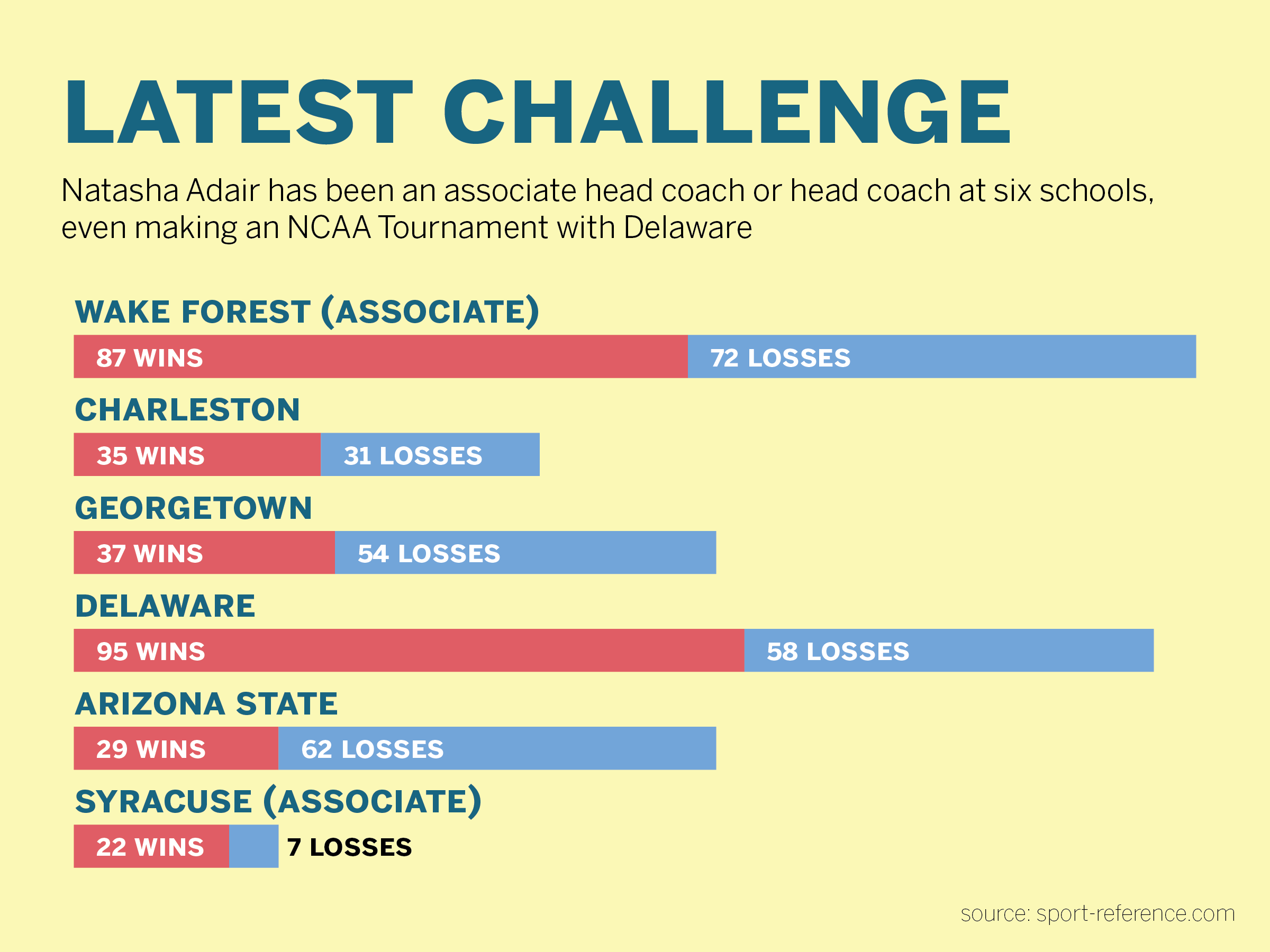
Adair was a fixer. Taking over the Cougars on the heels of a seven-win campaign, she led them to two consecutive Women’s Basketball Invitational appearances, going 35-31 in her tenure as their head coach. Georgetown brought her back to engineer a rebuild in 2014 when Keith Brown resigned after allegations of verbal abuse.
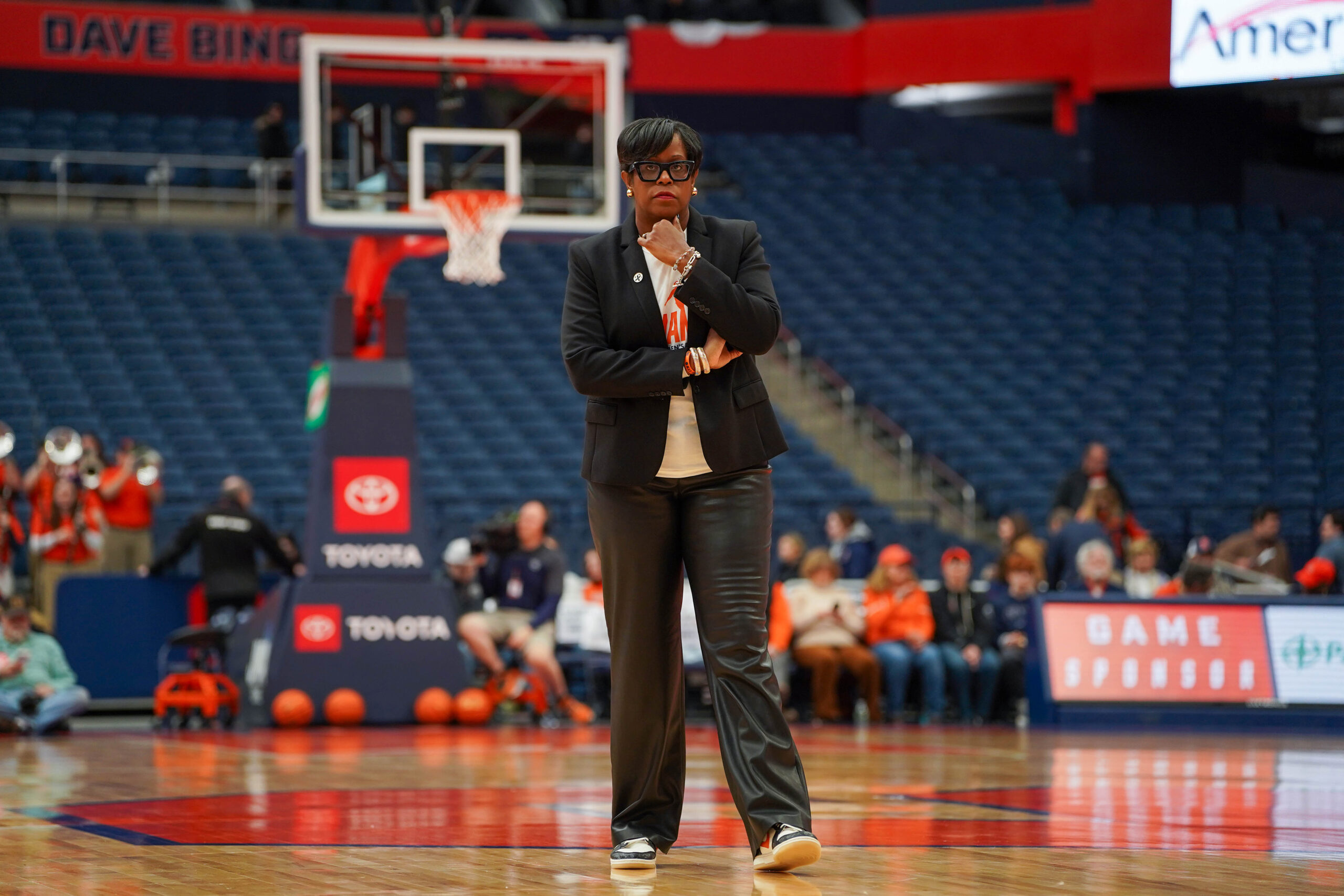
Natasha Adair stands on the JMA Wireless Dome court during Syracuse’s 84-65 loss to Louisville on Feb. 8. Adair was brought to be Felisha Legette-Jack’s “second head coach.” Zoe Xixis | Asst. Photo Editor
The first year was a dismal 4-27 campaign, and Adair said she had to do a lot of healing that season. She “got back to basketball” the following two seasons, though, finishing with winning records and making Women’s National Invitation Tournament appearances both years.
“I think the belief in Coach (Adair), knowing that she was there for them, they really started playing hard for her,” said David White, Adair’s director of basketball operations at Georgetown. “There was a little bit of hesitancy to believe in a coach.”
But there’s something about the Hoyas that Adair could never escape. When you think of Georgetown’s venerable brand, you always think of men’s basketball. That’s why, when Delaware athletic director Chrissi Rawak first called her, she didn’t immediately hang up the phone.
Rawak understood how it sounded; the sheer ridiculousness of poaching a head coach from the Hoya Paranoia. But she’s never lacked confidence. Once Adair opened the door for Rawak, there was no closing it.
“She says, ‘This is not something that I think I’m gonna pursue,’” Rawak recalls. “And I was like, ‘That’s not an option.’”
Through conversations with Blue Hen players and some of the sport’s top coaches — like Dawn Staley and Brenda Frese — Rawak had developed a vision for what she sought in a leader. It took just one conversation for her to realize Adair was the perfect fit. Adair prayed on it for a while, and realized she could make Delaware a destination for women’s basketball.
She took the job in the spring of 2017. Before her first season, Blue Hen forward Nicole Enabosi walked into Adair’s office, fully intending to transfer. Adair told Enabosi she wasn’t going to leave.
So, Enabosi stayed, becoming the Colonial Athletic Association Player of the Year. She wasn’t the last Adair coached to do so — the other was Jasmine Dickey.
When Adair first recruited her, Dickey was a 5-foot-10 forward who wasn’t a consistent shooter. But Adair saw a kind of tenacity she couldn’t coach. As she recruited Dickey, she promised her parents she’d make their daughter a professional.
Four years and two CAA Player of the Year awards later, Blue Hens surrounded Dickey at a rented banquet hall, awaiting the 2022 WNBA Draft. When she got selected in the third round, Adair wrapped her arms around Dickey, hugging her protege with the joy and pride of a promise fulfilled.
“One of the best days of my life,” Dickey said.
Success begat more success. In 2022, after Adair led UD to its first NCAA Tournament appearance in nine years, former Arizona State athletic director Ray Anderson fixed his search on her. Rawak tried everything to convince Adair to stay, but Rawak understood when Adair decided to leave for the draw of rebuilding a Power Five program.
“It was certainly heartbreaking, I’m not gonna lie,” Rawak said. “This is where, as humans, we can feel two different things. I was proud.”
Though Adair could never get the same alignment in Arizona as she could in Delaware. Anderson resigned after Adair’s first season, an eight-win slog of a campaign. That challenged Adair because, in her words, “he was the one I said yes to.”
Sophia Burke | Co-Digital Design Director
She didn’t say “yes” to Anderson’s replacement, Graham Rossini. Multiple sources indicated they felt like the team lacked financial support from ASU’s administration. Carter Caplan, Adair’s director of basketball operations, pointed to the team’s lack of chartered flights as an example, saying he felt they were in the bottom tier of resources among Big 12 programs.
And, in a time where name, image and likeness money became ubiquitous in college athletics, multiple sources indicated they felt there wasn’t enough financial support in that realm either. Darrell Mosley, Adair’s associate head coach with the Sun Devils, said the program had “zero” when it came to NIL — which, in turn, led to Adair’s 29-62 record in Tempe.
In an email to The Daily Orange, Rossini declined to comment on Adair’s tenure.
“We were literally stuck bringing in mid-major players and JUCO kids to Power Four, which is unheard of,” Mosley said. “That’s all the interest we can get, because that’s all we could afford.”
Adair was fired on March 8, 2025, having won just 10 games in her third season. Legette-Jack called her within 24 hours. SU’s head coach doesn’t remember when she first met Adair — she posits it must’ve been at least two decades ago — but she does remember needing a “second head coach.” Adair fit the bill to a T.
Years of head coaching experience taught Adair what she needed from her assistants. That makes her the perfect assistant for SU, Legette-Jack said. They talk to the players in equal measure, together. The Orange have affectionately nicknamed them “The Golden Girls.”
SU forward Journey Thompson, who played under Adair at Arizona State, remembers the sheer excitement she felt when she heard Adair was coming to Syracuse. It’s a different dynamic now, with Adair as an assistant, and she feels she can confide in her more than she ever could at ASU. A lot of things have fallen into place for the Orange in their revitalized season, and Adair is one of them.
“She’s such a meticulous person, so disciplined in everything that her teams have done,” Legette-Jack said. “I wanted that for my staff.”
So now that she’s here — on the Carmelo K. Anthony Basketball Center court, sitting in a little white chair — she’s asked if she has any regrets. If she could do it all over again, would she change anything about the way her career played out?
She doesn’t even let the question register.
“Not one,” Adair says. “I absolutely wouldn’t change a thing.”
Then she rises from her seat, shakes hands, says her farewell and steps off the court into a hallway, ostensibly off toward the meeting she’s late to. The clock reads 11:15 a.m. Someone will have to get her up to speed on everything she’s missed.
Photo by Avery Magee | Photo Editor