Opinion: Bondi offered deflection, not answers, on Epstein
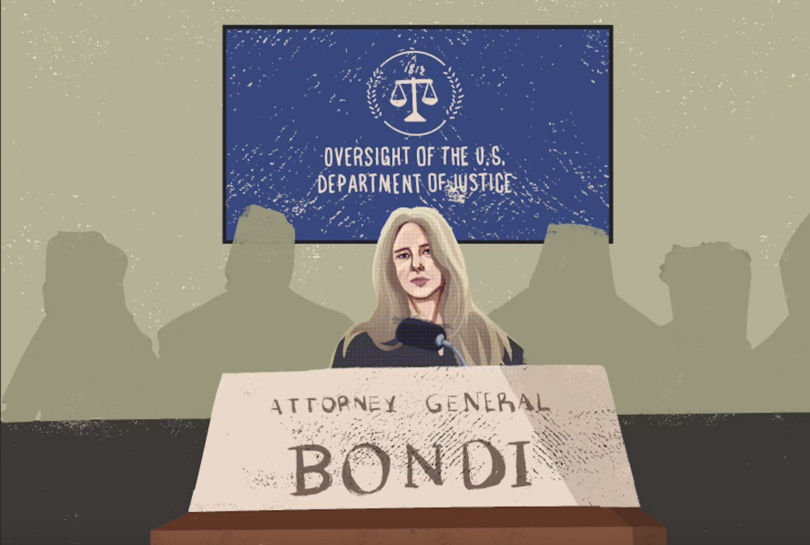
The U.S. Justice Department exists to check executive power, our columnist writes. She claims Pam Bondi’s attitude at a recent House hearing was unacceptable and made it difficult for the Justice Department to do its job. Emma Soto | Contributing Illustrator
Get the latest Syracuse news delivered right to your inbox.
Subscribe to our newsletter here.
United States Attorney General Pam Bondi appeared before the House Judiciary Committee on Feb. 11 to testify on her leadership of the Justice Department. Bondi’s answers raised troubling questions about transparency and accountability within the department.
The hearing was intended to explain the department’s handling of the Epstein files, a collection of over 3.5 million pages of documents, 180,000 images and 2,000 videos documenting the activities of convicted sex offender Jeffrey Epstein. But the testimony was defined less by explanations and more by deflections.
Rather than offering measured responses expected from the nation’s chief of law enforcement, Bondi has relied on hollow rhetoric and ad hominem attacks against lawmakers.
One of the many members of Congress Bondi clashed with was Rep. Jamie Raskin, the committee’s top Democrat. During the meeting, she resisted his attempts to prevent her from wasting time with lengthy answers.
“You don’t tell me anything, you washed-up loser lawyer. You’re not even a lawyer,” Bondi said.
Congress is constitutionally obligated to check the powers of the executive branch. Lawmakers are required to ask uncomfortable questions about how the Justice Department — one of the most powerful institutions in the federal government — exercises its authority.
With access to sensitive evidence, investigative and prosecutorial powers, the department wields immense influence over the political and legal climate of the United States. Oversight exists precisely because of the scope of such power.
The problem, then, isn’t that Bondi faced immensely tough or unfair questioning but that she rejected the idea of oversight itself, treating accountability as an inconvenience. This behavior is fundamentally incompatible with the responsibilities of leading the Justice Department. If this attitude goes unquestioned, then congressional hearings become a waste of time, rather than a check on executive authority.
This attitude is especially upsetting given the subject of the hearing. The Justice Department’s careless handling of the Epstein files has raised bipartisan concerns about the government’s willingness to confront wrongdoing by the powerful.
Several GOP lawmakers joined Democrats on the House Oversight and Government Reform Committee in voting to subpoena her testimony, while others have signaled frustration with delays and inconsistencies in the release of the documents.
The bipartisan subpoena suggests that frustration with the Justice Department’s handling of the files is no longer confined to just one party.Navya Varma, Columnist
When Rep. Thomas Massie criticized Bondi over excessive redactions in the released files — including the name of billionaire Les Wexner being blackened out — Bondi accused Massie of having “Trump derangement syndrome.” Wexner was one of six “wealthy, powerful men” whose names were originally redacted in the Epstein files, Reps. Massie and Ro Khanna revealed through unredacted versions of the documents.
Yet, what remained the most troubling aspect of the testimony was Bondi’s blatant disregard for Jeffrey Epstein’s survivors. Seated in the hearing room were Theresa Helm, Jess Michaels, Lara Blume McGee, Dani Bensky, Liz Stein, Marina Lacerda, Sharlene Lund, Lisa Phillips and the family of the late Virginia Giuffre.
When requested to turn around, face them and apologize to the survivors behind her for the mishandling of documents — exposing their identities and the details of their abuse — Bondi refused, going so far as to dismiss the request as “theatrics.”
Congressional hearings often descend into political battles. This moment was blatantly different and handled inappropriately. For survivors who have spent years seeking justice, even a brief recognition of their battle would have signaled to them that they mattered. Instead, her dismissal conveyed exactly the opposite.
On March 4, in a rare break with party lines, the House Oversight Committee voted 24-19 to subpoena Bondi to testify about the Justice Department’s handling of the Epstein files.
Under committee rules, Rep. James R. Comer will issue a subpoena for a closed-door deposition. Such a setting could force Bondi to engage more seriously with lawmakers’ investigation than during a congressional hearing.
Oversight exists to ensure that political institutions serve the public, not shield the powerful or silence victims. The bipartisan subpoena suggests that frustration with the Justice Department’s handling of the files is no longer confined to just one party.
But, a subpoena alone cannot restore the public’s trust. A subpoena which induces accountability, direction and a willingness to confront uncomfortable truths is necessary — traits largely unseen in Bondi’s testimony.
For the survivors, Congress and the Justice Department, it’s these traits that are long overdue.
Navya Varma is a freshman majoring in political science. She can be reached at navarma@syr.edu.