Opinion: Free speech concerns point to SU’s echo chambers

SU students struggle with civil literacy due to the echo chambers on campus, our columnist writes. When students don’t practice engaging with competing viewpoints, she argues they lose the ability to do so altogether. Emma Soto | Contributing Illustrator
Get the latest Syracuse news delivered right to your inbox.
Subscribe to our newsletter here.
Last year, the Foundation for Individual Rights and Expression, a nonprofit civil liberties group, published a report evaluating the climate for free speech on America’s college campuses.
The report included a list of 257 United States colleges ranked from most to least tolerant of free speech. Syracuse University ranked 76th and received a free speech climate grade of “D-.” Based on responses from 327 SU students, the report found that 44% of respondents self-censor on campus at least once or twice a month, and 67% say “shouting down” a speaker to prevent them from voicing their opinions on campus is acceptable.
These numbers point to a campus culture where disagreement isn’t engaged — it’s actively shut down, creating an echo chamber that prioritizes ideological conformity over open debate. In such an echo chamber, the habits of debate, compromise and mutual understanding erode. Polarization grows because certain voices are silenced while other ideologies go unquestioned.
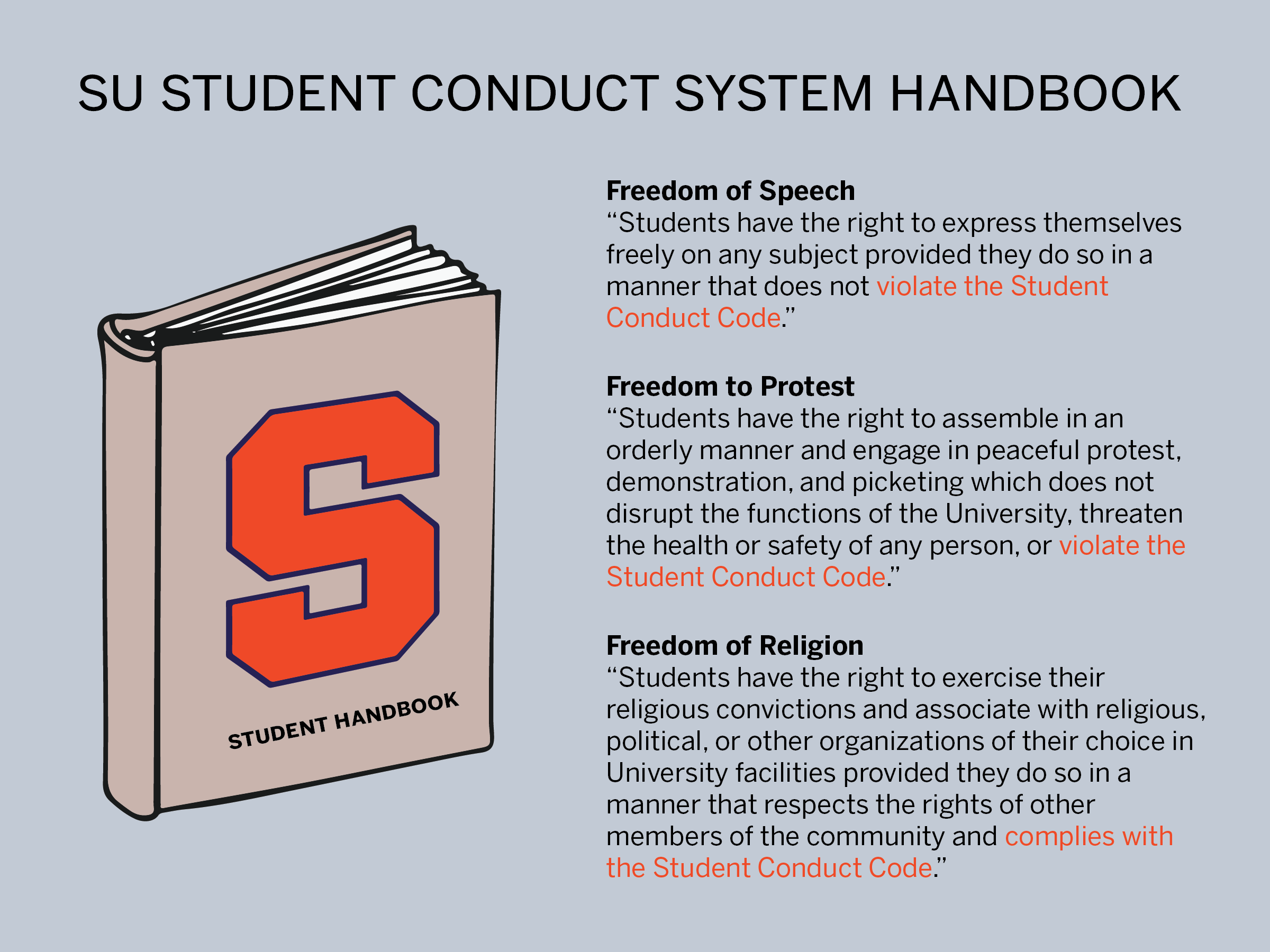
“Students have the right to express themselves freely on any subject provided they do so in a manner that doesn’t violate the Student Conduct Code. Students in turn have the responsibility to respect the right of all members of the University to exercise these freedoms,” SU’s student handbook states.
In theory, this language appears consistent with the First Amendment. In practice, though, SU’s Student Conduct Code and Bias Sanction Enhancement Clause leaves room for administrators to apply disciplinary action selectively. By prohibiting speech that administrators interpret as harassment or bias-motivated, the code relies on subjective judgement rather than clear, objective standards. This grants administrators wide discretion to decide which viewpoints are harmful and which are acceptable, creating an uneven enforcement standard.
The Bias Sanction Enhancement Clause further complicates this ambiguity by promising harsher penalties if administrators deem speech or conduct to be bias-motivated against a wide range of protected categories. Its broad scope raises questions about whether political, religious or cultural speech could be construed as bias-motivated and therefore subject to punitive consequences.
For instance, the handbook claims to protect religious expression while simultaneously prohibiting speech biased against “reproductive health decisions,” a term that encompasses abortion. This contradiction could place religious students who hold pro-life beliefs in a precarious position.
Whether a well-intentioned belief is treated as protected free speech or a punishable offense depends entirely on how administrators interpret and apply the policy.
The gap between policy and practice extends beyond written rules. SU’s 2024 Statement on Free Expression and Free Inquiry affirms that community members “may not obstruct the freedom of others to hear or express views they reject or find offensive.” Yet FIRE’s report found that 38% of respondents believe using violence to silence a speaker is acceptable.
The statement also allows the university to restrict speech that “harasses an individual based upon a protected characteristic,” but this standard again remains precariously vague. Without clear, objective definitions, administrators retain the ability to classify dissenting viewpoints as harassment, creating uncertainty that encourages self-censorship and undermines the very “fearless debate and deliberation” SU claims to promote.
In effect, SU’s commitment to diversity and inclusion becomes contingent on which identities or viewpoints administrators deem deserving of protection — a deviation from the content neutrality guaranteed by the First Amendment. This imbalance encourages students to self-censor rather than risk facing disciplinary action. By embedding ideological preferences into disciplinary mechanisms, SU’s policy functions more as a tool of control than protection.
SU did not respond to The Daily Orange’s request for comment.
Sophia Burke | Design Editor
For over two decades, SU has built up a long track record of student and faculty censorship accusations. In 2005, then-Chancellor Nancy Cantor shut down a satirical student-run TV show about the university. In 2012, the SU School of Education expelled a graduate student over a Facebook post about a racially charged comment made by a community leader. More recently, SU rejected a Young Americans for Freedom chapter over its conservative beliefs and placed a professor on leave for writing “Wuhan Flu or Chinese Communist Party Virus” on his syllabus.
Incidents such as these contribute to a broader perception that certain viewpoints are more likely to face institutional consequences than others. These actions contradict SU’s own stated commitment to protecting free speech and reveal an ideological bias against conservative viewpoints. Additionally, the FIRE report found liberal students at SU outnumber conservative students 4.58 to 1.
Advocates of stricter speech codes argue that allowing unrestricted expression may enable hateful ideologies and harm vulnerable students. This concern is well-founded. College campuses should be a safe learning environment where all students can thrive academically and socially.
But policies that rely on subjective interpretation enable administrators to silence valuable debates and violate students’ constitutional rights. Even when policies are well-intentioned, biased enforcement and unspoken academic pressure undermine both the spirit and the letter of free expression on campus.
An unspoken rule circulates on campus that you can’t voice dissenting ideas without risking academic consequences, creating a false consensus among supporters of dominant views that their own opinions are the default. As a result, those students’ beliefs are rarely challenged, removing any need to rigorously examine or defend them.
In a statement to The D.O., FIRE noted that ideological homogeneity and self-censorship can reinforce this dynamic.
“When many students hold similar views, it becomes easy to assume the views of the majority are correct rather than debatable. Exposure to disagreement is reduced, and people often learn that expressing dissent or questioning the prevailing views of the majority can carry steep social costs, which encourages self-censorship,” FIRE wrote. “This in turn creates a self-reinforcing cycle maintaining the echo chamber: individuals hear their own views echoed back without challenge, others self-censor and the ideological majority appears more dominant than it actually is.”
Institutions that rank highly for free speech tolerance demonstrate that protecting expression doesn’t require sacrificing inclusion.
Claremont McKenna College, ranked No. 1 on FIRE’s list, requires a finding of discrimination to include an identifiable adverse action that materially limits a student’s access to educational opportunities, along with a demonstrable link between that harm and the protected status. Its policy explicitly excludes minor or trivial conduct — speech that merely angers or offends — from qualifying as actionable discrimination.
The difference is CMC’s policy provides clear, unambiguous guidelines: Disagreement, ideological conflict or unpopular viewpoints don’t trigger sanctions unless they result in concrete, material exclusion or harm.
“Policies alone often struggle to change institutional climates, but they can be an important first step if they are consistently matched in practice by protecting the expression of divergent or viewpoint-minority views,” FIRE wrote.
When colleges punish dissenting speech, students aren’t taught how to think — they are taught what to think. If SU truly aims to prepare students for democratic citizenship, it must meet classroom and campus disagreement with discussion, not discipline. Such refusal is both irresponsible and undermines the foundations of our democracy.
Ella DeCamp is a junior majoring in english and textual studies. She can be reached at emdecamp@syr.edu.