‘Love Story’ captivated me. Does that justify its tragic subject matter?
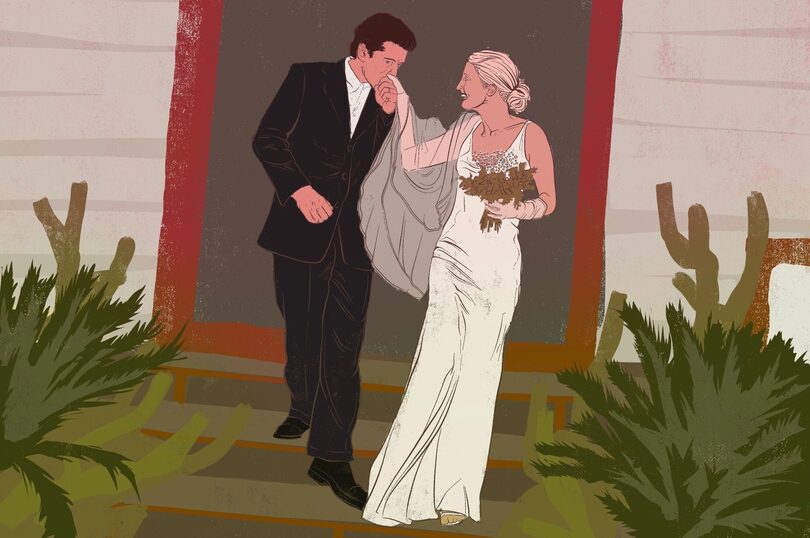
The first season of “Love Story” follows the complicated romance of John F. Kennedy Jr. and Carolyn Bessette Kennedy, from the day they met to their death. The inaugural season also raises ethical questions about what portrayals are fact versus those that are fiction. Emma Soto | Contributing Illustrator
Get the latest Syracuse news delivered right to your inbox.
Subscribe to our newsletter here.
I avoided watching “Love Story” for the first few weeks of its Thursday evening releases. But, as my For You Page flooded with clips of a dramatic, sweeping epic between two American icons, I realized I had some catching up to do.
The inaugural season of “Love Story” revolves around the romance (and a healthy amount of intense arguments) between Carolyn Bessette Kennedy (Sarah Pidgeon) and John F. Kennedy Jr. (Paul Kelly Anthony). The show’s inaugural season ran from early February to last Thursday, releasing an episode each week. More seasons revolving around new couples and their respective love stories have already been discussed.
The Hulu show portrays intrusive public attention turned on people who strove to be private. But the show itself does the same thing, shining more light on the private couple. Knowing how the real story ends (tragic young death for both “lovers”), the whole appeal of the show felt lurid.
The opening scene of “Love Story” immediately acknowledges that ending, depicting the moments before John and Carolyn take off in a plane piloted by John. Carolyn, John and Carolyn’s sister, Lauren Bessette, died on July 16, 1999.
Carolyn and John’s story got cut short in real life, and it feels like we’re all desperate to write them a different ending. If they lived longer, we may have seen some of the storylines alluded to in the show — like John considering a political run — play out. But we’re left to write stories filling in the margins of their life.
That’s why I resisted the idea of watching the show initially — would we be so interested in this love story if the characters were still alive? Are viewers fascinated only because of the tragedy that has plagued the Kennedy family for generations? I was afraid the show would trivialize the couple’s lives into a rom-com, or worse, a steamy romance a la “Bridgerton.” Finally, I had to see for myself.
“Love Story” began to impress me with its portrayal of Jacqueline “Jackie” Kennedy Onassis in the final few months before her death in episode three. I have to admit that Jackie is a personal hero — I spent a lot of teenage hours immersed in historical fiction about “Camelot” and Jackie’s life.
The exploration of generational trauma between her, Jack and Caroline Kennedy felt poignant and authentic, deftly laying the groundwork for later scenes when Jack and Carolyn grapple with Jack’s childhood spent in the spotlight.
The scenes focused on Jackie’s sadness regarding her late husband and complex relationships with her children gave the show much more credibility in my mind. They proved this show wouldn’t just focus on the sexy New York City makeout scenes I glimpsed on social media. “Love Story” seems interested in evaluating the Kennedy family for more than just their flashy exterior.
But the flashy bits shouldn’t be set aside earlier. Carolyn and John’s styles are very present in the show, which made it all the more enjoyable for me as someone who has most definitely pinned a few too many “CBK” inspo pictures of tortoise shell headbands and black turtlenecks to my Pinterest boards.
Carolyn’s minimalistic but highly elegant style is a treat, and her fashionable job at Calvin Klein is the stuff of my 90s fantasies. John’s aesthetics (and looks) have caught people’s imaginations too, with JFK Jr. lookalike contests springing up across the country.
The imagery of the Kennedys’ Hyannis Port home and prim dinners contrast the Kennedys’ almost-institutional elegance with the more flippant coolness Carolyn possesses.
The show expertly illustrates Carolyn’s alienation from the fortress of the Kennedy family. A scene where John quietly instructs Carolyn to remove her (very stylish) shawl at a family dinner after a comment from the family matriarch was perfectly uncomfortable.
Pidgeon excels in portraying Carolyn’s cool confidence, which makes it all the more heartbreaking to watch her tip into depression and isolation around episode seven. In episode seven, Carolyn leaves Calvin Klein and makes hiding from the paparazzi her occupation.
Her shelter from the public eye makes for a whole lot less frolicking around the exclusive New York City party scene and a whole lot more frustrating arguments between her and Jack.
All of episode eight takes place inside John’s fashionable loft as Carolyn struggles with her place in the world and in their relationship. When the focus is on Anthony’s acting and not his near-perfect casting as People’s 1988 Sexiest Man Alive, I’m a little less impressed by his portrayal.
Pidgeon out-acts Anthony in these difficult scenes by a significant margin. She portrayed deep pain and emotion, while Anthony’s delivery reminded me of a petulant child throwing a tantrum.
But, that could be an intentional choice — a main theme of the show is John’s emotional immaturity when it comes to communication. Still, I’d like to see a little more conviction behind the eyes of a character whose father was assassinated and whose famous mother has just died.
I’d be remiss not to mention the perfect needle drops that punctuate the show’s nine episodes. The sound of Sade, Fiona Apple and Mazzy Star immersed me in the 1990s nostalgia that “Love Story” seems to be hoping to tap into.
While most can probably agree on the show’s excellent soundtrack and the costumes, the treatment of the facts about the characters’ lives is much more polarizing. There’s an insatiable hunger to know if elements of the show are fact from fiction, like a shared KFC meal and controversial portrayals of living people, like Daryl Hannah.
Hannah heaped more focus on the show’s accuracy when she published an essay condemning the portrayal of her in early episodes. Hannah argued the show turned her into an antagonistic plot device, which she described as “inappropriate and no accident.”
While the supposed opportunity to peer into the reality of these details is exciting, it also presents the dilemma I still can’t square. Is “Love Story” doing the same thing as the paparazzi — projecting an authoritative yet warped narrative onto people who can’t defend themselves?
I began the final episode with that question at the front of my mind. The episode felt like a reaffirmation of the couple’s vows, with beautiful callbacks to the beginning of their romance. Even though we all knew it was coming, the sweet opening made Carolyn, John and Lauren’s deaths even more heartbreaking.
I thought the show crossed the line into sensationalization by taking the viewer into the plane with Carolyn, John and Lauren. Jump cuts and fade to blacks are prevalent throughout “Love Story,” and I think this moment could’ve used that discretion.
The four-minute-long scene felt dragged out and romanticized the accident, with the glimmering lights of the destination creating a Gatsby-like reference to yearning for a future the couple will never reach. Including dialogue in this moment seems overly speculative of real people’s last words.
Despite that indiscretion, the final episode answered the show’s warrant. The incredibly poignant scenes between Carolyn’s mother and Caroline helped the show feel well-rounded and not centered on just the catchy romantic moments. Caroline’s grief truly brought home the theme of the “Kennedy curse” for me.
Carolyn’s mother’s voice — reading “Death is Nothing at All” — ending the show felt wholly appropriate to me, and the shots of memorials outside the apartment were visually stunning and emotionally resonant. Though “Love Story” occasionally lapsed into feeling invasive, the drama left me with the message that our memories of John and Carolyn should stay alive outside of the tabloids.