Opinion: SAVE Act unnecessarily dampens democracy, voter voices
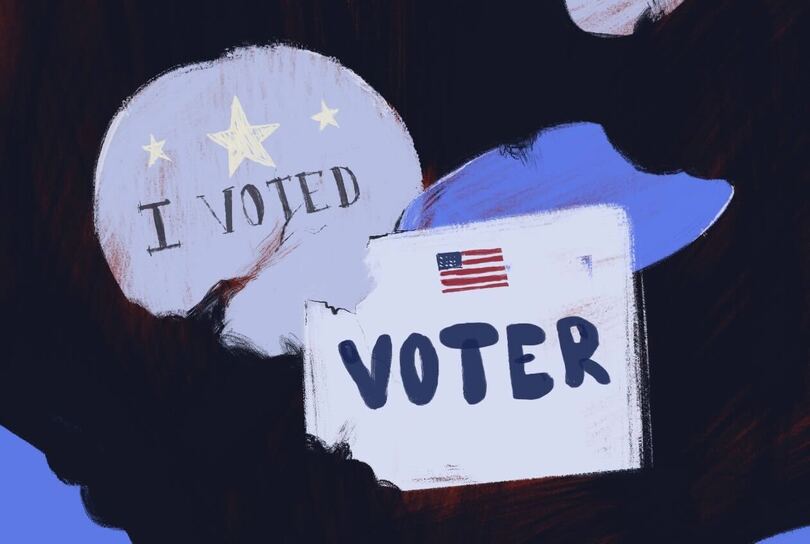
Though SU provides young voters with opportunities to practice democracy, the SAVE America Act would limit those opportunities at the national level, our columnist writes. Julia Rodenberger | Contributing Illustrator
Get the latest Syracuse news delivered right to your inbox.
Subscribe to our newsletter here.
On March 26, the Safeguard American Voter Eligibility Act, also known as the SAVE America Act, stalled on the Senate floor. This bill, which would require government-issued identification proving citizenship in order to register to vote, would upend voting as we know it.
But, the system it aims to replace already works.
Proponents of the SAVE America Act insist it’s a necessary safeguard against noncitizen voting, but the data tells a different story. Utah recently completed one of the most exhaustive voter citizenship reviews in the country, conducting a multistep audit of more than 2 million registered voters over nearly a year.
The result: one noncitizen registered to vote but never voted.
This isn’t a crisis, nor is it a rounding error. Utah follows the same registration method as the majority of the nation, providing options to register in person, online or by mail. A study of this magnitude proves that the bill won’t provide additional security to our already secure voting methods; it just doesn’t make sense.
In fact, data from the United States Citizenship and Immigration Services highlights that only 0.04% of registered voters have been flagged as potential noncitizens. To implement additional verification in response to such a small number is both unnecessary and irrational.
The SAVE America Act would require all currently registered voters to re-register with updated documentation. That is a significant issue — and not a partisan one. Tens of millions of Americans would need to navigate a more complicated registration process, and for some, these added burdens may drive them away from voting altogether.
Despite the heightened security, many Republicans claim these additional forms of identification won’t disenfranchise voters, as 36 out of 50 states already have some form of voter ID laws to register. But, the SAVE America Act would require documented proof of U.S. citizenship, a regulation that is significantly more extensive.
This means birth certificates, naturalization certificates, records of birth and other government-issued documents must be presented along with a government-issued photo ID, such as a passport or a REAL ID-compliant driver’s license. None of the 36 states with voter ID laws require this level of identification.
For many, these documents might not be easily accessible.
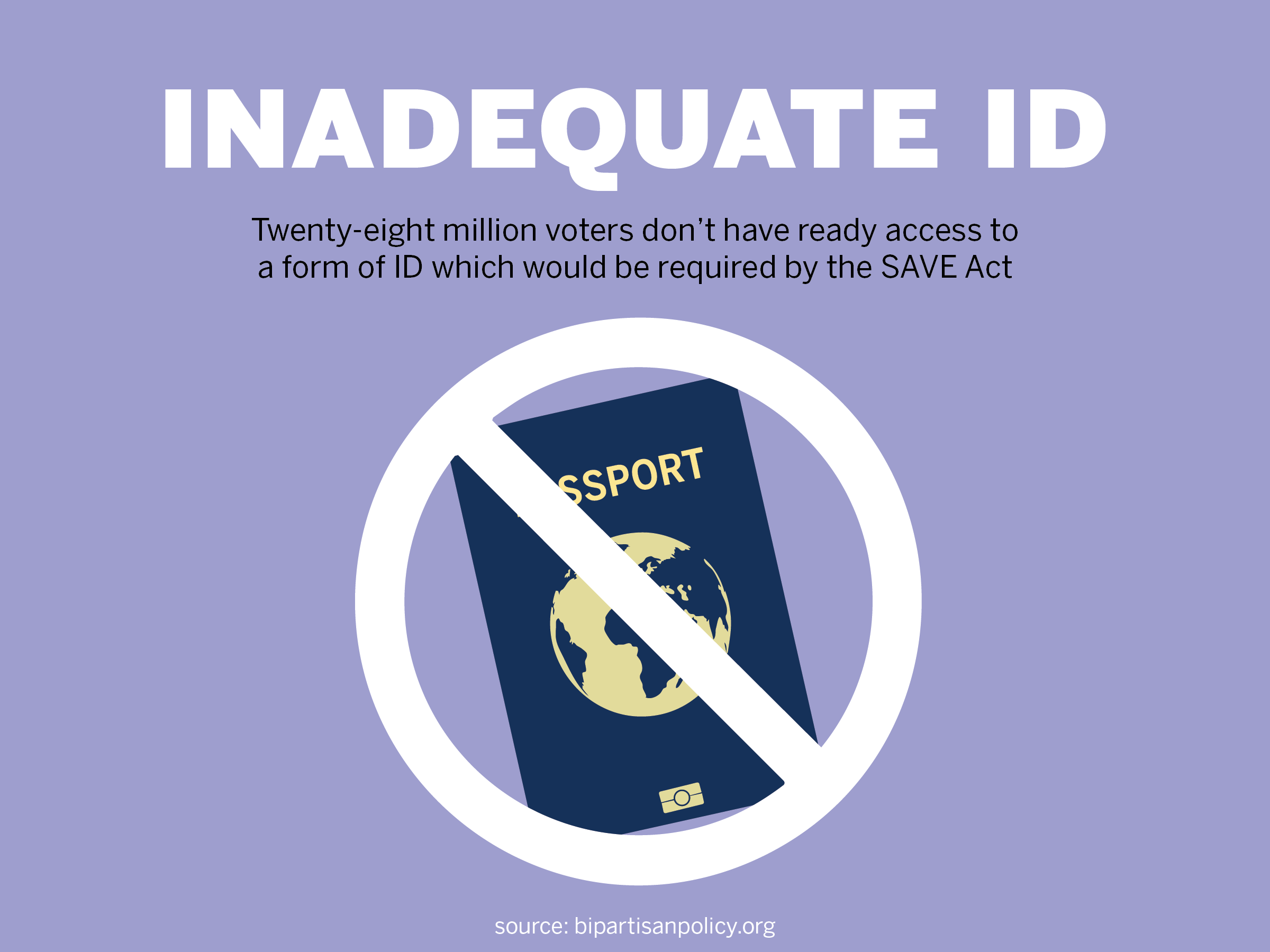
Sen. Ed Markey of Massachusetts expressed his concerns for the many citizens who don’t have an easily accessible passport or birth certificate. Others, like women who have changed their name in marriage, may not have proof of identification without providing additional documentation or signing an affidavit.
Sophia Burke | Digital Design Director
Sixty-nine million women don’t have a birth certificate to match their name. About 21 million American citizens don’t have easy access to identification documents.
Requiring extensive documentation may scare off students from registering at all.
These numbers aren’t abstract. Behind these statistics might be a student who participated in a voter registration drive on their campus, a first-time voter who showed up to the polls or a young person whose political voice is just beginning to take shape.
The SAVE America Act doesn’t just complicate paperwork for new voters — it threatens to silence that voice before it ever gets the chance to be heard. For many young people, that voice is first developed and expressed on college campuses like Syracuse University.
Organizations like SU Democrats or The College Republicans at SU meet freely on campus to discuss their party’s opinions, host events and learn more about our nation’s government. Other groups, such as Kappa Alpha Pi or Kappa Omega Alpha, two Professional Fraternity Council fraternities that center around policy, law and government, discuss how laws are implemented and what policy can do for our nation. The Student Government Association helps build a student government grounded in the values of our nation’s democracy.
Many students learn key ideas about policy through groups like these outside of the classroom. These organizations work because they all allow students to vote and be represented. Effectiveness in government depends on votes, and students here have full access to express their opinions through voting.
These student organizations exist at SU because students recognize their importance. Student engagement matters. College is a space where students are free to find their voice and practice the civic principles they hope to uphold. The SAVE America Act threatens that opportunity, making it more challenging for students to voice their opinions through the power of the vote.
If voting becomes more difficult, the impact would extend beyond the ballot. The protests that students attend, speakers that come to incite change and all the other events that spark ideas and interest in our nation would all become less effective. Engagement lessens, and our voices are softened.
The SAVE America Act won’t save student voices, and it’s crucial to stand against this bill.
I have faith in the minds of our senators. With discussions on the SAVE America Act currently stalled, it’s exceptionally important that they remember that American voices are at stake over small instances of noncitizen registration. When the final vote comes, they must vote against this bill. The cost isn’t just our vote — it’s our voice, a price democracy can’t afford to pay.
William Dumond is a sophomore studying political science and policy studies. He can be reached at whdumond@syr.edu.