‘It was the social life’: Glimpse into what’s shifted on Marshall Street
Design by Adelaide Guan | Design Editor, Photographs courtesy of Linda Epstein and Special Collections Research Center
Get the latest Syracuse news delivered right to your inbox.
Subscribe to our newsletter here.
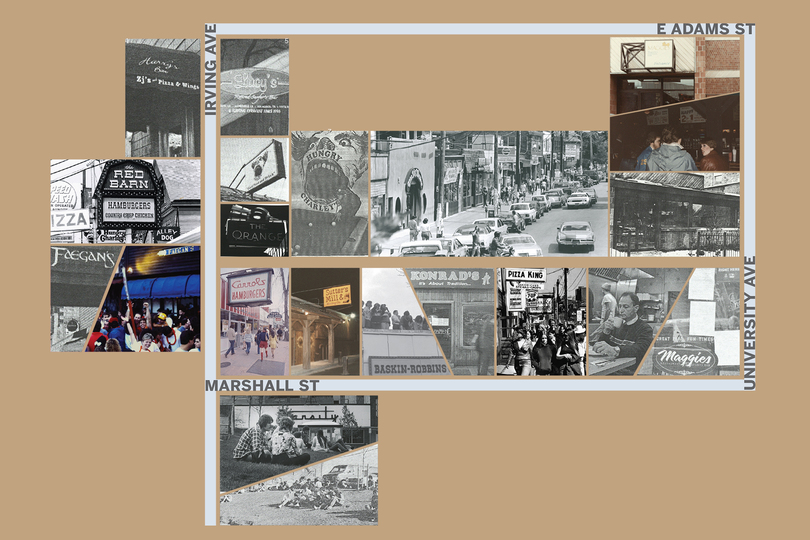
Before Marshall Street’s chain stores, there was Acropolis Pizza House, 44’s Tavern and Konrad’s Sports Bar. There was Maggie’s Tavern. There was The Orange, Cosmos Pizza & Grill and Lucy’s Retired Surfer’s Bar.
Now, those homegrown establishments have been largely replaced by chain stores like Popeyes and Chipotle Mexican Grill.
“Marshall Street was a hopping place, and throughout the years, that deteriorated,” Jerry Dellas, Varsity Pizza owner, said.
Dellas is not the only person to feel this shift. In the last few decades, Marshall Street has lost many of its independently owned bars and eateries in place of chain restaurants that now occupy a large portion of the area. For some people, Marshall Street’s vibrancy has deteriorated.
Amid those changes, few spots on and around Marshall Street have maintained their name. Varsity, Faegan’s Cafe & Pub and Harry’s Bar are some of the only businesses that have remained open for decades.
Over the years, Marshall Street’s neighbor, Syracuse University, has bought more space on and around Marshall Street.
Born and raised in Syracuse, Dellas’ father opened Varsity in 1926. In 2001, Dellas inherited Varsity with his cousin, when his father retired. But, Dellas is no stranger to Marshall Street. He and his cousin opened Faegan’s a few doors down from Varsity in 1978.
Those Marshall Street, known to many as “M-Street,” staples are ingrained into some families, like that of Ira Berkowitz. Berkowitz, who graduated from SU in 1982, remembers the street as “the center of campus activity at the time.”
In the summer of 1981, Berkowitz worked as a bartender and then as a greeter at the now defunct Magnolia’s Courtyard, also known as Maggies. The legal drinking age at the time was 18, and Maggies was just one of the plethora of bars around Marshall Street, Berkowitz said.
Aside from Burger King, Berkowitz remembers the other restaurants and bars near and on Marshall Street being independent and family-owned, like Cosmos.
Cosmos was more than a place where students gathered. It was also where locals would see a concert, said Howard Groopman, who graduated SU in 1972.
During Groopman’s senior year at SU, he spent Saturday nights waiting tables at Cosmos from 7 p.m. to 3 a.m. Back then, Groopman said a slice of pizza or a burger at Cosmos would cost between 25 and 35 cents.
But, he said the real perk of working at Cosmos wasn’t the paycheck — it was seeing the crowds of different people and groups congregate after concerts every Saturday night into early Sunday morning.
“After concerts downtown, all these hungry hippies would flood in looking for food,” Groopman said.
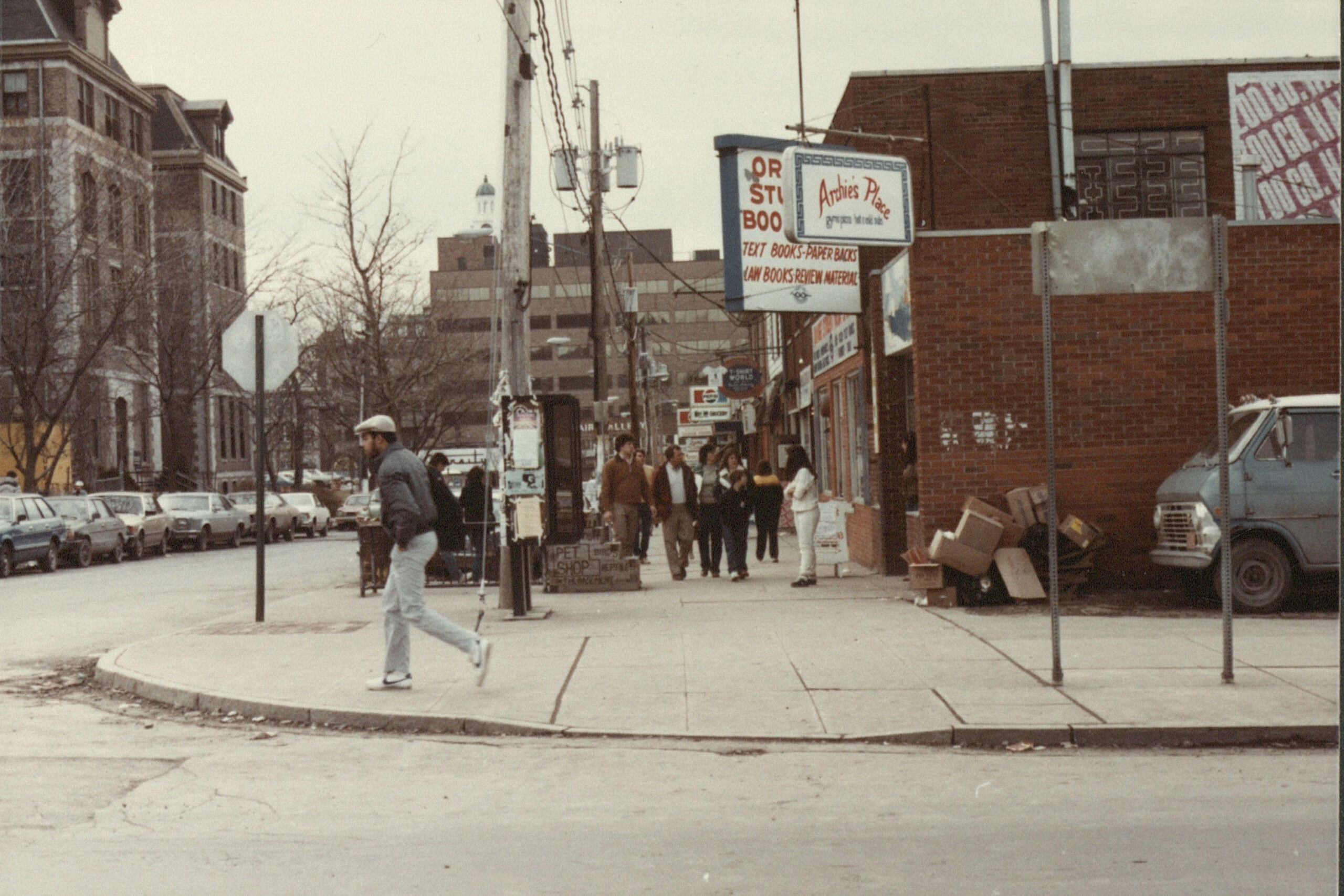
A group of people walk past Archie’s Place, an eatery on the corner of Marshall Street and University Avenue in 1983. Businesses like T-Shirt World and Varsity Pizza were positioned along the bustling street in the ’80s. Courtesy of Special Collections Research Center
Decades after working at Maggies in Marshall Square Mall, Berkowitz’s daughter, who graduated SU in 2011, happened to be at the same bar her father had worked at. Maggies was renamed to Maggies Restaurant and Sports Bar and moved to 161 Marshall St. In 2009, Maggies Restaurant and Sports Bar was raided and shut down for good.
Besides Maggies, Berkowitz said he stuck to two other nearby spots during his time at SU — Varsity and Cosmos. Through the experiences of other SU alumni like his children and nephew, Berkowitz said his family has seen Marshall Street change from independent, family-run bars and restaurants to a strip of chains.
But out of all the restaurants that have since “shuttered,” Berkowitz said Cosmos closing left the biggest void in his returns to SU. The restaurant’s absence leaves SU without their classic toasted honey buns — known to Berkowitz as the “THB.”
Bags of toasted honey buns were even given away as a goodie bag at his son’s Syracuse-themed bar mitzvah, along with Cosmos’ recipe for the signature dish.
When Berkowitz returned to Syracuse for a game or to see his kids, he would always go to breakfast at Cosmos and order his favorite toasted honey buns.
But, the tradition ended in 2014 when Cosmos closed its doors for good.
“I remember being on campus and thinking to myself, I don’t have any place to go for breakfast anymore,” Berkowitz said.
For some SU alums, like Bruce Waltuck, who graduated SU in 1973, eating on Marshall Street was a daily occurrence — sometimes more than once a day.
“Marshall Street was the place, it was just the center of our casual and recreational culture,” Waltuck said.
Evan Brudney, who graduated SU in 2013, worked at Cosmos for four semesters. While working, Brudney would see friends through the window or they would visit him.
Compared to other eateries on Marshall Street, Brudney described Cosmos as “grungier” than other Marshall Street establishments with jukeboxes on the tables adding a vintage touch. Marshall Street was “just very alive, very active,” he said.
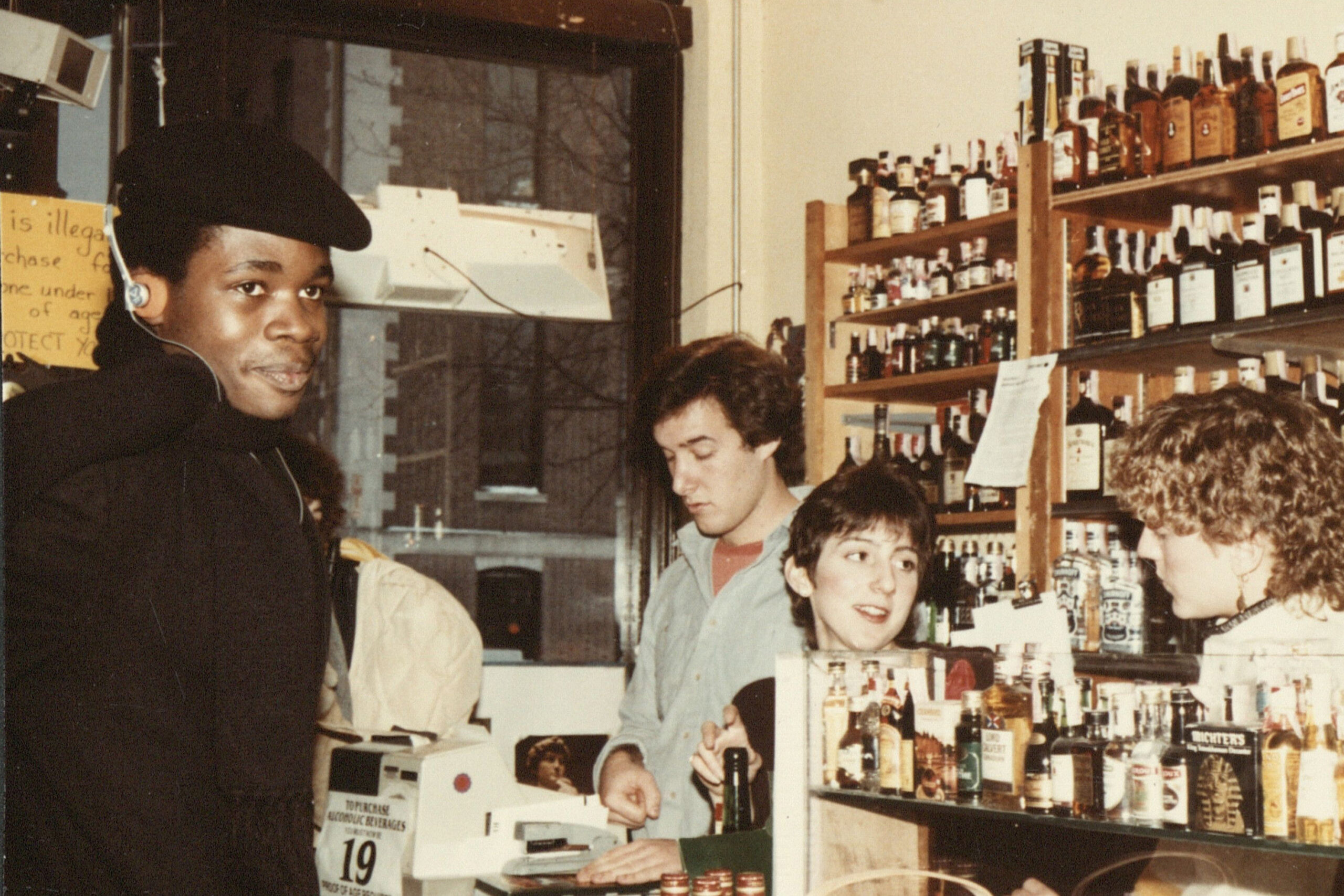
A customer waits to purchase something at a liquor store on Marshall Street in the early ’80s. The legal drinking age in New York was 18 until 1982. Courtesy of Special Collections Research Center
“I was just really sad to see it go. I thought it would be there forever,” Brudney said.
For Linda Epstein, it was as if no time had passed inside Faegan’s nearly 30 years after graduating. Epstein, who graduated SU in 1989, spent Sunday nights during her senior year at Faegan’s, a tradition they called “Senior Sundays.”
Every year, when Epstein returns to her alma mater for a Newhouse School of Public Communications visual communications workshop, she returns to Faegan’s with the group, showing fellow workshop coaches her favorite college bar.
“It was the social life,” Epstein said.
Amid the recycling of chain restaurants and closing of family businesses, Dellas said he’s fortunate to have seen Marshall Street’s evolution and keep Faegan’s and Varsity as Marshall Street’s constants.
“I don’t stop and say, ‘Wow, we’ve been there the longest of anybody.’ It’s just another day in my life, you know?” Dellas said.
When Epstein was at SU, she frequented Faegan’s, Varsity, Harry’s, Maggies, 44’s Tavern and Buggsy’s — all located in the Marshall Street vicinity. But the real place was Marshall Street itself.
“It felt like a place to be. It felt like home,” Epstein said. “You knew the stores, you knew the owners, you knew the restaurants and you knew what food you wanted, because you’ve gone there so many times.”
When Epstein thinks about Marshall Street, the first memory that pops into her head is the day SU’s men’s basketball team made it to the Final Four in 1987. Marshall Street was swarmed by SU student fans and city residents.
Not much changed on Marshall in April 2003, Brian Harrison said. The 2005 alum said he was at a friend’s house on Livingston Avenue when SU’s men’s basketball won the Final Four game against the University of Texas. Immediately after the win, Harrison ran down to Marshall Street with nearly 8,000 other people, he estimated. He found himself in Darwin’s Restaurant and Bar.
That was just the beginning of festivities. When SU defeated the University of Kansas and became the 2003 national champions, Harrison was watching the game through a livestream in the then-Carrier Dome. Harrison celebrated the same way he had two days prior — running down to M-Street.
“Nothing beats when your school wins at that level,” Harrison said. “Obviously it’s not the reason that you go to school, but it is one of the reasons why you go to a big school.”
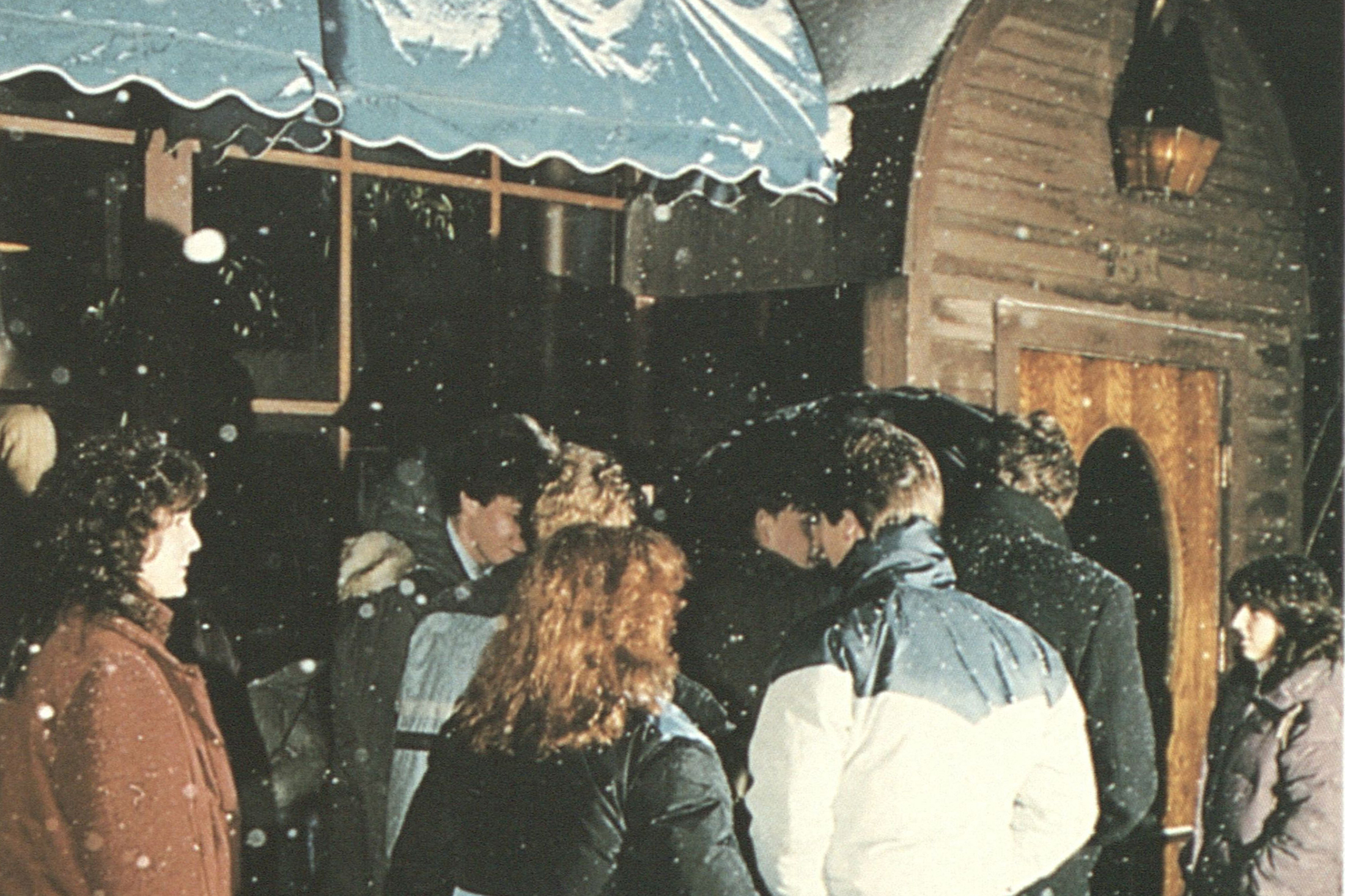
Customers wait in line to enter Faegan’s Cafe & Pub in 1979. Faegan’s still exists today. Courtesy of Special Collections Research Center
But this time around, there were police guarding storefronts, people climbing nearby trees and T-shirts set on fire.
Years ago, Marshall Street was unpaved, until receiving a $3.8 million “facelift” in 2001, according to a story from The Daily Orange that year.
Dellas said he feels fortunate Varsity and Faegan’s spots were in close proximity to the now-extinct grass area across the street, where the National Veterans Resource Center now stands.
“That’s where all the students would hang out, right across the street from the Varsity, that was ‘The Beach,’” he said. “You didn’t see that paved area. That was all just a hill of grass, and people used to hang out on it while eating Varsity.”
Though Berkowitz and Harrison both considered Cosmos a “greasy spoon” place, it was one of Harrison’s favorite restaurants on Marshall Street. Friday afternoons were spent at Darwin’s and Faegan’s. If there was a home game, Harrison’s Saturdays were spent at Varsity for postgame traditions with the marching band.
“My mom used to say, ‘Well, you didn’t make the dean’s list, but you got your name on the wall at Faegan’s,’” Harrison said. “It was like the center of all kinds of the social stuff that we did near or on campus.”
When Linda Landau was at SU from 1972 to 1976, Marshall Street’s bars didn’t just serve upperclassmen or graduate students, they also served underclassmen. Hours before Landau would walk into her Friday morning Newhouse School of Public Communications class her freshman year, she would venture into Marshall Street’s bars.
Then, the legal drinking age was 18 in New York. It was the height of counter culture, Landau said.
“Of course, Friday morning we were all shutting down the bars at 4 a.m. and showing up for class at 8 a.m. Let’s just say people would still be a little inebriated,” Landau said.
Landau’s mom, who attended SU in the 1940s, always told her stories of roaming Marshall Street and neighboring streets many nights, always finding herself at The Orange bar.
When Brudney attended SU in the late 2000s, “pretty much whatever you needed or wanted in a way you were going to find over on Marshall Street,” she said.
But when people like Berkowitz return to SU and their beloved eateries are replaced with new storefront signage, Marshall Street feels different. Every time Berkowitz passes by Taste of Asia, which used to be Cosmos, he cries.
Among SU alumni, there’s a shared feeling about what Marshall Street is presently.
“It’s not the same,” Berkowitz said.