Decade-old Central New York Diaper Bank helps address supply shortage
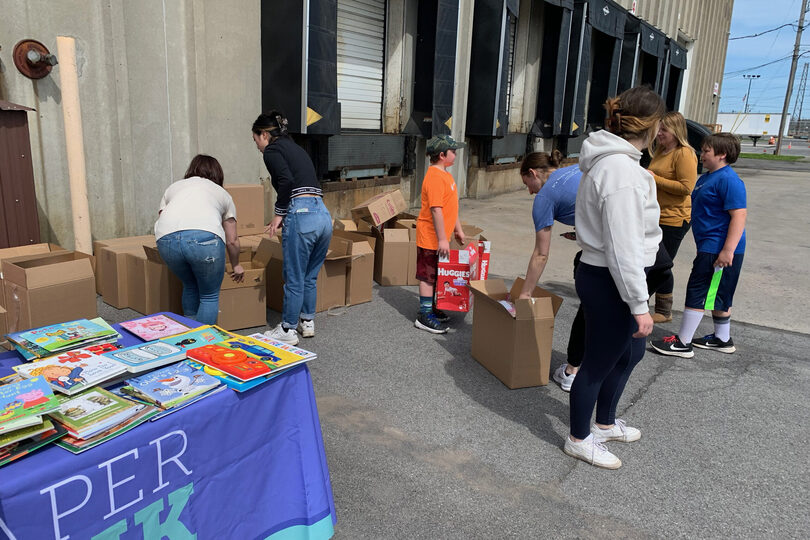
Michela Hugo began CNY Diaper Bank when she realized diapers aren’t covered by government assistance programs, making them an unaffordable luxury for some. The nonprofit has since partnered with DoorDash to lower diaper delivery fees. Courtesy of The Diaper Bank
Get the latest Syracuse news delivered right to your inbox.
Subscribe to our newsletter here.
When Michela Hugo founded the Central New York Diaper Bank 10 years ago, her youngest child was also in diapers.
Hugo had been thinking about diapers for a long time, not only because she’s a mother of three and was knee-deep in them herself, but also because she learned that diapers are not included in any government assistance programs.
Now, the diaper bank has 50 collaborators and distributes over 250,000 diapers a month through its partners. Operating out of its Pioneer Warehouse office and donation drop-off center in Liverpool, the bank organizes distributions with the help of volunteers.
Buying diapers for a newborn costs parents around $100 a month, according to the CNY Diaper Bank’s program manager, Melissa Grabowski. For her, they’re a “basic human need.”
“I couldn’t imagine as a mom, being in that position of just not being able to provide the most basic of needs,” Hugo said. “It was something that I just couldn’t let go of.”
Hugo surveyed other organizations, including food banks and health clinics in Syracuse, and found all expressed a significant need for diapers. So, she gathered friends who were interested in helping her, filed for nonprofit status and in May 2016, held her first diaper drive that collected around 23,000 diapers.
To support the program, Hugo found six partners. The next month, the bank distributed 6,000 diapers. In its 2025 annual report, the bank distributed 2,833,190 diapers, serving an average of 4,200 children in the region.
The diapers are distributed to a variety of organizations, Hugo said, including Upstate Golisano Children’s Hospital, The Salvation Army, schools and food banks in the area. The organizations then distribute the diapers to families in need across the city.
“I’ve seen people so dependent on what we are able to distribute,” said Inez Albanese, who’s volunteered at the diaper bank for the past three years.
Albanese remembers one man at a food bank who arrived to pick up diapers. He was caring for seven grandchildren, all under the age of 5, struggling under the weight of their care.
“It was so rewarding to be able to say, ‘Well, we have diapers that we can give you,’” Albanese said.
While the bank has grown and fulfilled the needs of many, demand has also grown, Hugo said.
“When I first started there, we were always able to fill the shelves pretty easily,” Albanese said. “We can’t wrap (the diapers) fast enough and get them on the shelves.”
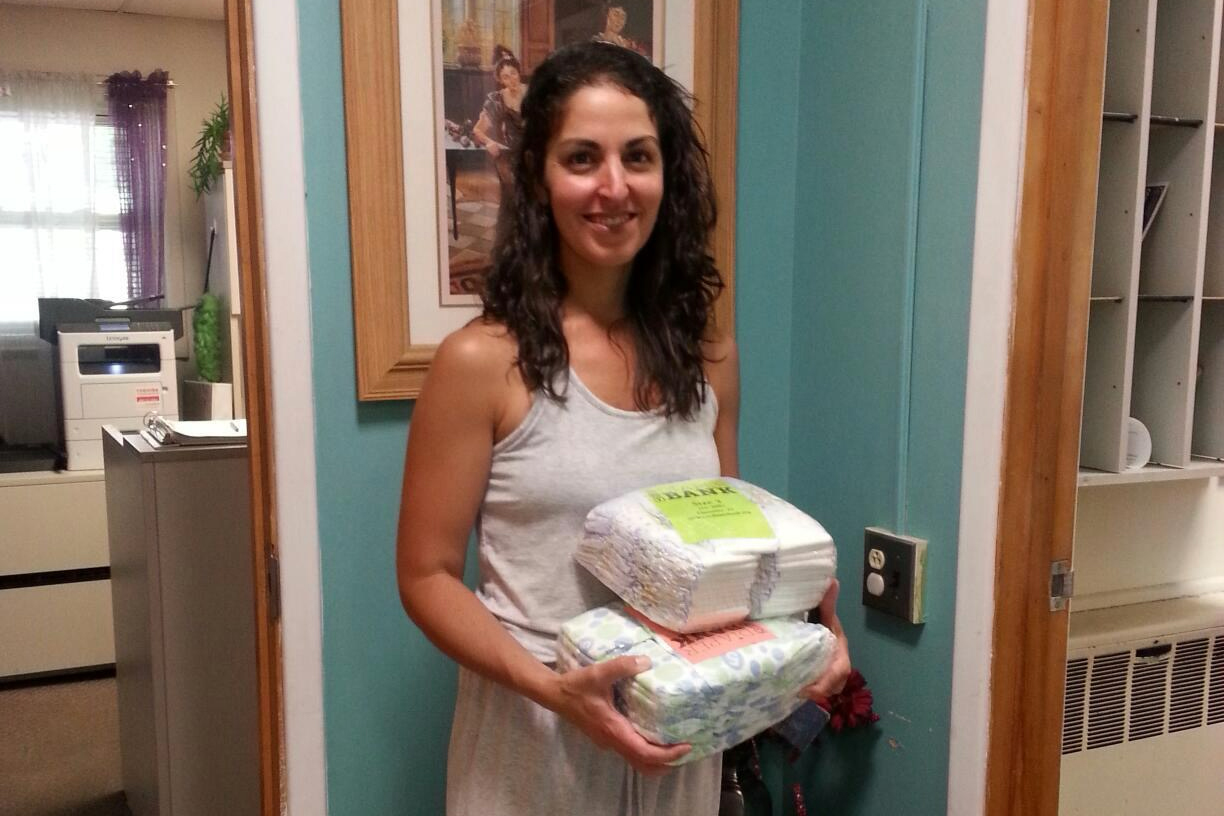
Michela Hugo founded the Central New York Diaper Bank 10 years ago, when her youngest child was also in diapers.
Courtesy of The Diaper Bank
The diaper bank has found different ways to aid rising demand. The state’s partnership through a program known as Temporary Assistance for Needy Families works to help families experiencing financial hardship pay for food, housing, child care and home energy.
New York state provides the funding for families on temporary assistance, which Hugo said is applicable to about 700 to 1,000 families in Onondaga County. Families enrolled in the program can receive a box of 200 diapers a month for each child in need.
The funding from TANF also includes a DoorDash program for nonprofits that helps distribute diapers to families who lack transportation to diaper distribution centers, a common issue in Syracuse, with families only paying the $4 delivery fee.
“That’s been really cool to provide that convenience to families who, for so often, transportation is such a big barrier,” Hugo said.
Nationally, Grabowski said recent lobbying has been more successful, pointing to the TANF initiative as an example, along with additional state funding that allows the bank to purchase diapers at the lowest possible cost.
“I think that conversation has been brought up enough where there are people now in these decision-making positions that recognize the need,” Grabowski said.
This year marks the second time diaper banks have been included in New York state’s yearly budget, as the largest such bank in the state.
However, Grabowski, Hugo and Albanese all emphasized that the bank is still not where it needs to be. There must be greater awareness on a local level.
Albanese, who’s lived in Syracuse her entire life, said she wasn’t aware of the scale of the issue before she began volunteering three years ago. She said she still thinks that locally, not enough people know about families needing diapers.
“People aren’t aware of a lot of the things that they don’t need, you know?” Albanese said.
Diapers are essential for child health beyond comfort. Babies who lack diapers are more likely to develop urinary tract infections, have more frequent doctor visits and often develop painful rashes, according to the National Diaper Bank Network. Mothers, too, experience negative effects due to a lack of a diaper supply, like increased stress and poor sleep.
“We could have way more reach,” Grabowski said, “but we rely heavily on support from the community.”
Grabowski said that, despite state and federal contributions, the diaper bank is constantly struggling to find funding. In addition to the vast amount of diapers that are donated to the bank, she said it purchases five truckloads of diapers a year.
Ten years since the bank’s beginning, Hugo’s children aren’t in diapers anymore, and the bank has gotten past its growing pains as well, expanding from a small operation to helping families across Onondaga County.
Yet for Hugo, it’s still not enough. She wants diapers to ultimately be distributed without the bank’s help.
“I really think my goal in this is to not have to be in operation anymore,” Hugo said.