


Get the latest Syracuse news delivered right to your inbox.
Subscribe to our newsletter here.
UPDATE: This story was updated at 10:59 a.m. EST on Thursday, April 23, 2026.
Head south, past South Campus, to a part of Syracuse you’ve probably never seen before. Turn into the SUNY ESF Lafayette Road Experiment Station and drive past a barn and a greenhouse. Turn right onto the gravel road and drive through the forest to the back of the property. In the clearing right behind the tree line, you’ll find a hive of activity: an ESF Timbersports team practice.
The sun is starting to set on a scene that feels like it’s not just from beyond University Hill, but from an entirely different state — maybe somewhere in the Pacific Northwest. Here, ESF students trade backpacks for razor-sharp axes slung over their shoulders, and their sneakers for spiked cleats layered with chainmail shin guards to reduce the damage caused by a wayward swing.
The club team, founded in 1912, is preparing for their upcoming meet, the Annual Northeast Collegiate Woodsmen Conclave, this weekend. ESF is hosting the regional championship for the first time, drawing over 40 timbersports teams from across the Northeast.
The Woodsmen are preparing by analyzing their performance at their meet from last weekend, explained senior Luke Myers, the captain of the men’s team and vice president — occasionally interrupted by the sounds of chainsaws hefted by teammates.
“We are very much gritty teams,” Myers said. “All the other teams can tend to comply to things. We really take things on the chin when we lose and try to get better.”
As Myers walks around the clearing, he directs team members on what to practice and when, splitting their time between individual and team events. It’s a delicate balance between the sport’s 19 possible events and the 40 team members. Only 24 woodsmen, members of the men’s and women’s A teams and two Jack and Jill (men and women) teams, compete at each meet.
At meets, the top time for each event receives 100 points, with slower times bringing in lower points. The points for each event are totaled at the end of the meet to determine the winner.
The clearing is carpeted with wood shavings and full of activity, centered around a fire barrel where the woodsmen warm up on an uncharacteristically chilly April evening. Each event has a dedicated space, and woodsmen rotate through them based on what they need to work on, coach and ESF class of 2022 alum Emily Ellithorpe said. It’s a balance between preparing the competitors for the weekend and priming underclassmen to compete in later years, she said.
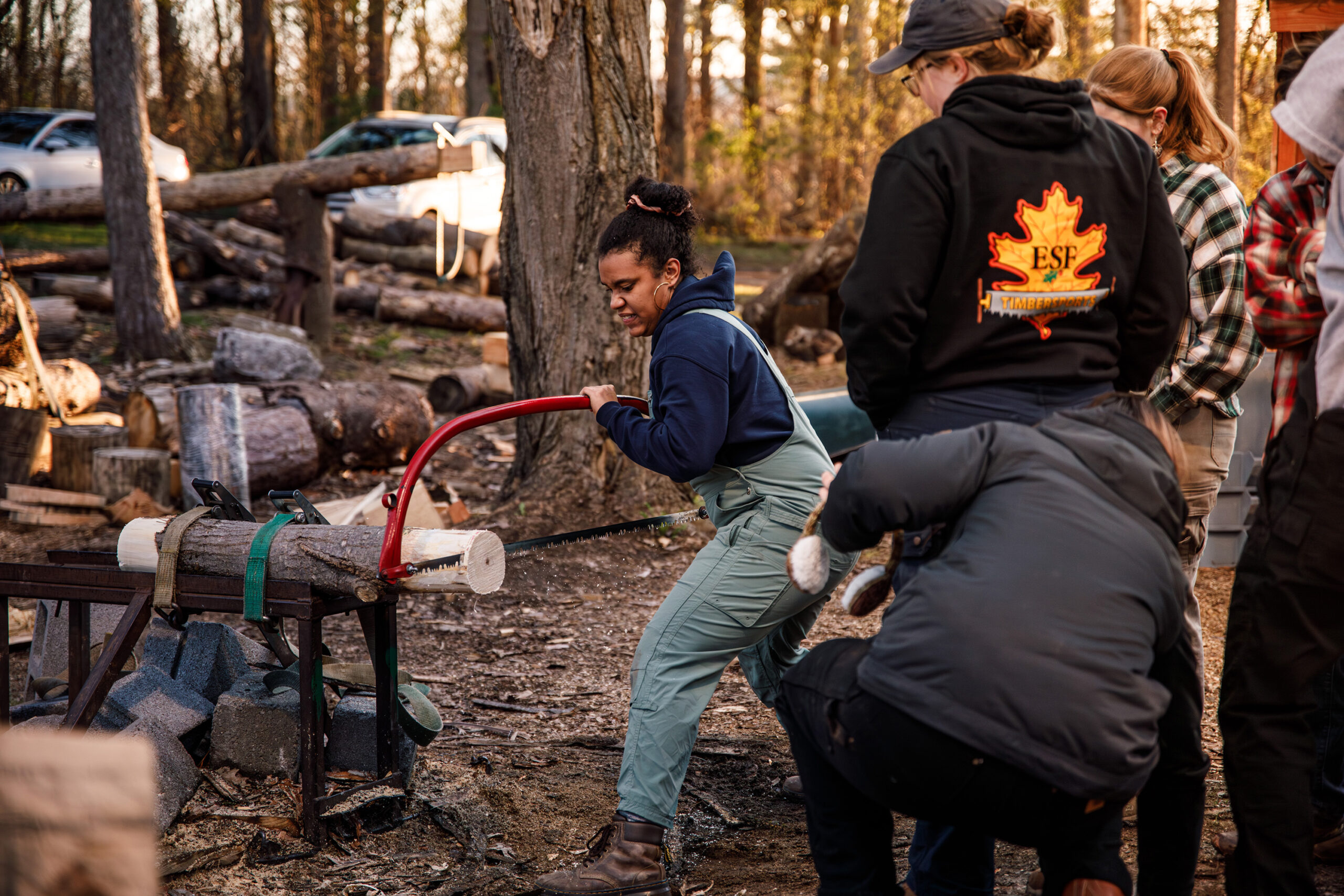
An ESF woodsman practices bow sawing. Teammates often gather around to encourage and coach each other as they practice. Avery Magee | Photo Editor
The team has been successful at recent meets, Myers said. The women’s team consistently places first or second, and the men’s has climbed from fifth at their first meet to first at their most recent competition last weekend. They’re hoping to replicate the performance at the upcoming meet, Myers said.
“We have to be calmer than the other teams,” President Sophia Ryan said, looking up from marking a log with a crayon to prepare it for underhand chop.
“The other teams tend to go into meets really psyched out and hyped up, really angry, and they tend to get really frazzled,” Ryan said. “And our teams do a really good job at staying calm, keeping our heads on our body and not freaking out, not letting little things trip us up.”
For underhand chop, a woodsman straddles a log and chops wedges out of it, following marks like the ones Ryan is drawing. The marks represent the most efficient path for an ax, which must be swung at exactly the right angle.
Once those marks are made, it’s time to move away.
“I’d take a step, because he’s gonna swing that ax,” Myers warns.
Most timbersports events are timed, which gets adrenaline pumping, ESF senior Kennon Gardner said. In the full-team bow saw event, all six members of the team line up to cut slices — called cookies — off of a log, rapidly handing the saw off to the next person as soon as they finish.
“Everybody’s screaming the whole time,” Gardner said.
A few seconds can make or break an event, Myers said as he watched a woodsman practice the start of her stock saw event over and over again. The woodsman wears noise cancelling headphones, protective eyewear and overalls. She kneels in front of a log ratchet strapped to a platform and rests her hands on top of it.
Like the official in a track race, a teammate calls her to start. She picks up the chainsaw and places its teeth on the log as quickly as she can, stopping short of cutting the wood.
She practices the motion again and again. If she doesn’t make the necessary cuts within the six inch allotment of wood, she’ll be disqualified. If she sets the saw too far in and has to pick it back up to reset, she’s already lost.
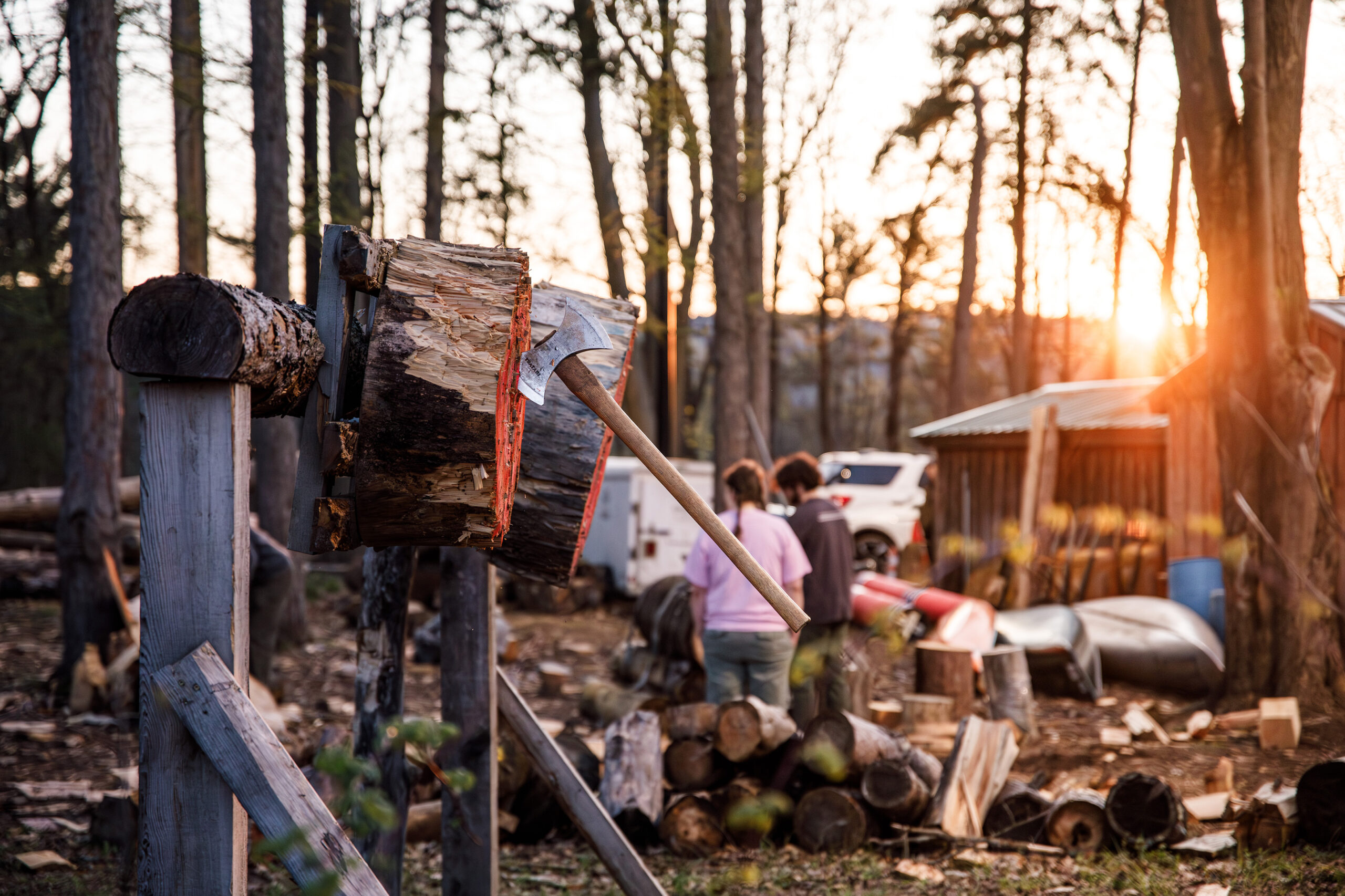
An ax hits a throwing target. Ax throwing is one of the few untimed events in timbersports, requiring mental focus under pressure for a perfect bullseye. Avery Magee | Photo Editor
Ax throwing is one of the few untimed timbersports events. Gardner picked it up this semester after the former men’s A team ax thrower left to study abroad. Gardner was bad at first, he said, but he took home an ax throwing target over winter break to hone his skills.
Though it’s not done under a time crunch, ax throwing gets adrenaline pumping in a different way, Gardner said.
“It’s how to not psych yourself out,” Gardner said. “Like, to not get up to the line and freak out that I have to hit it. It has to be perfect. And then you’re just rigid, tense, not dialed in on what you’re actually doing,” he said.
At a meet, an ax thrower is allotted one practice throw and five throws. When Gardner is competing at meets, he reevaluates after his practice throw to see what he needs to adjust based on the position of the ax on the target. If it’s too high, he knows his hips are tight. If it’s too low, he needs to adjust the position of his hands when he releases the ax.
“I grew up two hours north of here in a real small town and so I’ve been splitting firewood my whole life,” Gardner said. “It kind of felt like when I came to the field, ‘Oh, I get to do the work that I like doing and do it for fun.’”
Unlike Gardner, most who join the team are former athletes from sports like rowing or track and don’t have any prior experience with timbersports. Myers is from Long Island and didn’t grow up chopping any wood, he said.
Myers saw the team on ESF’s website and “showed up” his freshman fall. He points to a friend across the clearing — they’ve been doubles event partners for four years now. The team is a real community, he said.
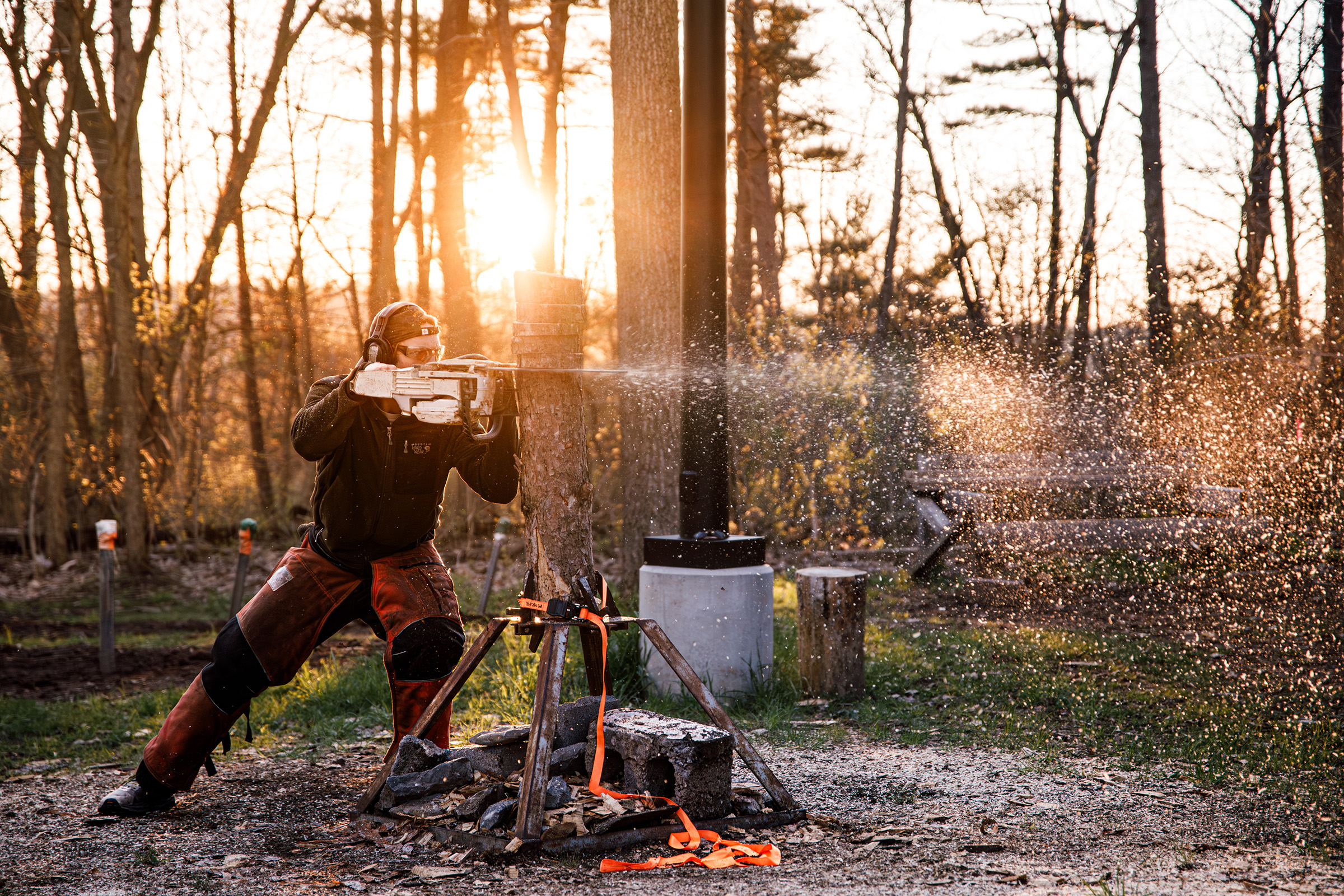
An ESF woodsman practices the cookie cut event. In cookie cut, the competitor tries to complete as many horizontal slices as possible in a given amount of time — 15-20 cuts is considered impressive. Avery Magee | Photo Editor
“Nice job,” he calls out to someone just completing a cookie cut — cutting as many horizontal cookies from the log as possible in a given amount of time while keeping them stacked.
“So that was seven or eight. A good stack will be like, upwards of 15 to 20. Yeah, he’s new,” Myers said.
Freshmen who are new to the team find their events mostly based on what the team needs, Ellithorpe said. Bigger, more muscular people tend to get put on events like single buck, she said. That’s how ESF junior James Dziergas, who didn’t have any prior timbersports experience, ended up specializing in what he described as “meathead” events: ones where the main requirements are being strong and fast enough.
Dziergas balances bodybuilding with timbersports, which helps with events like standing block chop and underhand chop. Though not all of the men’s A team are bodybuilders, they often lift together to build strength, endurance and their team bond. That connection is what keeps Dziergas coming back to the team, he said.
“I’m just here for my friends, I bodybuild mostly full time,” Dziergas said. “This is something that I love to do, and I love all the people that I do it with. I’m willing to sacrifice a little bit of progress in the gym so I can hang out with all my friends. That’s what I love about this team.”
That team connection is especially important for fire build, a technique-based event. Dziergas and Gardner start by gathering the limited materials they need — a few logs, a tin can filled with water and soap, matches, an ax and a knife.
Dziergas stands poised with the ax while Gardner kneels. When the timer starts, they spring into action: Dziergas splits the wood then tosses it to Gardner, who immediately slices it into smaller kindling, holding the knife horizontally and pressing down to slice the wood like a block of cheese. The tools they’re using are incredibly sharp.
Gardner arranges the pieces into a small log cabin shape and lights the middle. Once it’s a few inches tall, they place the can on the top and both get on their stomachs, cheeks pressed to the ground with their elbows propped up to their sides.
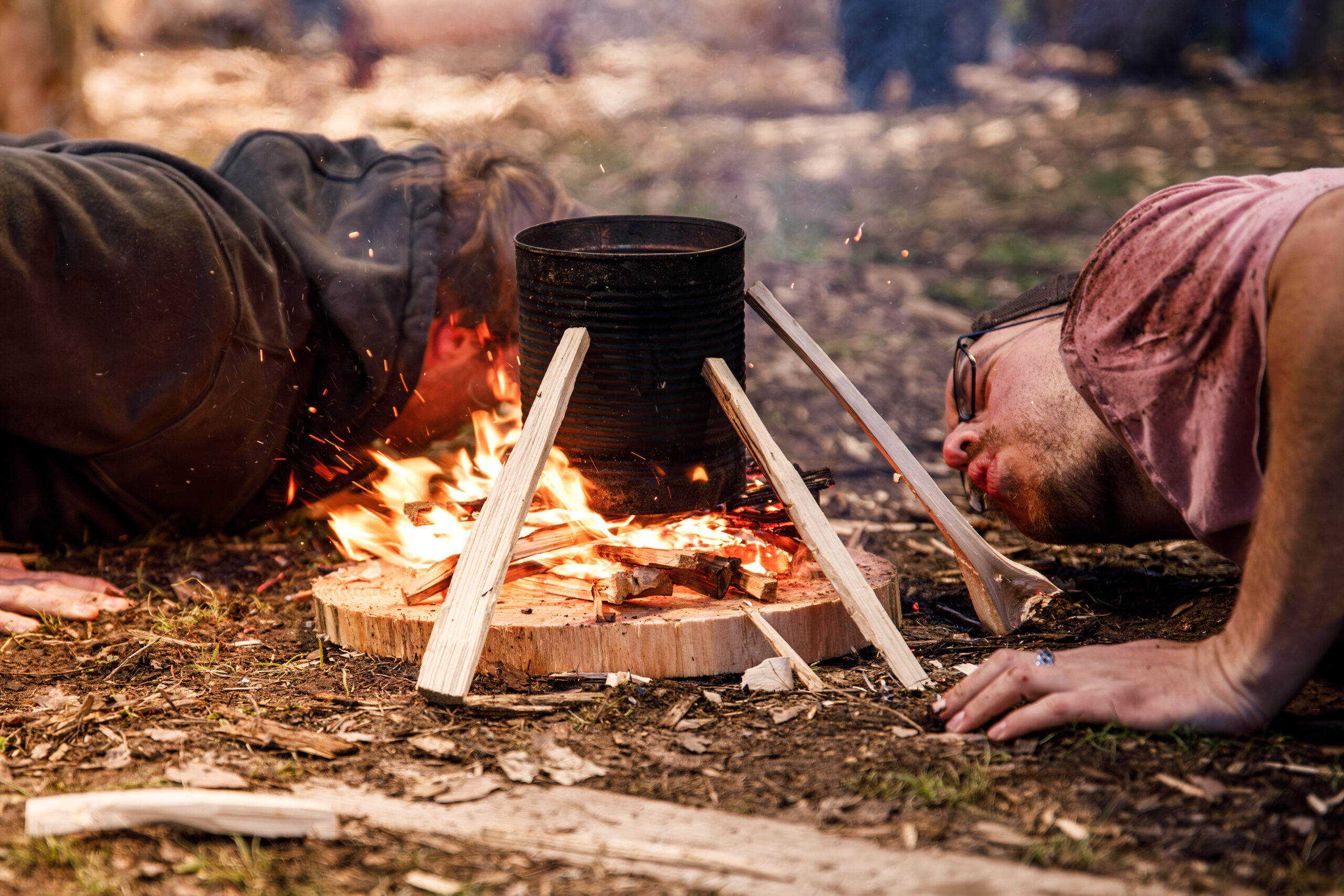
James Dziergas and Kennon Gardner practice fire building, a doubles event. After building a small log cabin fire, they use their breath to keep the flame underneath the can until water inside boils over. Avery Magee | Photo Editor
They start to alternate blowing on the small flame, pitching their heads back over their shoulders to gulp breaths of air and immediately blowing them back into the fire, like human bellows. The goal is to use breath to keep heat underneath the can, making the water boil as quickly as possible.
Gardner calls out “flip” and they simultaneously scramble to opposite sides of the fire like wrestlers doing a drill. They don’t talk much, and they don’t need to. They’re completely in rhythm.
“It’s a little unspoken,” Dziergas said. “It was rough at the beginning of the semester, just because you’re trying to get a vibe off the other person and figure out how the other person’s brain works.”
As woodsmen warm their hands around the central bonfire, it’s easy to tell who’s just practiced a fire build — their palms are caked in mud from scrambling on the ground.
Charlie Harkness, a sophomore and a women’s team alternate, is standing around the fire and can’t do much else — she’s on crutches after dislocating her knee while substituting in for the women’s A team at the woodsmen’s last meet during the wood splitting event.
Things turned out alright though, she said. Her knee “popped right back in” as she fell, and the women’s A team ended up winning.
Injuries like Harkness’ aren’t common on the team, Ryan said. Usually when people are injured it’s because they’re misusing the equipment, she said, cutting their hands or fingers on axes or saws.
Harkness is watching someone chainsaw two pieces of wood off of a log for the stock saw event. It was an impressively “smooth” run, Harkness said. The goal is to be as quick and smooth as possible without breaking any cookies.
Timbersports was featured heavily in Harkness’ supplemental essays for ESF. She’d never done sports before, but promised to show up to every practice and event in her essays. Once she got to try it, it was “invigorating,” she said.
Encouraging calls like “yeah buddy,” sound from athlete to athlete throughout the practice. That’s part of the environment that keeps everyone coming back to the woods.
“We have a really, really great community, really supportive of each other and really dedicated to what we do,” Ryan said. “It’s super fun and very, very competitive. It’s so niche, and it’s kind of addicting to get good at really weird, niche skills. And you meet weird people. Weird in a good way.”
Video by Avery Magee | Photo Editor
CORRECTION: A previous version of this article stated that Charlie Harkness dislocated her knee during the obstacle pole event. Harkness injured herself in the wood splitting event. The Daily Orange regrets this error.

Published on April 22, 2026 at 11:21 pm