Non-tenured professors, postdoctoral scholars work to form faculty union
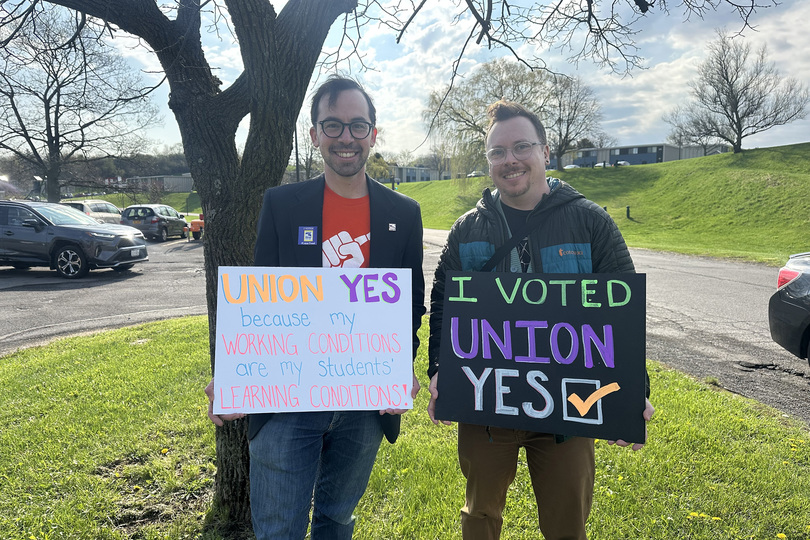
Ariel Gratch (left) and Rusty Bartels, both organizers for Syracuse Academic Workers United, stand together after completing their union vote Wednesday. If approved, the union will represent 350 non-tenured and post doctoral faculty members at SU. Courtesy of Ariel Gratch
Get the latest Syracuse news delivered right to your inbox.
Subscribe to our newsletter here.
Between teaching four classes a semester and expectations beyond the classroom, Ariel Gratch, an assistant teaching professor at Syracuse University, said he struggles to give his 200 students the attention they deserve.
When he applied for a position at SU’s Communications and Rhetorical Studies Department last year, the teaching load appeared to have “extra expectations,” but seemed “reasonable.” But after taking the job, Gratch, like other SU faculty, faced a “heavier” teaching load than he initially expected.
“It was clear that the only thing that (SU) would actually count as teaching would be my in-class time, which was already higher than what is reasonable, and I was still expecting to do all the other things,” Gratch said. “So at that point, I said, ‘Well, if I’m gonna stay here, these working conditions are not good for my mental health, my physical health. I can’t be the best teacher that I want to be under these conditions.’”
Now, after almost two years at SU, Gratch is working alongside other SU professors to organize the campus’s first union for full-time non-tenure-track faculty and postdoctoral researchers. The prospective union, named Syracuse Academic Workers United, aims to protect its members’ job security and initiate changes for teaching loads across colleges, Gratch said.
Non-tenure faculty and postdoctoral scholars eligible for membership began voting to unionize Wednesday and continued until Thursday at 4 p.m. The prospective union now awaits the final vote from its around 350 participating faculty and researchers.
After finding commonality between non-tenured faculty and postdoctoral scholars, Gratch said “momentum picked up” for the movement and that it received an “overwhelming positive response” from eligible faculty and postdoctoral researchers.
Organizers began working in the fall to gain traction for the prospective union through Service Employees International Union Local 200United. The local chapter of SEIU currently represents thousands of facilities workers, graduate workers, academic and technical staff and student employees in SU’s food service and libraries.
Since a nationwide shift from a majority tenured-faculty campus, SU is one of hundreds of colleges and universities across the country where faculty are attempting to unionize. According to National Education Association Today, about 83% of new faculty unions include non-tenured faculty, contingent or adjunct faculty.
In a statement to The Daily Orange, Sarah Scalese, SU’s Vice President for Communications, said the university “respects the important role of labor unions,” but will refrain from taking a formal position on the union vote.
“If a union is elected as the exclusive bargaining representative for either or both groups, the university will negotiate in good faith,” Scalese said in the statement.
Over 60 faculty members, including associate teaching professors, professors of practice and postdoctoral members across SU signed a “Dear Colleagues” letter, urging university support across all departments.
The letter, obtained by The D.O., highlights challenges organizers seek to address through the union, including “academic and intellectual” protection for non-tenured faculty members, job security for postdocs and acknowledgment of “teaching and service labor.”
Another letter, signed by over 75 tenured and tenure-stream faculty members, urges acting Chancellor Mike Haynie, Provost Lois Agnew and SU’s Board of Trustees to: “Commit to a stance of neutrality and provide a fair process for any and all NTT faculty and postdocs on campus to form a union.”
Jiwoon Yulee, an assistant teaching professor in the Women and Gender Studies Department, emphasized that, while the “Dear Colleagues” letter highlights the union’s primary goals, there is a need for “more intense conversations” surrounding the identified concerns.
In the few months she worked with faculty at SU and representatives from SEIU, she said the efforts “unfolded like a storm,” leading to a “quick, surprisingly successful” campaign. As a researcher focused on labor movements, she said she was “very passionate” about helping organize.
“This is my first time being the person who is leading the campaign, and at the same time, I’ve been reflecting back on what I studied and what I’ve been writing about,” Yulee said. “So it was kind of a very intense, meaningful experience to me.”
Due to the number of students Yulee teaches per semester — which she said ranges from 80 to 100 — and four classes a week, she said it forces her to prepare teaching plans on weekends, outside her work week. This led to Yulee working on weekends, from Friday to Sunday, to grade and respond to student emails, she said, leaving her with no time to focus on her own research and book contract.
“I’ve been just doing this in the past few years, which turned out to be completely unsustainable as a scholar,” Yulee said. “My daily routine became almost impossible to accommodate all the tasks that I’ve been involved in as a productive scholar in my field.”
Yulee pointed to the 4/4 teaching arrangement — where faculty are responsible for four courses per semester out of the academic year — which has been a main concern in her experience at SU and with the union.
“When I was teaching 3/3, somehow it was manageable, but when it turned to 4/4, it changed my everyday routine completely,” Yulee said. “I don’t know what’s the level of intensity between three and four, but somehow it really created kind of a vicious cycle in my daily routine.”
Within administration, Scalese referenced attempts to address organizer concerns within drafts of a proposed faculty workload policy, which was discussed at an April 15 University Senate meeting.
“The policy is intentionally designed to place most decision-making authority at the school and college level, where faculty are best positioned to define expectations within their disciplines,” Scalese said in the statement. “The university is committed to continuing to engage with faculty as schools and colleges implement their individual workload policies.”
Scalese said the policy was informed by input from faculty council chairs and those whom they represent, and that SU will “soon” publish the draft of the policy to hear comments from faculty and students.
Before the union vote, Yulee said she, along with other organizers, attempted to meet with every non-tenured and postdoc faculty member at SU to hear their thoughts and input to inform the requests.
Rusty Bartels, an associate teaching professor also working on the organizing team, said the policy only became public knowledge after efforts to unionize had already begun at SU.
“The faculty workload policy document is separate and distinctive from what we are doing, but part of (conversations) as we kind of think about things like workload and class sizes,” Bartels said. “These would be conversations that the union through bargaining would be having with the university.”
Gratch said organizers are working to secure representatives from a majority of the schools at SU, noting that some asked to “not be included in the union.”
“We respect that, so they’re not going to be part of the union,” Gratch said. “If they ever decide if they want to, they’ll be welcomed back in terms of the organizing committee.”
Wednesday morning, ahead of the union vote, Senior Associate Dean of the College of Arts and Sciences Karen Doherty sent an email to A&S faculty containing “additional considerations” about voting to unionize ahead of the election.
“You have the right to make your own choice about whether to support or join a union,” Doherty wrote in the email obtained by The D.O. “We want to share some information about the benefits provided by the University, as well as the rules, costs, and risks involved with union membership.”
Expanding upon the “rules, costs, and risks,” Doherty highlighted required union dues, and the possibility for members to receive more, less or no change to pay, following collective bargaining. “Regardless of whether bargaining results in better, the same, or worse employment terms,” she said union members will “likely” be required to pay dues.
In an open letter sent to The D.O., executive board members of SUs chapter of the American Association of University Professors said the email from Doherty includes “many key anti-labor talking points” and could be seen as an “act of intimidation” against their colleagues.
The letter emphasizes the “difficult decisions” voters face when deciding the “best course of action to move forward with their professional lives.”
“By communicating your office’s disapproval of their choices in such stark terms, the clear conclusion is that your office would view with disfavor anyone who promotes or elects to form a union,” AAUP’s executive board wrote in the letter.
AAUP’s executive board also said Doherty’s email counters the “values” of SU and is an “affront” to faculty members eligible to vote.
“We urge you to rescind the notice and to make clear to the union-eligible faculty involved that there is no potential threat of retaliation for participating in the union election or choosing to form a union,” AAUP’s executive board wrote.
Doherty did not immediately respond to The D.O.’s request for comment.
If the union is successful following Wednesday and Thursday’s vote, it will begin conversations about creating a bargaining survey to hear opinions about membership and set the groundwork for an initial contract with SU.
“The National Labor Relations Act requires both parties to bargain in good faith, but does not require either party to agree to any particular proposal,” Scalese wrote
Ahead of the vote, Gratch, Bartels and Yulee all described their outlook as “hopeful.”
Gratch, who found his passion for teaching through faculty at his alma mater, said he hopes the creation of Syracuse Academic Workers United will allow him to focus on the part of his job that he loves the most.
“We’re teaching faculty because we love teaching. We love students,” Gratch said. “That’s my problem. We’re unionizing because we don’t have the time to be the teachers that we know we can be.”