For 25 years, Zamboni Revolution members keep jokes running through improv
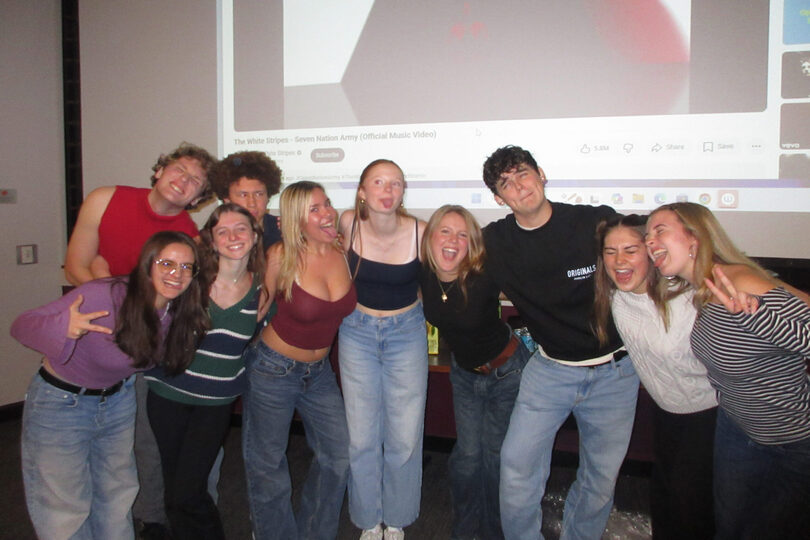
Members of Zamboni Revolution make funny faces. The improvisation comedy group practices twice a week and performs two to three times per semester. Courtesy of Alec Sturm
Get the latest Syracuse news delivered right to your inbox.
Subscribe to our newsletter here.
UPDATE: This story was updated at 11:56 a.m. on May 1, 2026.
Living in Oklahoma and New Jersey, Dylan Welch and Ronan Mansfield are now living nearly 1,500 miles apart, but their friendship still runs deep.
While at Syracuse University, Mansfield earned the nickname “mini Dylan,” not only because Mansfield is younger than Welch, but because they are both tall, brunette, share similar humor and were always seen together throughout their time at SU.
But if it wasn’t for Zamboni Revolution, the two 2025 graduates wouldn’t have been friends.
“Ronan was kind of my right-hand man when I was president last year, and he was always really helpful. He’s one of many lifelong friends that I’ve made out of Zamboni,” Welch said.
On April 18, Zamboni Revolution, an improvisation comedy club, celebrated its 25th anniversary. The group was started in 2001 by Matthew Artus, Justin Weinberger, Dan Reitz and John Kazanjian. They were inspired to start the club by Newhouse School of Public Communications professor Richard Dubin, Weinberger said.
Twenty-five years later, Zamboni Revolution still practices twice a week and performs two to three times per semester.
During their two-hour practices, the group spends the first 10 minutes catching up on day-to-day events before diving into improv. Then, the 11 members act out a scene one by one. While there aren’t many guidelines on how each person should perform a scene, there is one rule that everyone has to follow: keep the joke running.
“A lot of improv is rolling with the punches,” SU senior and Zamboni Revolution president Alec Sturm said. “Everyone has a different idea in their head about where the scene is gonna go. You have to build that continuity and be able to be malleable.”
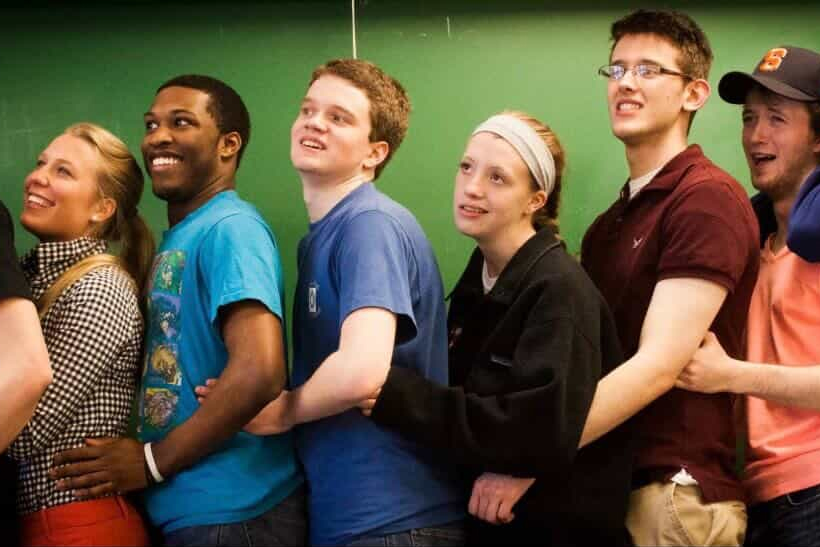
Former Zamboni Revolution members interlock arms. Successful comedians and artists like Mary Shalaby got their start in the club. Courtesy of Alec Sturm
During the fall of his freshman year, Sturm saw a flyer on a Bird Library wall. That was the start of his Zamboni Revolution tenure. Sturm didn’t have any improv or comedy experience beforehand, but he still wanted to try out. After an unfortunate mistake with a buried email thread, Sturm wasn’t able to attend the group’s callback.
Then, it happened again. When Sturm auditioned the following semester, the club was only looking for one member and, unfortunately, he didn’t get in for a second time.
Understandably, Sturm lost his motivation to try out for the group again. But when Sturm ran into Mary Shalaby, Zamboni Revolution’s president at the time, Shalaby encouraged Sturm to join. He had some reservations.
“I said, ‘Mary, I really don’t know if I can do it. My pride has been hit a few times.’ But she said, ‘No, no, I really want you to.’ And so I did,” Sturm said.
Three years later, Sturm is now its president.
Sturm initially found out the group was turning 25 when a former member came across the 2001 yearbook as he was working with archival pieces at the Special Collections Resource Center. On April 10, Sturm turned the group’s last show into a 25th anniversary celebration while honoring graduating seniors with a 95-photo slideshow sent from alumni and current members.
Throughout the years, Zamboni Revolution has produced successful comedians and artists like Mary Shalaby, whose witty humor propelled her social media stardom and landed her an upcoming NBC pilot. Other alumni include Dan Gurewitch, comedy writer known for his former Emmy-winning work on “Last Week Tonight with John Oliver,” and Josh Simpson, who writes sketches for pregame shows on Fox Sports’ NFL Sundays.
Simpson joined Zamboni Revolution during his sophomore year in 2003. While Simpson had always enjoyed comedy, he’d never thought of joining an improv club until visiting several shows in Milwaukee. With some comedy experience, Simpson was accepted into Zamboni Revolution on his first try.
Initially, Zamboni Revolution focused on short-form improv. Between two people, one person would say a line, and the next person would start their line with the last letter from the previous person’s sentence.
However, when Simpson and the rest of the group visited New York City in 2004 to watch other improval troupes perform, they saw a performance from the Upright Citizens Brigade, which focused on long-form comedy.
When Simpson, Gurewitch and David Young took over Zamboni Revolution the following year, the three decided to pursue long-form improv instead, which is what the group currently does.
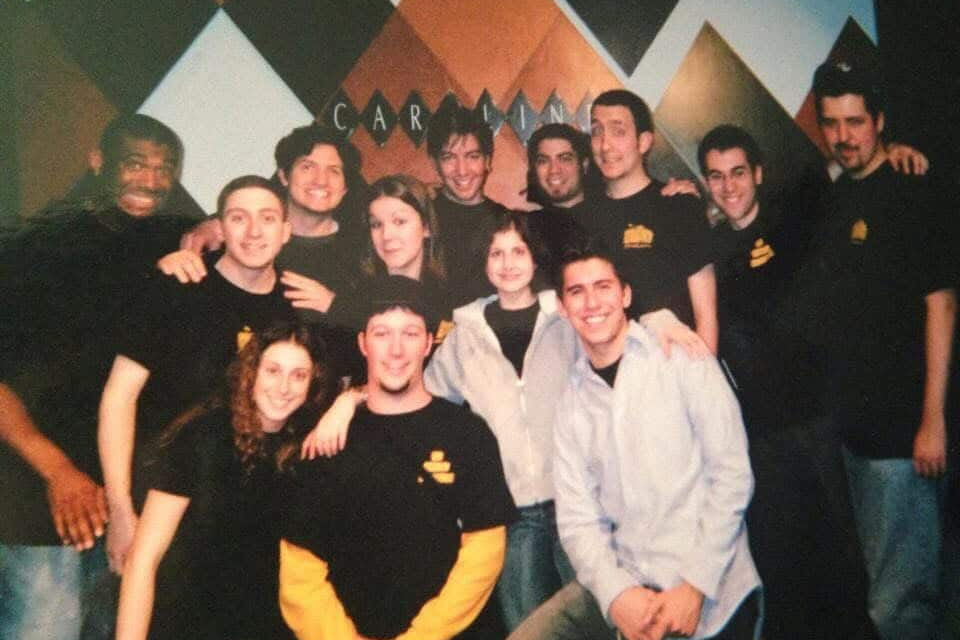
Members of Zamboni Revolution smile for a group photo in 2003. The improv comedy troupe performed at Carolines on Broadway. Courtesy of Alec Sturm
With Zamboni Revolution’s current model, the group has to be quick to think of a scene on the spot. In a typical show, the group asks an audience member to give them a random word. Every member of Zamboni Revolution creates and acts out a 60 to 90-second scene based on the word — something they also emulate in practice.
It was hard to pick out what sophomore Ariana Plotas’ favorite scene is because of how quickly each scene moves. However, an exception was a scene from her friend and fellow Zamboni Revolution member, junior Ava Aguero.
“She’d whip out a typewriter, imaginary, and start clacking away. There’s so much you could do off of that,” Plotas said. “Everyone could ad lib the sounds of the typewriter. We could form a class, like so much could be done. But it cracks me up to no end.”
Thanks to Zamboni Revolution, Simpson, along with other alumni, is pursuing comedy full-time. Even if comedy isn’t their dream career, members have found other benefits of being part of the club.
Welch, who moved on to law school after graduating from SU, said being in Zamboni Revolution helped him get comfortable with public speaking, especially when it comes to practicing for legal cases and being able to talk in front of a judge.
Mansfield, a waiter, said being part of Zamboni Revolution allowed him to think on his feet quickly, no matter the situation, which is what a typical Zamboni Revolution performance looks like.
Plotas plans on going into medicine after SU, where she’s now taking EMT classes. In those classes, she learns about crisis management and strategic thinking. Being part of Zamboni Revolution has helped her handle tough situations more easily than others.
“While shadowing on ride times, a lot of it can be related to the things that I’ve been implementing with the group in improv, that type of quick thinking,” Plotas said. “But they’re not just quick-thinking, they’re random thoughts. Intentional quick thinking formed by times and trials of gut reactions that really, truly work.”
Unlike Plotas, Simpson is not only a writer for Fox Sports but an actor who stars in the “PBC Series,” a workplace comedy that’s available on YouTube. Everyone in Zamboni Revolution had the same level of passion for improv as Simpson did. He not only had countless memories with the group, but was also inspired to go into comedy because of it. 20 years after Simpson graduated from SU, his success is indebted to Zamboni Revolution, he said.
“When there’s people that are on the same wavelength and have the right energy as you, embrace that. Because that’s not as prevalent when you get older, in your late 20s and 30s,” Simpson said. “Sometimes you really luck out, that group that you find will be like an extraordinary one. And I do think that was the case for Zamboni Revolution. It was really an extraordinary group of people.”
Disclaimer: Alec Sturm is a Staff Writer for The Daily Orange. Sturm did not influence the editorial content of this article.
CORRECTION: A previous version of this article misstated how Alec Sturm found out about Zamboni Revolution’s 25th anniversary. It wasn’t through a friend, it was a former member. The Daily Orange regrets this error.