A sign led Father Gerry to SU. Now, it’s ‘bittersweet’ to leave.
A storm drain bearing Father Gerry’s last name, “Waterman” first convinced him to serve at Syracuse University. Tara Deluca | Photo Editor
Get the latest Syracuse news delivered right to your inbox.
Subscribe to our newsletter here.
When Father Gerry Waterman was a chaplain at Elon University, Syracuse University’s Catholic chaplain at the time, Father Linus DeSantis, regularly called him for advice. Waterman was glad to help, but to him, the situation at the Catholic Center seemed beyond salvation.
“They were deficit spending. The (chapel) was a pigsty,” Waterman said. “They had no relationship with the university at all.”
When DeSantis died in 2016, SU offered Waterman the chaplaincy. At first, Waterman wanted to decline, but his spiritual director suggested he check out what he was turning down first. If Waterman was meant to be there, he’d get a sign.
Waterman visited SU on an April weekend, packing only a windbreaker. After all, he was coming from North Carolina, where the sweltering summer was just beginning.
It was freezing cold rain the whole weekend.
Waterman read the church’s accounting spreadsheet, and the columns were “red, red, red, red,” he said. Only about 20 students regularly attended Mass. The doors were locked and the Wi-Fi was private. Nothing was shaking his misgivings.
On the last day of his visit, Waterman went for a run before meeting with then-Chancellor Kent Syverud. He asked around for a running route — at the time he was running 35 miles a week — and headed toward Armory Square for a three-mile run.
On the way, Waterman prayed.
“Lord, give me a sign,” he said. “If this is where you want me, you gotta give me a sign.”
Waterman came to a metal bridge near Interstate 690 when he looked over at an iron storm drain. He couldn’t believe what he saw.
Stamped in iron, clear as day, was his name: “WATERMAN.” The priest had to make sure it didn’t say “water main.” Underneath it was the number 84, the year he was ordained, and 55, the year he was born.
“You don’t get many signs clearer than that,” he said.
When he met with Syverud later that day, the chancellor had a thick file on Waterman sitting on his desk. Immediately, Syverud made promises — to fix the property, to clean things up and to make it a “wonderful place” for both students and himself, since he also regularly attended Masses there.
But Waterman didn’t need the promises. He’d made his decision already.
After showing Syverud a picture of the drain, Syverud printed and framed the image — a reminder of why Waterman chose to come.
“I guess Waterman is the name of the company that put that metal piece of iron up. I don’t know. I don’t need to know.” Waterman said.“It was a sign to me.”
Ten years later, after completing DeSantis’ term and two of his own, Waterman’s time at SU is ending and Syverud’s promises have come true. Hundreds of students attend Mass weekly, the Catholic Center has a new building and its doors are always open.
Leaving is “bittersweet” for Waterman.
“There’s gonna be a huge hole in my heart,” Waterman said. “I’ve had pain in every place I’ve left, but I don’t think I’ve had this much pain.”
The Call
Waterman’s life has been defined by signs. Growing up in Bridgeport, Connecticut, his grandmother told him he’d be a priest. But Waterman didn’t need her to convince him — he always felt the call.
When he graduated from Catholic grade school, his friends went to nearby Notre Dame High School. Waterman didn’t go with them.
“My parents said, ‘Nope, you’re a discipline problem. You’re going to go to the Franciscans,’” Waterman said, laughing. “I was always in detention. BB guns.”
In high school, Waterman was impressed by the brotherhood he saw in the Franciscan Order, and he figured if God was really calling him to the priesthood, that’s where he wanted to end up. So he asked for a sign.
A week later, Waterman’s girlfriend broke up with him. That same weekend, the friars were running a trip for students to see the seminary. Waterman, a junior still considering his options, decided to go.
“It broke my heart, but I said, ‘Maybe that was my sign,’” Waterman said. “I got what God wanted. When you do what God wants, everything works out.”
The Path Down Walnut
Waterman stops and talks to everyone when he walks around campus — students, workers, faculty and parents alike.
An energetic guy, even though he only gets five hours of sleep a night, Waterman claims he doesn’t drink a lot of caffeine — just enough. One cup of coffee when he gets up, one cup when he gets to the Catholic Center and one more around 3 p.m.
Maybe it is a lot of caffeine. But he needs the energy.
As he walked down the street mid-interview, Waterman ran over to a parking garage attendant he sees nearly every day, gave her a hug and told her, “I love you.” Later on, a young guy walking down the street cheerfully greeted Waterman, saying, “Hello Father,” as he passed by.
It feels like Waterman knows everyone, because he basically does. After the Catholic Center’s new building opened last semester, he thanked everyone, including the construction workers that he’d taken the time to get to know, offering lunch to everyone who came into the building.
“There’s an unfortunate but very human tendency to reduce that relationship to purely utility. They’re here to do a job, and that’s the end of it,” Patrick McLaughlin, a campus minister at the Catholic Center, said. “Father Gerry learns their names, he learns their stories. And it’s not just that he learns those things. He remembers.”
On one of their Tuesday morning walks, Syverud asked Waterman how he knew everyone.
“I told Kent, ‘You have too many other people to worry about and too many other things to worry about,’” Waterman said. “For me, I just have to worry about people.”
But Waterman doesn’t just worry about people. People might be the center of his ministry, but being a priest is similar to managing a small business, McLaughlin said, with many responsibilities.
“You have a very tight budget, you have employees you have to pay, and oftentimes you have a facility that is not in great shape,” McLaughlin said. “People who have the talent to be really great administrators, they’re cut out to be the pastors of a parish.”
Waterman’s a gifted conversationalist, Linc Zdancewicz, a business management senior who spoke at Waterman’s farewell on April 16, said. Talking to Waterman is informal and casual. Conversations might be comedic, theological, or deeply personal.
“He’s been great at meeting me where I’m at,” Zdancewicz said. “He’s been great at getting me to talk about my feelings and opening me up, but also seeing the beauty in a lot of things.”
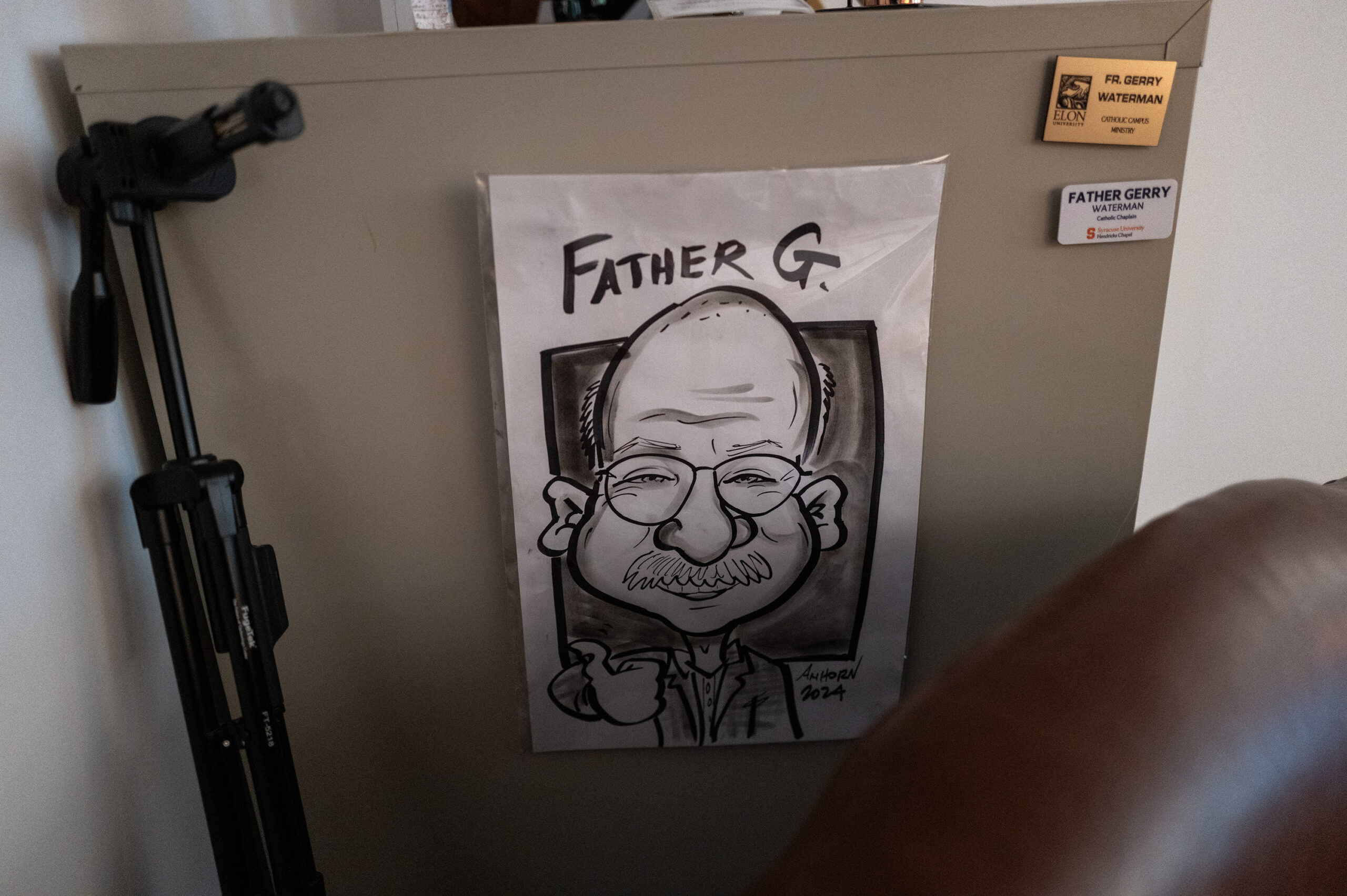
A caricature of Father Gerry from a wedding reception in Florida two years ago hangs behind his desk. His office contains many objects, each with their own story and memories. Tara Deluca | Photo Editor
Pieces of Father Gerry
Waterman’s office is warmly lit. His desk is a little messy these last days, typical at the end of semesters. But with his impending departure, Waterman hasn’t had a free moment. He just returned from Ann Arbor, Michigan, where Syverud is receiving treatment for his brain cancer diagnosis.
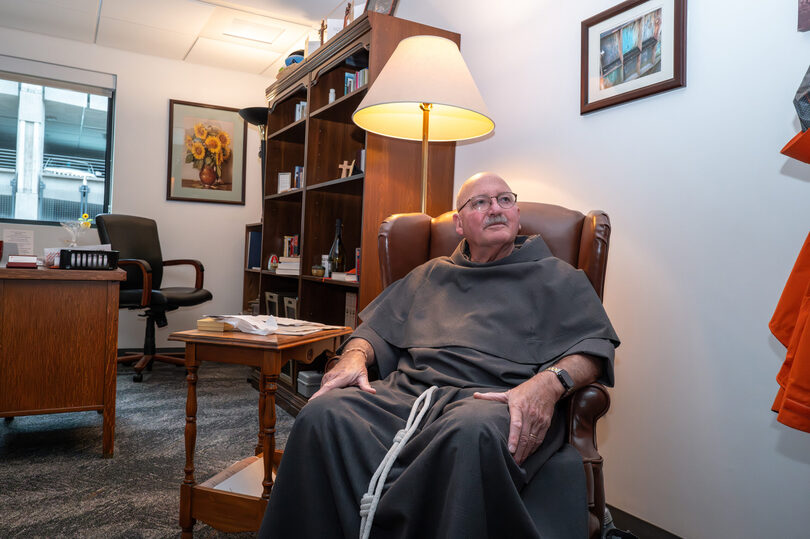
In his office, Waterman points out a basketball signed by fellow SU Gerry — MacNamara — sitting beneath the chair students sit in during confession. A caricature of him from a wedding reception in Florida two years ago hangs behind it. Even though it’s black and white, you can almost make out his reddened cheeks from his big grin.
The office is Waterman’s base for counseling students. When students need him, he meets them. Sometimes he’ll even leave guest speaker events a few minutes early to ensure he can meet students on time, Imam Amir Duric, assistant dean for religious and spiritual life at Hendricks Chapel, said.
“If it’s his office hours from 2 to 4, nothing else can get in the way,” Duric said.
Zdancewicz was raised Catholic, but Waterman has helped deepen his faith. Others, like junior broadcast journalism student Evan Fay, converted to Catholicism because of him.
When one of Fay’s favorite hoodies was stolen last year, Waterman walked him over to 315 Vintage on Marshall Street and bought him another hoodie and a pair of pants. For a man who took a vow of poverty, Fay said, this meant everything. And when Waterman taught Fay how to tie a tie, he gave Fay 15 of his own to take home.
“I’m very lucky and grateful that now I have 15 pieces of Father Gerry,” Fay said.
Waterman once told Jack Rose, an SU alum and current student engagement coordinator at the Catholic Center, that he’d be bringing issues to the priest until Rose is 90. The line stuck with Rose — the implication being that Waterman would still be there to listen to Rose’s worries and struggles at 136 years old.
“I picture Father Gerry as the future head in a jar with, like, a cyborg body,” Rose said.
But pastors are people too, Reverend Devon Bartholomew, one of SU’s Protestant chaplains, said. Ministry doesn’t come without personal tolls and grief, and the perception that ordained people are holy and thus superior is flawed, Bartholomew said, because pastors need counseling or time to grieve, too.
Waterman was in the room when Bryce Lander, an SU senior, was pronounced dead last year. He was anointing Lander and spending time with his friends, Rose said, and Lander’s death came suddenly. The responsibility of planning and ministering at a memorial Mass fell on Waterman, a difficult yet necessary element of pastoral service.
The day after the memorial, a Friday during Lent, Rose took Waterman to Blarney Stone for a fish sandwich to do what he could to show his appreciation for Waterman.
Waterman is honest with students. He lets them know he’s vulnerable and he’s not afraid to cry around them. But he refuses to lean on them for support, because he’s their counsel, he said, not the other way around.
“It puts pressure on them, because that’s not their role,” Waterman said. “I tell students, ‘Don’t make your peers be your counselors, either. You need to go see a counselor. That’s not their job.’”
The United Front
Aside from the new Catholic Center chapel and the increase in attendance, Waterman also transformed the church’s relationship with other faith communities at SU. From other denominations of Christianity, to other religions like Islam, Judaism, Buddhism and Hinduism.
Waterman worked with other Christian chaplains at SU to expand Ash Wednesday services and collaboration around Easter, Bartholomew said. As a result, the university’s Christian community presents a more “unified front,” Bartholomew said.
Coming from a Baptist tradition, Bartholomew had never attended an Ash Wednesday service. He wasn’t sure what his responsibilities might entail, whether you had to be a confirmed or ordained Catholic to administer ashes on people’s foreheads, like taking and administering the communion Eucharist requires.
“(Waterman) said, ‘No, there’s actually no obligation. There’s no requirement. But we’re all trained to do it,” Bartholomew said. “When I discovered that, I jumped in with both feet.”
Waterman’s been a mentor for Bartholomew, who hasn’t ministered anywhere else. SU is Bartholomew’s first parish as pastor. Bartholomew often bounces ideas off Waterman and asks him questions about service.
Waterman isn’t just a source for other Christian chaplains. Like the recent efforts in the Catholic Church under Popes Francis and Leo XIV to expand interfaith dialogue, Waterman transformed the church’s relationship with other faith communities at SU.
Muslim students at SU don’t have a designated space in the same way Catholic students do, Duric said. They usually use auditoriums around campus for events, and a few years ago, when Duric needed a space to host a welcome back dinner for students, he went to Waterman.
Duric asked if he could use the Catholic Center for the dinner, and Waterman didn’t hesitate to help.
“He said, ‘No, you’re more than welcome. It’s really almost like your space,’” Duric said. “I have many Muslim students who have nothing but respect for Father Gerry.”
The Stories That Can’t Be Told
Waterman’s next step is in Washington, D.C. He’s not retiring, but he won’t be gone from Syracuse entirely either. He said he can never really leave this community behind, even if he isn’t there physically. A hole will be left in his heart when he leaves, he said, and it’ll be hard to fill.
“I know he loves people, but even that is a skill that he’s honed over 20 years of college ministry,” Rose said. “Every one of us has the capacity to be like that.”
Whether it’s students, fellow chaplains, or staff at the Catholic Center, there are seemingly endless stories to tell about Father Gerry Waterman. When Fay spoke at Waterman’s farewell, he invoked the ending of John’s gospel.
“Jesus did many other things as well. If every one of them were written down, I suppose that even the whole world would not have room for the books that would be written,” the verse reads.
Fay said the same is true of Waterman — no one could really know how much of an impact the priest has had.
“Only God knows the full fruit of his life,” Fay said. “And perhaps, one day, Father Gerry will know too.”