Personal Essay: Heritage helped me as a 1st-generation U.S. college student
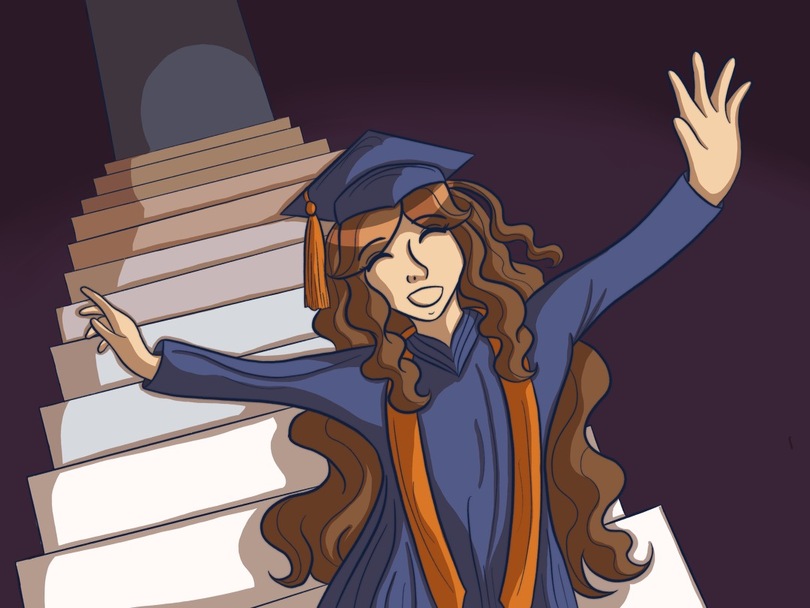
First generation college students often have less guidance and grapple with more isolation than their peers. Our essayist reflects on how a community rooted in friendship and cultural practices made school feel like home. Maria Masek | Contributing Illustrator
Get the latest Syracuse news delivered right to your inbox.
Subscribe to our newsletter here.
Graduation is a week away, and for the first time, I’ve built a life I don’t want to run away from. It’s bittersweet to leave the people who made Syracuse University my home, but I keep coming back to how lucky I am to leave with a heavy heart weighed down by love.
I’m the youngest of three sisters and will be the first in my family to graduate from an American university. Lacking a blueprint of what my experience should look like has made my time at SU seemingly boundless and entirely passion-driven.
I’m an honors student triple-majoring in sociology, geography and environment, sustainability and policy. I’ve worked more than one job since arriving at SU and have taken 18-21 credit semesters, alongside research and leadership roles. I’d be lying if I said balancing all of my responsibilities came easily, especially when I was still adapting to life at SU.
Being from Laredo, Texas — a 95% Latine metro city — is why I came to SU with as much passion as I did and took on so much. Simultaneously, it’s also the reason I struggled to adapt.
During the COVID-19 pandemic, an article from the Texas Tribune revealed that medical manufacturer Midwest Sterilization was putting my community at nationally elevated carcinogenic risk through exposure to the regionally unregulated chemical ethylene oxide. It was only after going down a rabbit hole of research that I learned what environmental justice is and how communities that are predominantly Latine, Black or low-income are systemically zoned next to industrial areas.
Understanding how weak regulations play a strong role in health disparities inspired my pursuit of becoming an environmental lawyer. My understanding of how Laredo’s people became locked into a cycle where weak regulations exacerbated pre-existing health disparities drove me to get as far away from Texas as I could.
Arriving in Syracuse was a culture shock. Within the first week, I’d been called exotic at least five different times. I realized I had an accent after people tilted their heads or seemed visibly confused when I spoke, asking where I was from. I also found myself struggling with school for the first time. Saying that the Texas education system failed me would be underselling my countless sleepless nights as I struggled to keep up with peers who came from private schools or states that prioritized academics. I had to teach myself how to study effectively, read old English for philosophy and even properly write an academic paper.
My first semester was the hardest, but giving up was never an option. My mom’s mantra is “querer es poder,” or “where there is a will, there is a way.” Although she might not know English, she’s always been fluent in hard work, a legacy she ingrained in me.
Syracuse didn’t feel like home at first, and I constantly felt like I didn’t belong, as if I’d tricked the admissions office into giving me a full ride I didn’t deserve.
Living intentionally through purpose is the biggest lesson I’ve learned, and the hundreds of mistakes I’ve made are the backbone of my experience.Valeria Martinez-Gutierrez, Personal Essayist
Joining clubs like OrangeSeeds led me to my best friend and mentor, Alekhya. She became the glimmer of hope I sought when imposter syndrome paralyzed me. Although we’re polar opposites, our relationship blossomed through our shared ambition and relentless will to achieve our goals.
I co-founded the Latine Honors Society my freshman year to ensure no other Latine honors students felt the alienating gap I experienced through hidden curricula as a first-generation college student. Our goal was to create a culturally competent nexus of peer advising through enriching programming and collaborations with organizations and departments like the Career Center.
Developing LHS motivated me to become further involved with cultural student organizations on campus, leading me to the Mexican Student Association. I’ve served on the executive board since my sophomore year and grown with the organization. As president of MEXSA, I wanted to create the warm and culturally nourishing space I needed when I first arrived. Whether it was hosting traditional events like Día de Los Muertos, showing up for our Syracuse community through philanthropy or leading a collaborative three-part teach-in on United States imperialism, MEXSA has become my proudest achievement.
La Casita Cultural Center was another place I held close to my heart because it did exactly that — embrace and celebrate Latine culture. It was my model for effectively bridging SU’s privileged resources with the wider community through regular, free programming for women and children.
One of the most important things SU taught me in this political landscape is that education is a form of resistance. When our government actively works against immigrant communities like ours, thriving, graduating from university and still having the drive to give back is proof that we’re more than capable. No policy or administration can take that from us.
My college experience hasn’t been linear. But I’ve grown to be someone I’m proud of, and I have so many to thank for helping me find who I am and make Syracuse home.
Next fall, I’ll start my Masters of Public Health at Boston University with a concentration in human rights and social justice. Without realizing it, I’ve made all of my dreams come true and continue to make my family proud. I cherish every version of myself that I’ve outgrown to become the person and scholar I am today. I’ve matured, and like a rock, the constant movement of life has softened my edges. How to live intentionally through purpose is the biggest lesson I’ve learned, and the hundreds of mistakes I’ve made are the backbone of my experience.
New beginnings are upon me, and I’ll be starting all over again in a new city before I know it. Being a first-generation student is hard, but it eases with time, experience and firsts. Even when I thought I had it all figured out entering my senior year, I had to learn how to apply to higher education all over again. Through every milestone, I’ve proved that resilience is vital to my drive. Most importantly, I’ve used my passion to bridge the gap between my hometown and SU communities alike, doing so with a sense of rightful justice.
Valeria Martinez-Gutierrez is a senior majoring in geography, sociology and environment, sustainability and policy. She can be reached at vmarti10@syr.edu.