We must remember Chinese Americans’ struggle for citizenship
Get the latest Syracuse news delivered right to your inbox.
Subscribe to our newsletter here.
I stood on the sixth floor of Bird Library, walking through an exhibition celebrating 250 years of activism in the United States. I stopped at nearly every display case, searching for a history that resembled my own.
I expected to see the Chinese Exclusion Act highlighted, showcasing the struggle that helped shape the meaning of American citizenship. I assumed I may discover displays detailing the Filipino American labor movement that improved working conditions and reshaped labor rights in the U.S. I at least expected to see the Stop Asian Hate movement, which brought anti-Asian violence and discrimination into national political conversation.
Instead, I encountered a striking absence. Asian American social movements were nearly invisible in the exhibition’s story of American activism. Some of the rights Americans take for granted were won through struggles that are now barely remembered.
Chinese Americans weren’t simply victims of exclusion. Their resistance helped force the U.S. to confront the boundaries of American citizenship.
In the 19th century, Chinese immigrants were described as perpetual foreigners in legal and popular discourse. The term was more than a stereotype. It reflected a system that treated Chinese belonging as conditional, no matter how long people lived in the U.S., how much they worked or how deep their communities ran.
The Page Act of 1875 and, more significantly, the Chinese Exclusion Act of 1882 marked a major shift in federal immigration policy, explicitly restricting immigration based on nationality and race. Chinese immigrants were increasingly positioned outside the imagined boundaries of American citizenship.
This question of belonging eventually moved into the courts.
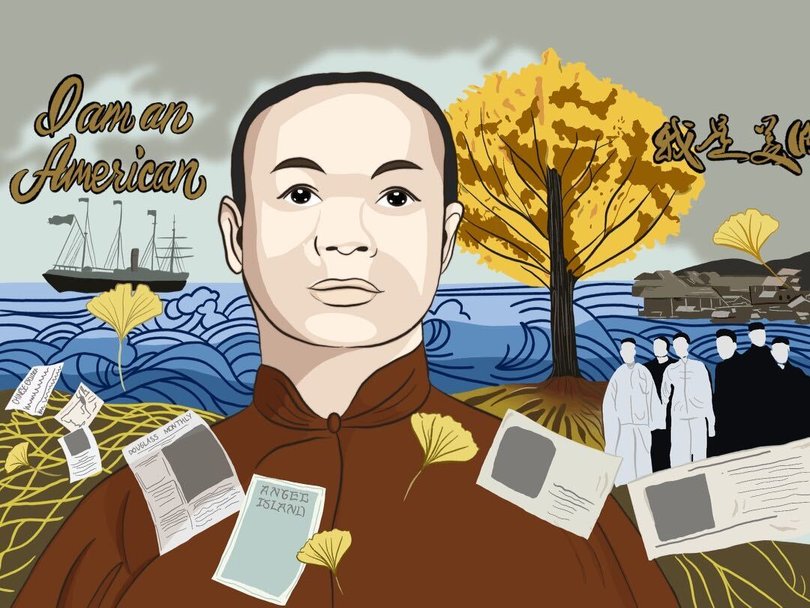
Consider Wong Kim Ark, a child born in San Francisco to Chinese parents who were barred from becoming U.S. citizens under exclusion laws. After traveling outside the country, Wong was denied reentry. Officials argued he wasn’t a citizen because his parents were Chinese and therefore ineligible for naturalization.
Some movements change history not with a single spectacular protest, but through the stubborn accumulation of ordinary acts of resistance.Renee Yu, Guest Columnist
The case exposed a fundamental contradiction between the 14th Amendment’s promises of birthright citizenship and a legal system that still tied belonging to race and ancestry.
In 1898, the Supreme Court ruled in Wong’s favor in United States v. Wong Kim Ark, affirming that a person born in the U.S. is a citizen regardless of the nationality or immigration status of their parents.
The case is remembered as a precedent for birthright citizenship and tells us about how citizenship is defined. Citizenship isn’t simply a fixed legal category handed down by the state — it’s been contested, interpreted, defended and transformed through struggle.
Some struggles are easier to see than others. Marches make for photographs; mass demonstrations give history its defining scenes. But much of Chinese American resistance unfolded far from the streets: in courtrooms, newspapers, mutual-aid societies and community meetings, through people who kept pressing the government to recognize their rights.
That resistance may lack the drama we’ve come to associate with social movements. It doesn’t make it any less consequential. Some movements change history not with a single spectacular protest, but through the accumulation of ordinary acts of resistance.
Chinese American activism isn’t a missing movement so much as a reminder that movements don’t always look the same. When we equate visibility with significance, we risk allowing the archive to determine which struggles count.
But public memory isn’t neutral.
Museums, libraries and archives do more than preserve history. They help shape how a nation understands itself and how the next generation understands who belongs in that story. When certain communities are repeatedly absent, their role in shaping the nation becomes harder to see and easier to forget.
The absence of Asian American movements from public narratives reflects the enduring idea of Asian Americans as perpetual foreigners. Even when their histories are deeply connected to American legislation and political identity, they can be treated as stories about immigration rather than the making of America.
The tendency to tell American racial history primarily through a Black-white framework is another issue. That framework is crucial for understanding slavery, segregation and the Civil Rights Movement, but it can also flatten histories that don’t fit neatly within it. Asian American struggles over immigration, labor and citizenship occupy a different historical position, and they disappear when the national story is organized around only one racial binary.
If Wong Kim Ark helped establish the constitutional meaning of birthright citizenship, then forgetting his struggle doesn’t merely leave an Asian American story out of an exhibition. It leaves out part of the history of American citizenship.
To broaden the story isn’t to displace the histories already told. It’s to make the story more accurate.
American democracy was shaped by courtrooms, newspapers, community organizations and neighborhoods by people who challenged the boundaries of belonging, one institution at a time.
Wong Kim Ark’s story belongs in that history, not because Chinese Americans need a place in someone else’s narrative, but because they were part of defining citizenship in America.
The question is whether we choose to remember this impact.
Renee Yu, Class of 2026, can be reached at correrrenee@gmail.com.