ESF students share thesis projects, address ecological concerns at NYS Fair
Get the latest Syracuse news delivered right to your inbox.
Subscribe to our newsletter here.
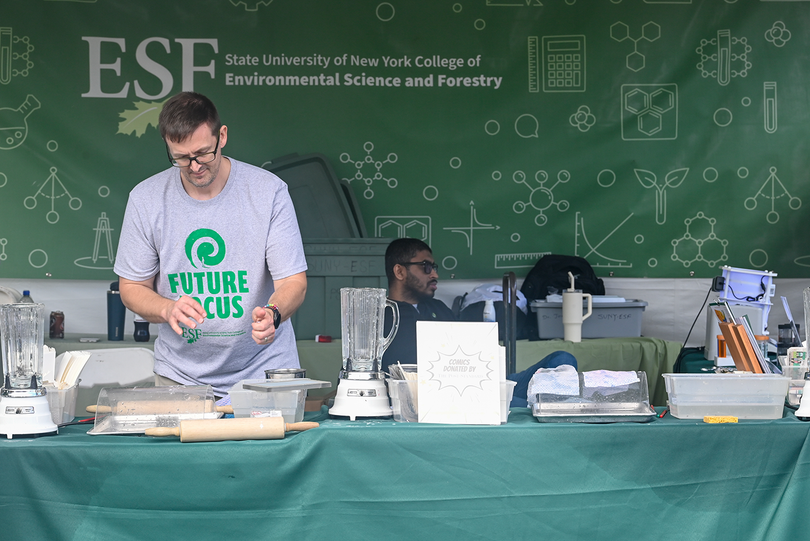
SUNY ESF chemical engineering graduate students Chi Zhang and Sushant Gawali are on a mission: replace plastic wrap, a household staple, with a green alternative made from sugar maple tree shavings. Their current sample, a sheet of biodegradable film about an inch across, allows air to pass through it.
Zhang and Gawali showcased their invention, part of their shared thesis project, at ESF’s booth at the Great New York State Fair after their thesis adviser told them they’d been selected. ESF highlights its students’ work, along with science demonstrations and promotional brochures, for ten days every year — an ongoing tradition dating back to the early 20th century.
ESF showcases a wide range of research and activities from its booth in the State Park section at the Fair. Zhang and Gawali displayed their film and its components alongside the chemical engineering department, which had taken over the ESF booth on Friday.
Zhang and Gawali’s process starts by taking shavings from a sugar maple, a hardwood tree common to the eastern United States. Zhang and Gawali then bleach the shavings and grind them into a fine powder. A proprietary blend of chemicals is added to the powder, and the mixture is left to dry into a thin sheet. The resulting product is translucent and has a faint yellow tinge.
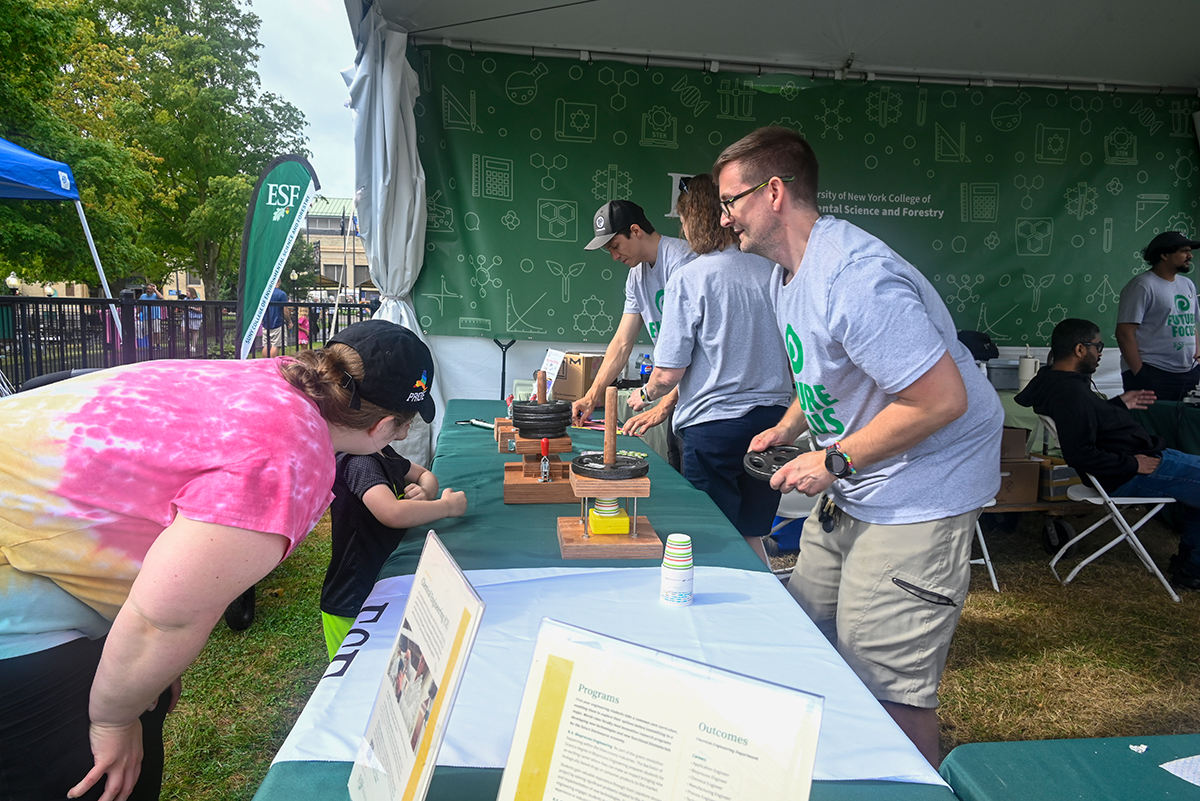
Attendees of the Great New York State Fair watch demonstrations at SUNY ESF’s booth. The interactive science models allow ESF to raise awareness about its academic programs. Christian Calabrese | Asst. Photo Editor
Presentations are hosted by most of the college’s departments on a rotating basis throughout the Fair’s yearly production. Each department has one or two days to make its case to the public at the forum. On Wednesday, one spotlighted the Lake Ontario Watershed — which encompasses the city of Syracuse, the Finger Lakes and Oneida Lake — by constructing a large puzzle made from satellite imagery.
On Monday, a department explained how blight wiped out the American chestnut tree, which is valued for its strength and color. The booth also discussed how ESF researchers are attempting to restore the tree’s population.
Sean Hohm, director of operations at ESF’s Paper and Bioprocess Technology Center, demonstrated some of the paper industry’s standard testing procedures. These included crush tests where paper sheets are suspended between two clamps while subjected to increasingly heavy weights, and trials where paper cups have weights placed on them.
Hohm said that children, many of whom are just beginning to understand weights and dimensions, are particularly impressed by the demonstration.
“When the little piece of two-inch by two-inch paper is holding 30, 40 pounds, they’re like, ‘that’s holding me,’” Hohm said.
The interactive science model hopes to leave younger fairgoers with lasting memories, but it also allows the college to raise awareness about its academic programs. Kelly Watson-Collins, an instructional support specialist in ESF’s chemical engineering department, said some students remembered their time at the fair influencing their college decisions.
“We have people who come to the booths every year, and they’re like, ‘This was my first exposure to ESF, making a sheet of paper when I was a kid,’” Watson-Collins said. “You know, so that helped them come to ESF.”
WHAT YOU SHOULD READ NEXT
Follow sounds of axes splitting logs to ESF Timbersports’ hive of activity
Past South Campus, off a gravel road, the ESF Timbersports team wields axes and chainsaws as they prepare for meets.
In addition to boosting admissions, the college’s booth also educates the general public on a variety of topics from geography to biology.
Karen Moore, associate director of communications at ESF, said the public asks about much more than just the college and its research at its annual table. These often revolve around neighborhood trees or animals in someone’s backyard, questions faculty and students are happy to answer.
Zhang and Gawali emphasized that their film was far from a finished product, but they’re optimistic about the future and happy for the exposure. If it can be mass-produced, the duo hopes that it can replace Saran Wrap and other petroleum-based cling films.
“There are still more aspects to consider, like economics, what chemicals we are putting in, how much water we are using,” Gawali said. “We’re working on it.”