
Ex-NBA players’ WNBA escapades have nothing to do with activism
Get the latest Syracuse news delivered right to your inbox.
Subscribe to our newsletter here.
The WNBA has many problems worth discussing, from issues with pay to travel to media coverage. Enes Kanter Freedom’s campaign against the WNBA doesn’t address any of them, making the former NBA player’s crusade against the league misogynistic and unnecessary.
On Aug. 7, Kanter announced plans to enter the 2027 WNBA Draft while identifying as a woman. Royce White, another former NBA player, soon followed with the same announcement. Both have since been deemed ineligible for the WNBA. But they wouldn’t stop there.
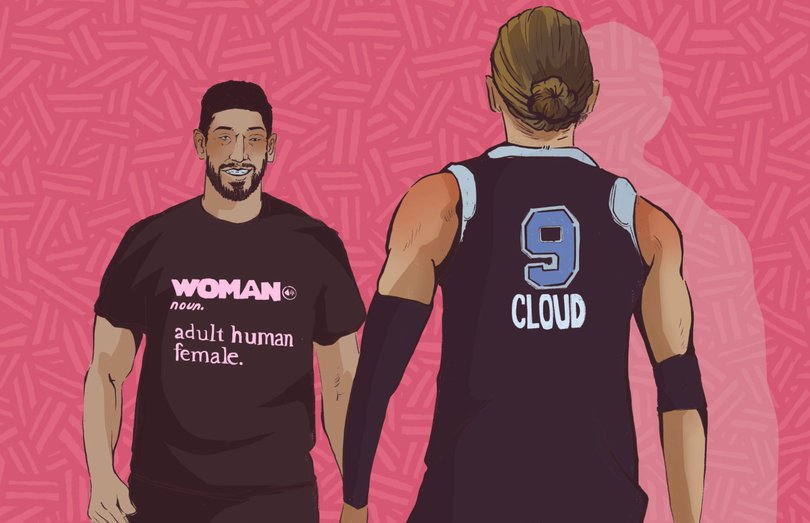
Kanter has shown up at WNBA games and confronted players, leading to him being banned from arenas following an incident involving the Chicago Sky’s Natasha Cloud. White has made his own public appearances, including appearing at Indiana Fever games wearing a wig.
At some point, it becomes fair to ask what exactly the two are trying to accomplish. If the answer is to defend women’s basketball, as they claim, their strategy becomes even harder to understand.
No transgender woman has ever played in the WNBA. Yet, the league is now being pulled into a national debate over transgender inclusion despite the fact there aren’t any transgender women currently competing in their league.
As someone who enjoys watching the WNBA, this entire situation is frustrating to me for a reason that has very little to do with the debate over transgender women in sports.
It’s inherently misogynistic for men to decide they can insert themselves into women’s sports as they please, turn it into a spectacle and expect society to treat it as legitimate advocacy. Kanter and White aren’t WNBA players raising concerns about their workplace. They’re outcast NBA players injecting themselves into a rising and self-sufficient women’s league to make a selfish political point.
Kanter has repeatedly framed himself as someone fighting for women’s sports, but it becomes difficult to take that claim seriously when he simultaneously uses WNBA players as a punchline.
After Angel Reese missed a potential game-winning layup, Kanter took to social media to announce that if he were drafted, Reese would be the first woman he’d dunk on. He also told her to lean into podcasts, referring to the female athlete’s growing presence in sports media.
When two former NBA players make themselves the face of a hypothetical controversy, it becomes hard to see their campaign as anything but patriarchal provocation.Emmanuel Usiomwanta, Columnist
If we want to protect women’s sports, we need to defend them from men or women who reduce female athletes to the same worn-out misogynistic jokes that women have been playing and prospering through for so long. Kanter’s crass statements are everything wrong with his advocacy.
Women’s sports have spent decades fighting to be taken as seriously as they currently are. The WNBA is finally experiencing unprecedented attention, investment and popularity. After years of being treated as an afterthought, there are now men claiming to defend and elevate women’s basketball while simultaneously making a mockery of it.
“I am identifying as a woman. I should be allowed to play,” Kanter said in an interview with Fox News.
This encapsulates the problem with this publicity stunt. It simplifies a complicated conversation about women’s sports into an irrelevant game in which unplayable former NBA players can turn into conservative political activists and threaten to make themselves a hypothetical test case.
When two former NBA players make themselves the face of a hypothetical controversy, it becomes hard to see their campaign as anything but patriarchal provocation.
If Kanter’s argument is that the WNBA should establish clear, defined policies regarding transgender athletes despite the lack of transgender athletes in the WNBA, that’s a conversation the league can have. But there currently isn’t a transgender woman playing in the WNBA, nor are there any transgender women declaring for the WNBA Draft. There never has been.
Women’s basketball doesn’t need men creating controversy around it to prove that women’s sports deserve protection. If you truly respect women’s sports, you should also respect that not every conversation surrounding them needs to be centered around men.
Emmanuel Usiomwanta is a junior majoring in policy studies. He can be reached at eousiomw@syr.edu.