Law students say SU’s inaction on Big Beautiful Bill leaves futures unclear
Get the latest Syracuse news delivered right to your inbox.
Subscribe to our newsletter here.
When President Donald Trump signed the One Big Beautiful Bill Act into law in July 2025, students across the country, including Syracuse University College of Law student Emily Bailey, braced for impact.
The act dramatically restricts federal loan options for graduate and professional students, but Bailey was sure SU would communicate its impacts to her cohort.
It wasn’t until their Discord group chat began blowing up that she realized she needed to take matters into her own hands.
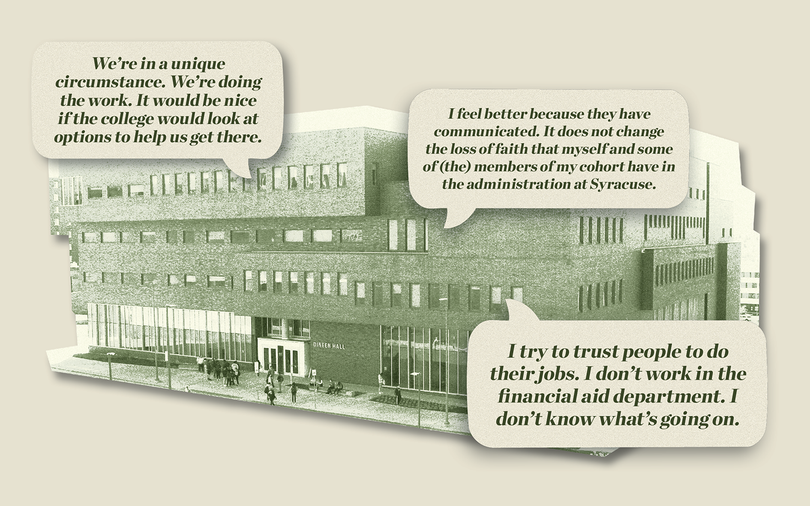
“I try to trust people to do their jobs,” Bailey said. “I don’t work in the financial aid department. I don’t know what’s going on.”
While the change came from the federal government, some students in the College of Law’s JDinteractive program say SU hasn’t communicated enough with its students amid uncertainty surrounding their financial aid awards.
Beginning in July 2026, Trump’s OBBBA significantly limited federal loan options and placed strict caps on graduate student loans, including Grad PLUS loans which ended for new applicants on July 1, according to Federal Student Aid.
Several students in the program’s class of 2029 cohort told The Daily Orange the changes to their financial aid have caused extreme stress and will severely impact their futures. The students said they didn’t receive direct cohort-wide communication from the university until early September.
“Financial Aid issued class-wide guidance this week on disbursement timing, and deadlines and staff from that office are readily available to meet with students individually to walk through how the federal changes affect their specific situation,” a College of Law spokesperson wrote in a Tuesday statement to The D.O.
Some students said they’re considering leaving the university, even though transferring or taking a year off would mean losing complete access to their Grad PLUS loans.
“I know they’re trying hard,” Nicole Pearson, another student in Bailey’s cohort, said. “But it is unsettling as a student when you realize the people who are helping us are just as confused as us, and again, that’s not their fault…I know that they’re trying to work together to figure out what’s best.”
One student, who asked to remain anonymous out of fear of retribution, said they spoke with Courtney Abbott Hill, the College of Law’s Interim Dean of Students, who encouraged them to let her know if students wanted to withdraw or take a leave of absence, so she could help with the process.
“It was sad to me that the response from administration was, ‘All right, we can help show them the door,’ instead of ‘Oh my god, no, we don’t want them to leave the program. We care about that. We want them to be Syracuse law students,’” the student said.
The OBBBA eliminates new Grad PLUS loans. Active students who’ve previously received the loan — and are pursuing graduate or professional degrees such as a Juris Doctorate — must be enrolled full-time to be eligible for their loan until they complete their program.
Students enrolled less than full-time will have their aid prorated, meaning the amount is adjusted based on their number of credits enrolled. According to SU’s website, JDi students typically average nine credits during their second year, to complete the program in the “standard” four years.
In some cases, loans are being cut by thousands of dollars, making continuing their education at SU unfeasible.
“The College of Law has been in continuous coordination with the University’s Financial Aid Office since these changes took effect to help students understand their options and navigate the current environment,” the spokesperson added.
The act set borrowing limits for graduate and professional students, capping loans at $100,000 and $200,000, respectively. Previously, students could borrow up to the full cost of their tuition and fees, ABC News reported.
The United States Department of Education argued the new caps will “help prevent borrowers from taking on debt they may struggle to repay” and make higher education more affordable, according to a May release.
JDi students in their fourth semester typically take six credits, due to “challenging and important” courses, Associate Dean for Academic Programs Shannon Gardner wrote in a May cohort-wide email obtained by The D.O.
However, some students viewed an outdated class plan and thought their fourth semester would contain nine credits, rather than six.
I try to trust people to do their jobs. I don't work in the financial aid department. I don't know what's going on.Emily Bailey, JDi student
Many students hoped the College of Law would offer additional credit options, such as electives or externship credit, to help meet the new threshold.
A second student who requested anonymity, who’s involved in the Student Bar Association, said they’re working over 15 hours a week with the law school’s Travis H.D. Lewin Advocacy Honors Society alongside a full-time job and six-credit course load. The student is also a member of the mock trial team, something they said SU provides two credits for once an upper-division status is reached.
They said the College of Law denied their request for additional credit.
A third student who requested to remain anonymous for fear of retribution, said they also hoped to complete an externship to reach the credit total needed for aid, but the university said they needed to first complete a supplemental course that wouldn’t be offered in the fall semester.
It’s up to the university’s discretion when students are required to take the course, titled “Professional Responsibility.” Other universities, like The University of Texas at Austin and Cornell University, allow students to take it at any time.
“All of our students are subject to the same academic rules, including the requirement that lower-division courses be completed before upper-division courses, absent an approved petition showing extraordinary circumstances,” a College of Law spokesperson wrote.
Some students also expressed frustration that the College of Law’s administration could add an additional credit for veterans, in the form of an independent study, to counteract a separate policy affecting their housing stipend.
“We’re in a unique circumstance. We’re doing the work,” the student involved with SBA said. “It would be nice if the college would look at options to help us get there.”
The student said though their circumstances are different, they believe the veterans’ situation was handled differently than the rest of their cohort.
“For military-connected students, certain veterans, education benefits are tied to a specific per-semester enrollment threshold that can differ from the standard academic progression,” a College of Law spokesperson wrote. “For a small number of students, those limitations demonstrated extraordinary circumstances under the petition process available to all students.”
After Wednesday, which serves as the College of Law’s official deadline to drop classes, JDi students are entirely responsible for their tuition balance, even though they still haven’t received a finalized bill. Bills for the fall semester will be sent out by email on Sept. 18, with payments due on Oct. 16, according to a Friday financial aid bulletin sent to the JDi class of 2029, obtained by The D.O.
Many students said there’s uncertainty surrounding the disbursement of Grad PLUS loans, since some may not fully understand their aid awards before the drop deadline.
“Unfortunately, like many institutions, we’ve experienced technical issues which hindered packaging and disbursement of federal loans,” the bulletin reads. “We are now up to date with processing, and the University has disbursed about seventy percent of fall loans for College of Law students, with more disbursements forthcoming, but we understand that such delays and uncertainties create worry and concern.”
The third anonymous student, who’s involved with SBA, said they didn’t receive their financial aid award letter until a day before the drop deadline.
“From an SBA perspective, we are steadfast with our cohort about keeping calm, realizing that we have advocates and people and that we can’t be digging in and expressing our frustrations, in the wrong way,” the student said. “We are encouraging people to give them grace, we just really hope that they’re doing something with that grace.”
The second anonymous student said they didn’t receive their award letter until 30 minutes before the 5 p.m. deadline.
To prepare for an unknown aid award, the student said they withdrew $20,000 in private loans, just to cover one year of tuition.
“I’ve spoken to several people who that’s not even an option for,” the student said. “It’s not an option for them to get screwed that bad financially.”
Since at least May 12, the College of Law has provided information on its website regarding updated federal aid resources available to students and updates on how the resources are affected by OBBBA, according to internet archives.
“The changes to federal student aid enacted this year have created uncertainty for some
of our students, and we take that seriously,” a College of Law spokesperson wrote.
Pearson, also involved in SBA, said she appreciates the financial aid office’s effort to try to answer student questions.
“I think that obviously the issue is coming from higher up, the Department of Ed and the Trump administration, and they’re not being clear with the schools, and then the schools don’t know what’s up, what’s down,” Pearson said. “But I know that they have been trying.”
The first anonymous student agreed that the Department of Financial Aid has been doing all it can amid the confusion but still felt the university didn’t address student concerns early enough.
“I feel better because they have communicated,” the first anonymous student said. “It does not change the loss of faith that myself and some of (the) members of my cohort have in the administration at Syracuse.”
Across the country, countless universities and students are grappling with how to adapt financial aid plans following the OBBBA’s impact on Grad PLUS loans. Some law schools at other institutions, including Harvard University, The University of Iowa and The University of Chicago, have updated pages on their websites detailing the specific impacts OBBBA will have on JD students.
Despite the uncertainty among students, many said they don’t blame the financial aid office, or even the university, for the current circumstance. They do, however, blame the university for a lack of communication.
“I sympathize with the fact that this is difficult for the financial aid situation, and it’s not their fault,” the first anonymous student said. “But again, they could have done significantly more. It is your impetus, your responsibility as the financial aid office, to communicate how those people’s lives are going to be impacted.”