Syracuse Cultural Workers use Peace Calendar art to forefront social change
Get the latest Syracuse news delivered right to your inbox.
Subscribe to our newsletter here.
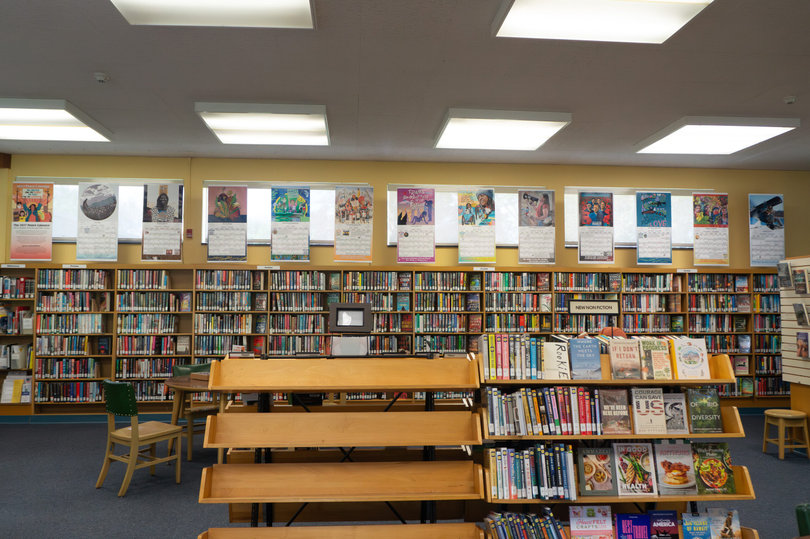
As visitors walk through the front doors of Syracuse’s Soule Branch Library, a cozy atmosphere awaits. Above colorful stacks of books, in front of the sunny windows, 13 long panels of artwork hang in a row — with one for each month of the year plus an introduction.
One panel depicts a colorful rowboat. Others show healthcare workers on strike, climate activists and more.
“Art has always been where people have been able to express their feelings about what’s going on in the world,” Colleen Dwire, one of the panels’ artists, said.
Dwire is one of 12 artists involved in the “The 2027 Peace Calendar: Art to Provoke, Inspire and Offer Vision” project — the 56th edition of the peace calendar. It’s currently at Soule Branch Library, the first of the exhibition’s stops on the Onondaga County Public Libraries tour. The project is organized by the Syracuse Cultural Workers, an organization founded in 1982 that strives to bring communities together by highlighting social issues and promoting diversity, equity and expression through art.
The panels illustrate topics such as human rights protests, transgender inclusivity and the celebration of different cultures, among others. Each panel also features a calendar month — except for the introductory piece — with important social justice dates from the past.
“I try to showcase as much art in the library as possible anyways, because art is a conversation between the artist and the viewer,” said Sarah O’Neill, the library’s adult services librarian for the Soule Branch Library.
Andy Mager, coordinator and social movements liaison at Syracuse Cultural Workers, curated this year’s peace calendar exhibition. The display, which will be shown at the Soule Branch Library until Oct. 29, is especially necessary this year, he said.
“We are at a very dangerous time in the history of the United States. There are dire threats to democracy itself,” Mager said.
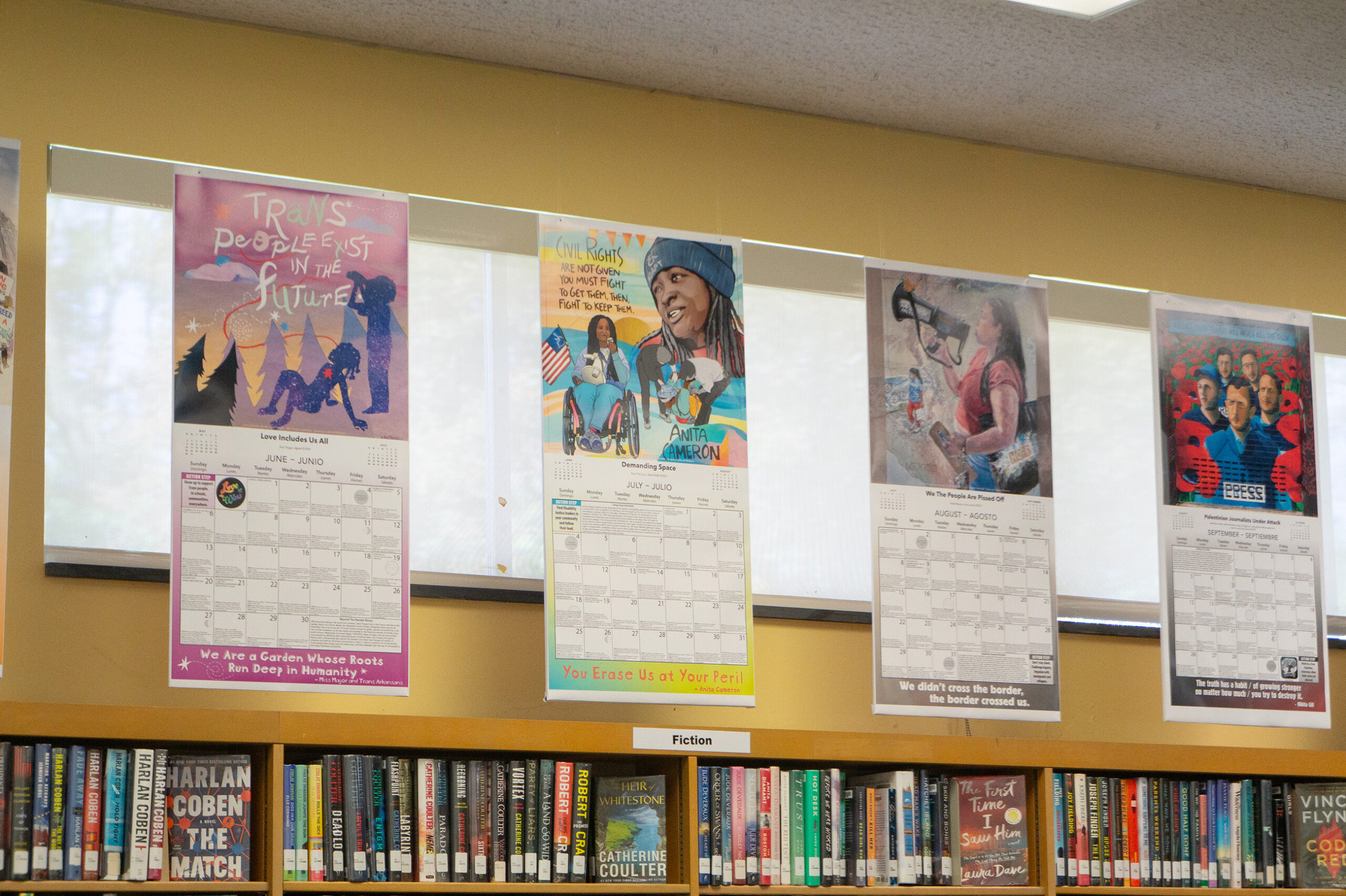
Four pieces from “The 2027 Peace Calendar: Art to Provoke, Inspire and Offer Vision” are displayed in front of a sunlit window at Soule Branch Library. Sarah O’Neill, the library’s adult services librarian, described the artwork as “protest images.” Rivka Spitzberg | Contributing Photographer
This year’s exhibit uses more vibrant colors than previous ones. Some of the artworks highlight individual people, while others contain groups of people, all “who are examples of those working to create a better world,” Mager said.
The calendar’s artists include painters, digital creators, collage artists, muralists and photographers from around the world, Mager said.
Dwire’s “One Boat” for January’s calendar is a linocut print created in 2023 and serves as the opening monthly image. The print depicts people in different hues — white, blue and gray — all aboard the same boat.
“I do tend to get political with some of my art. There’s no doubt about that,” Dwire said. “Art has always been where people have been able to express their feelings about what’s going on in the world.”
The artwork is a three-color reduction linoleum block print, which Dwire made from linoleum she found at a construction site years ago. She first carved the surface and printed one color, then carved away more material before printing the next.
For Dwire, the “peace” of the Peace Calendar means “taking care of our individual selves and taking care of the people around us, including strangers,” she said.
Nicole Dixon’s February panel adds another dimension to the calendar’s idea of peace. The work’s full title is “Come Celebrate with Me, That Every Day Something Has Tried to Kill Me and Has Failed,” drawn from Lucille Clifton’s “won’t you celebrate with me” poem.
The piece is part of Dixon’s larger body of work, “The Light of Truth,” inspired by journalist and activist Ida B. Wells. The image, composed of acrylic, charcoal, graphite, magazine paper, watercolor and gold leaf on canvas, is rooted in “the indomitable spirit of Black joy,” Dixon said. For her, art also bridges divides between people.
“Art has always been at the forefront of social change and social movements and of progress in general, because it is a way to kind of connect people on an emotional level,” Dixon said.
WHAT YOU SHOULD READ NEXT
SU Art Museum’s ‘Space and the Sacred’ juxtaposes religion, science
The Syracuse University Art Museum’s latest exhibit showcases pieces by Letterio Calapai that explore space and Catholicism.
Dixon said she hopes viewers leave her work viewing Blackness differently — not through stereotypes but through beauty, culture and humanity. Art is “like an invitation, an open door, a window to be able to look into somebody’s world and see yourself on the other side,” Dixon said.
Other panels explore social issues, including the April edition, which depicts young climate activists holding signs with phrases like, “IT’S OUR FUTURE” and “CLIMATE ACTION NOW.” May’s panel shows healthcare workers holding union signs.
Some artworks coincide with events or celebrations that take place during their months. For example, June, which is Pride Month, envisions a future for transgender people with the words “Trans People Exist in the future.” September’s artwork, “Palestinian Journalists Under Attack,” shows journalists in a field of poppy flowers, with the words “Killing truth tellers will never kill the truth.”
While O’Neill called the illustrated calendar “protest images,” they still focus on the theme of peace, Mager said.
“Peace, for me, means not just the absence of war or overt physical violence but also that people have the opportunity to thrive,” Mager said. “It means that people are not stigmatized or limited because of their economic situation, the color of their skin, the language they speak or their abilities to perform certain kinds of tasks.”