Art turned my disability into something beautiful and relatable
Get the latest Syracuse news delivered right to your inbox.
Subscribe to our newsletter here.
Disabilities appear in various ways. Some disabilities can be invisible while silently eroding one’s mental health. For others, disabilities can be debilitating and noticeable, shining a spotlight on them.
Art can be a therapeutic coping mechanism for people with disabilities to release emotions, communicate inexplicable challenges and connect with others. I learned this from having scoliosis.
Adolescent idiopathic scoliosis is a sideways curvature of the spine of unknown etiology. I was diagnosed at age 14. It turned my world upside down.
I suffered constant back pain, wore a brace 22 hours a day and attended weekly physical therapy and yoga. My scoliosis made me feel alone and different from my classmates.
I couldn’t try out for the tennis team due to my pain. I stopped playing the clarinet because my brace limited my lung capacity.
Disabilities can be isolating when you have to restrict yourself from activities, experience condescending interactions or face exclusionary infrastructure.
Although I wasn’t bullied like some kids with scoliosis, students still asked insensitive questions, stared and pointed fingers. People often unintentionally hurt those different from them due to a lack of understanding.
My invisible condition made school challenging. Some teachers didn’t believe I was in pain.
Sometimes, I’d kindly ask a classmate to help me carry my backpack down long staircases when the elevator malfunctioned.
Some would ask why I needed help. They said I looked completely fine.
I bottled my emotions to avoid being a burden and didn’t speak up when I needed help. I used writing, art and music to express myself and turn my pain into something beautiful and relatable.
Creating art can help you embrace your identity and avoid directing negative emotions toward yourself and others. It can also help you communicate effectively, so people can better understand your needs.
I vividly communicated the depth of my pain to my mom, family and friends using art. From sketching swords piercing a woman’s back to writing poignant poems riddled with metaphors, art helped articulate my struggles.
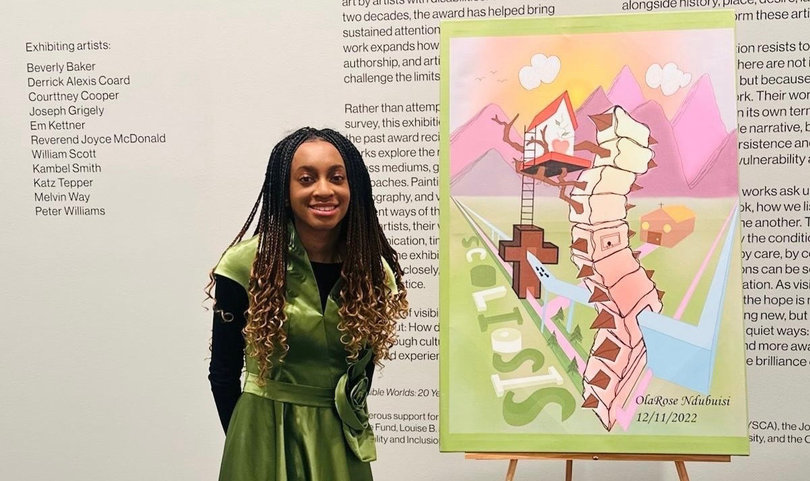
Having scoliosis also deepened my appreciation for nature. I noticed trees that were curved like my spine, yet still stood tall and blossomed, reminding me to remain confident in my individuality and find beauty in scoliosis. Trees feature frequently in my poetry and artwork about scoliosis, including “My Perspective of Scoliosis,” which I painted at 15-years-old.
In 2023, I had vertebral body tethering surgery, hoping to alleviate my pain. Due to unfortunate surgical errors, I used a wheelchair for five months. I now have debilitating symptoms and more pain than before.
We all have invisible struggles. Finding an outlet to creatively express your thoughts and experiences can make you feel seen.OlaRose Ndubuisi, Essayist
After surgery, I was in too much pain to play the piano as usual, so I composed original music on my laptop. Music composition has now become one of my favorite hobbies.
Using creative outlets has helped me discern that my disability is a part of me, but not all of me. Neither does it hinder my life’s trajectory.
Using art to cope with my pain gave me the power to help others.
At 15-years-old, I founded my nonprofit, The Finding Scoliosis Kindly (FiSK) Project, to raise awareness for scoliosis, educate others and support free scoliosis screenings in the United States and Nigeria.
I was named the 2024-2025 New York State Youth Poet Laureate for submitting my poems about scoliosis. I recite my poems at literary events throughout New York state and I lead writing and art workshops for adolescents.
Being a writer and artist with disabilities inspired me to interview other artists navigating similar challenges.
This past summer, I traveled to Normandy, France, for a study abroad program with the Newhouse School of Public Communications. Under Professor Shaina Holmes, I was a production assistant for a World War II Foundation documentary. Students in the program also create independent projects.
For mine, I’m creating a medical documentary on how disability influences artists’ perspectives. I’m looking at Claude Monet’s diagnosis of nuclear sclerotic cataracts at 72-years-old and its effect on his art style.
Cataracts appear yellow due to condensed proteins in the lens. Yellow, brown and red began to feature prominently in Monet’s paintings because he poorly perceived cool tones. Before cataract surgery, his work became darker, blurry and abstract. Despite this, he continued to paint the masterpieces we still admire today.
In Normandy, I filmed at Monet’s house and gardens in Giverny, France, which Monet described as his joy.
My time filming my documentary helped me connect with other artists living with disabilities, revealing to me that art transcends language and culture.
Jess Kszos is a video journalist with scoliosis who captures stories of Rochester, New York locals through photography.
Courttney Cooper is an artist with autism who draws complex maps of his hometown, Cincinnati, Ohio.
Audrey Grison, an artist from Toulouse in southern France, with muscular dystrophy and scoliosis, paints portraits of faceless women.
Tony Chevalier, also from the south of France, suffers from long COVID and a traumatic spine injury, and makes metal sculptures.
These artists’ disabilities fuel their creativity, giving them a distinct, therapeutic method of self-expression and an increased empathy for others.
Similarly, art helped me turn my painful and isolating medical condition into the missing piece of my story.
We all have invisible struggles. Finding an outlet to creatively express your thoughts and experiences can make you feel seen.
Writing in a journal, painting a portrait or playing piano notes can alleviate stress. Even simple words, incomplete paintings or off-key notes are beautiful because they release what only you can feel and allow others to feel it with you.
OlaRose Ndubuisi is a sophomore majoring in biology and journalism. She can be reached at oandubui@syr.edu.