(Geo)cache in with me while treasure hunting around Syracuse University
Get the latest Syracuse news delivered right to your inbox.
Subscribe to our newsletter here.
“If I was a geocache, where would I hide?”
That’s the question I found myself nonsensically mumbling as I scaled boulders and crawled on my hands and knees around the grounds surrounding Syracuse University.
No, I didn’t drop my ID or lose my credit card. I was trying out a hobby more than 1.6 million people engage in worldwide: geocaching.
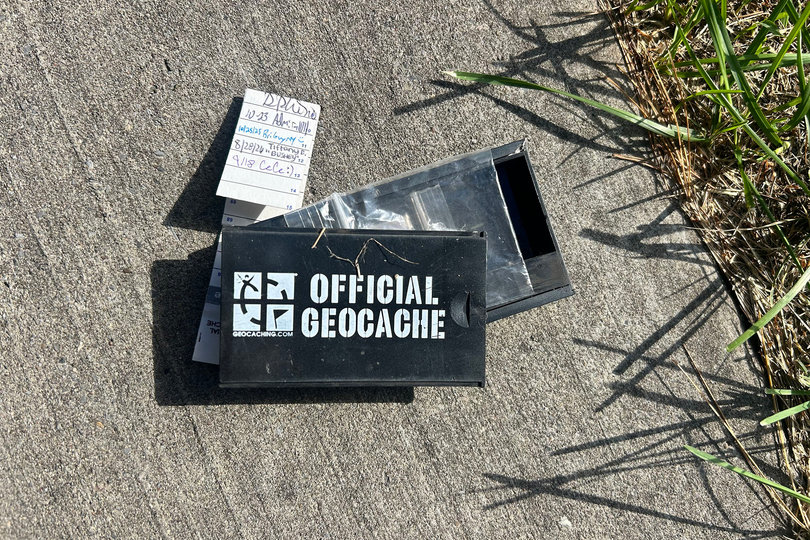
Geocaching is a real-world, GPS-guided treasure hunt. Players use published coordinates and clues — found on the geocaching app or website — to track down caches (hidden containers) stashed outside by fellow geocachers. When geocachers find them, they sign the logbook inside the cache and return the container for the next person. Some larger physical caches also include take-one-leave-one trinkets.
The area around SU has a rather large collection of caches, hidden in places like Thornden Park, SUNY Upstate Medical University’s campus, Walnut Park, Oakwood Cemetery and Green Lakes State Park, to name a few.
I’m ashamed to say that this simple cache — rated a 1.5 difficulty out of 5 on the game’s scale — took me an hour to find. This relatively simple-sounding hobby of treasure hunting may seem easy. But for new geocachers, it can be surprisingly hard to break into.
Karen Jane Gionet, who plays under the username “KJmoxiegirl,” stumbled into the hobby by accident. For the New York’s State Park system’s 100th anniversary in 2024, its yearlong Centennial Challenge included an option to complete 10 geocaches for one of the 100 “missions.” Gionet thought she’d find the minimum caches required and never do it again.
She didn’t start until August. That year there were 72 caches hidden across New York’s state parks, Gionet said. But, by the time she was done, she still found every one of them.
“I was hook, line and sinker into geocaching,” Gionet said. “I absolutely love it.”
Gionet has lost track of entire afternoons while geocaching in parks — walking into the woods in daylight and emerging as the sun was setting, still buzzing from the hunt.
After hearing about my own rather embarrassing outing, several seasoned geocachers pointed me toward the same resources: video tutorials and a glossary decoding the sport’s shorthand. It felt, at times, like wandering into a group chat mid-conversation.
One cache in Thornden had so many such acronyms in the description that I abandoned all hopes of finding it entirely. Let me take you through some of them.
FTF means first to find. DNF means did not find. TOTT — tools of the trade — covers the gear that cachers carry into the field: tweezers for pulling tightly-rolled logbooks out of thumbnail-sized “micro” containers, extendable poles with mirrors attached for checking inside guardrails and a pen — the most important TOTT of all, Gionet said.
Other terms Gionet picked up early: L&L for lock-and-lock, a snap-lid plastic container; AC for ammo can caches; and TYTF, aka thanks for the find.
Massachusetts-based cacher Katherine Gwozdz started in 2008 and said the language became second nature.
“(My husband and I) actually realized we were addicted to geocaching when we started talking using the acronyms,” Gwozdz said. “It was like, ‘Oh my gosh, we really have our own language, don’t we?’”
The types of caches can also be confusing. Not every cache is a container hidden in the woods. Traditional caches are the classic version: coordinates lead to a hidden box with a logbook inside, sometimes with small trinkets to trade.
Puzzle caches require solving a riddle or code before the real coordinates reveal themselves. Gadget caches hide the container in plain sight but lock it behind a mechanism that finders have to figure out how to open. Adventure Labs caches skip a physical container altogether, walking players through a series of questions tied to a town’s landmarks or history instead. One mystery cache, Mittman’s Geocoins, walks Syracusans through a math and thought puzzle in Walnut Park.
WHAT YOU SHOULD READ NEXT
Is Syracuse University haunted? We ghost hunted so you don’t have to.
Bird Library’s ghost hunting kit offered The Daily Orange a chance to explore the paranormal at SU.
Jason Mutford, a math educator based in Albany, has pushed the puzzle side of the hobby further than most, creating his own complicated cipher.
“I believe good puzzles should have ways that you can get into solving them and are satisfied when you do,” Mutford said. “Not that when you finally crack it, you go, ‘Oh, it was just this.’”
Mutford’s commitment runs well past puzzles. By his own account, he’s been on a streak of finding at least one cache every day since 2010 — closing in on 6,000 consecutive days by November. It’s the 18th longest streak worldwide.
“The day I needed an organ removed, I still managed to get my geocash of the day,” Mutford said. “Goodbye gallbladder, but I still managed to get an easy, park-and-grab kind of find.”
The rule he created for himself is simple: if he goes two straight days without wanting to go caching, the streak ends. In almost 16 years, that’s only happened once, he said.
Mutford said the transformation in his own life has been dramatic. He was roughly 50 pounds heavier when he started in 2004, watching hikers in their 70s pass him on mountain trails.
Health benefits come up constantly among veteran cachers, and not just physical ones. Gwozdz, a therapist by trade, calls the hobby her therapy — a way to clear her head after work, get outside and get moving.
The community shows up in person as much as it does online. Gwozdz hosted the Berkshire Geo Bash, a “mega-event” running for seven years before scaling back to a smaller annual reunion.
Caching solo has its own appeal, though, both Gionet and Mutford said. For Mutford, it’s a dedicated time to think through whatever’s on his mind. For Gionet, it’s simply the rush of the search.
For anyone thinking about trying geocaching, the advice from all three cachers landed in roughly the same place: start small, and don’t be afraid to ask for help.
So, if you run into a journalist up in a tree, either mind your own business or log into the app and join me.