What to know about the opposing sides of Westcott Theater’s permit conflict
Get the latest Syracuse news delivered right to your inbox.
Subscribe to our newsletter here.
After years of reported violent incidents and complaints from community members, the future of Westcott Theater is in the hands of Syracuse Common Council come Monday.
The live music venue has been the site of a stabbing and a shooting, though business owner Daniel Mastronardi denies involvement. Now, the council is considering revoking the special use permit allowing the theater to operate as an entertainment venue on Westcott Street.
If the special permit, given to the venue in 2008, is revoked, the company can apply for another permit. However, the new permit may not allow for after hours parties or comply with the theater’s lack of security, Councilor Hanah Ehrenreich said. Currently, the permit allows The Westcott to operate as an indoor entertainment venue even though it isn’t zoned for it, since the surrounding area is a neighborhood.
“It makes me disappointed and embarrassed that after nearly two decades of investing in the city, in the community, we’ve reached a point where the future of The Westcott Theater is being questioned,” Mastronardi told councilors during a Sept. 9 open hearing.
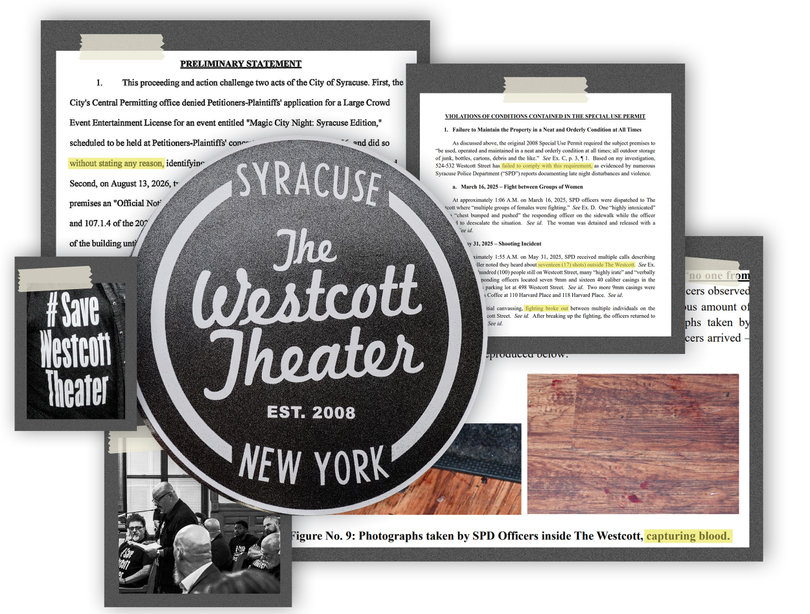
Community members and stakeholders spoke in front of the council during the public hearing, with most in favor of the theater. Some attendees even wore “#SaveWestcottTheater” T-shirts.
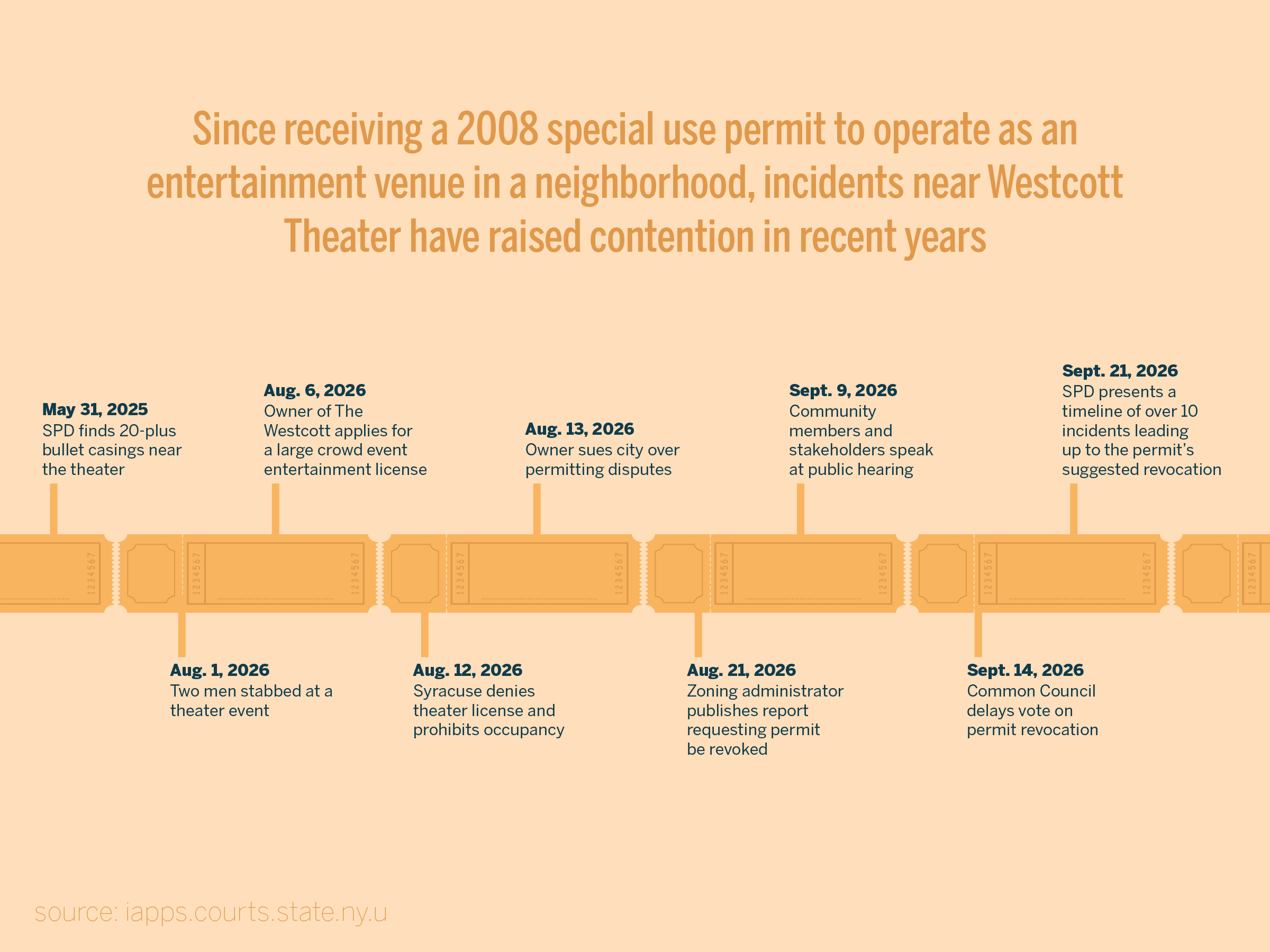
After a presentation of several incidents leading up to the permit’s suggested revocation by Syracuse First Deputy Chief Richard Trudell and Syracuse Zoning Administrator Jake Dishaw, the council confirmed the issue would be addressed and voted on at its Sept. 28 meeting after previously pushing the vote.
Councilor Marino Nave said he’s spoken to business owners in the area who said the theater’s crowds have caused damage to their businesses and community members who’ve felt unsafe. Only one community member spoke out in staunch opposition to the theater at the Sept. 9 hearing. Nave said others were afraid.
“People want quality of life,” Nave said. “They have a right to live in a peaceful, safe, clean neighborhood. And it’s our job as a councilor, it is to protect their rights, to clean, safe neighborhoods.”
Abigail Aggarwala | Digital Design Director
In August, Mastronardi sued the city of Syracuse and Director of Division of Code Enforcement Ryan Shiel after they denied an event license and temporarily closed the venue.
On Monday, an Onondaga County Supreme Court judge ruled that Westcott Theater can now host events that don’t require a special license. The decision says the city may have violated the theater’s First Amendment rights – the city has until Friday to respond.
In the lawsuit, Mastronardi claims the Central Planning Office denied his large crowd event entertainment license for an Aug. 15 event without explanation or opportunity for discussion.
The city claimed the permit was rightfully denied and said they reached out to Mastronardi with multiple bases for denying the event permit. On Aug. 13, the city also posted an Official Notice and Order, which said occupying the premises was prohibited until further notice. Mastronardi claims the order exceeds the city’s authority by shutting down the business without reason.
The order references previous failure of the theater to comply with licensed security staffing requirements.
In his affidavit, Mastronardi claimed a captain from the Syracuse Police Department threatened to arrest Mastronardi or his manager, Andrew Peck, if they host a party at the theater, as the order makes it unauthorized.
In response, the city’s lawyers referenced a stabbing at the theater and an event with insufficient security personnel as evidence the theater is “not maintaining the venue in a manner that ensures patron safety.”
The judge ruled Monday that these explanations were insufficient.
“No specific reasons or objective criteria have been provided to justify the closure,” State Supreme Court Judge John Dillon wrote in the decision. “Regardless of the validity of these concerns, they are not supported by competent evidence but are merely referenced in a memorandum of law.”
Mastronardi also claims a denial of procedural due process and that his business faces “irreparable injury” from the closure.
An August investigation by Dishaw revealed Westcott Theater violated the terms and conditions of its special use permit, referencing a “crescendoing level of problems.”
“It is my professional opinion that this failure is a violation of the terms and conditions of the 2008 Special Use Permit, and has had a detrimental impact on the character and development of the surrounding neighborhood,” Dishaw wrote.
Mastronardi denied these claims in a statement to The Daily Orange and said the report includes “misleading characterizations” and factual inaccuracies.
“Many of the statements presented as findings are, in our view, blatant fabrications that do not reflect the actual conditions of the Property or the conduct of our staff, management or security personnel,” he said in the statement. “The document relies on selective incidents and unsubstantiated assumptions that fail to acknowledge the broader context of public safety in the surrounding neighborhood.”
In Monday’s hearing, Trudell said SPD has been forced to send officers to the theater to assist with crowd control and break up fights on several occasions. Mastronardi said in his statement these claims place unnecessary blame on the theater for “shortcomings” in SPD’s response to incidents in the area.
“The document appears to place disproportionate responsibility on the Property while overlooking the role of law enforcement in maintaining public safety,” Mastronardi said. “This imbalance raises concerns about whether the City is errantly using regulatory authority to shift blame rather than addressing systemic issues.”
Davia Housley, a Syracuse resident and event coordinator, said she’s never felt unsafe at The Westcott.
Live music promoters and artists don’t support the negligence or violence at the theater, Housley said, but argued that there’s been no opportunity to present a solution together.
Dishaw’s 18-page report includes numerous instances in which he said the theater violated two conditions from the 2008 permit — “failure to maintain the property in a neat and orderly condition at all times” and “failure to abide by local regulatory and licensing provisions.”
WHAT YOU SHOULD READ NEXT
Syracuse community voices concern over Westcott Theater’s future at hearing
Syracuse Common Council held a public hearing Wednesday on the proposed ordinance requesting the revocation of the Westcott Theater’s permit.
On Aug. 1, two men were stabbed at an event held at the theater, according to SPD. While in the hospital, one victim told SPD officers the stabbing occurred inside The Westcott. After the incident, Mastronardi told syracuse.com that no one was stabbed.
According to Dishaw’s report, SPD officers who arrived at the theater that night found several spots of blood on the floor, which appeared to have been mopped up before SPD arrived. The report detailed that The Westcott staff told officers the floor had been cleaned because someone spilled a drink. The report also noted that no one from the theater called the police to report the incident.
SPD officers conducted a property check of the theater during a Skilla Baby concert in July and determined The Westcott had only 10 uniformed security – not the required 12, according to Dishaw’s report. A fight between two women also broke out after the concert, forcing SPD officers to conduct crowd control with one of the officers using pepper spray to stop the fight.
At the Sept. 9 hearing, Syracuse Chief of Police Mark Rusin said SPD’s attempts to work with the venue have been “brushed off,” specifically referencing the July incident.
In his statement, Mastronardi said he remains willing to work constructively with the city, but no office reached out to him “in a meaningful way” to communicate concerns or suggest working together to find solutions.
On May 31, 2025, SPD found over 20 bullet casings near the theater area after responding to early morning calls of shots fired, according to Dishaw’s report. After breaking up a fight in the area, the officers discovered two buildings and three vehicles had been struck by gunfire.
A video from the same night showed a woman being beaten in front of the theater.
“The video appears to show a security guard simply standing by and watching the beating take place,” Dishaw’s report reads.
The police department’s goals are hindered when they’re “forced” to send officers to a business that should be maintaining safety itself, Rusin told councilors on Sept. 9.
“I can’t tolerate this anymore,” Mastronardi said at the Sept. 9 public hearing. “This fact that there was a shooting around the corner from Westcott Theater has nothing to do with my business at all. It has nothing to do with how I run my business or what I do.”
According to the report, many local residents sent complaints and concerns to the city of Syracuse after the May 2025 events, sparking further action from the city.
Syracuse Mayor Sharon Owen’s Office referred The D.O. to Dishaw’s report when asked for comment.
City officials, both in hearings and in interviews with The D.O., stressed that their intention is not to shut down the theater or decrease live music in the area, but to increase safety.
“Live music needs to continue. There needs to be places for local bands and local promoters to thrive and grow. It cannot be a place that is absolutely riddled with violence,” Ehrenreich said. “The worst case scenario here is that somebody’s going to get so hurt that they die. That is not the price of live music in Syracuse.”
Housley said Westcott Theater is being held to a different standard than other venues because it showcases Black artists. Every venue that is Black-owned or caters to Black events is feeling the pressure, she said.
“We are watching Black events face scrutiny that does not appear to be applied equally across Syracuse nightlife,” Housley said at the Sept. 9 hearing. “Our music, our culture and nightlife should not be excluded and always included in that vision, not treated as a problem because the crowd, promoters and genres look different.”
For years, Syracuse promoters and club owners have said SPD shuts down hip-hop and rap concerts of Black artists at a rate at which they don’t for other music.
Ehrenreich pointed to an earlier lawsuit the city lost alleging SPD had more intensive permitting regulations for certain genres of music, such as Black and LGBTQ+ events. She said she’s heard from people involved in the live music scene that the previously discriminatory circumstances have changed since the lawsuit.
“I don’t believe that the people who came up to the mic, the promoters, I don’t think they knew the background, all the citations, even all the violence,” Ehrenreich said of those who spoke at the Sept. 9 public hearing. “So the artists and the promoters have a legitimate concern. They want to keep operating. And I want that very much to happen, but it can’t come at the expense of people’s lives.”
“(Working through legitimate problems) has become increasingly difficult for me in the feeling that The Westcott is not always being treated fairly,” Mastronardi said at the Sept. 9 hearing. “At times, we have seen several different levels of scrutiny depending on an event, a promoter or the audience.”
As of Thursday, The Westcott’s next event is scheduled for Oct. 16. On Sept. 1, the website included events on Sept. 24 and 26, as well as four dates in early October, all of which have since been removed.
Ehrenreich said she hopes to see the implementation of a new special permit allowing live music to continue at The Westcott with safety regulations in place for security and after-hours parties.
The theater is the “heart” of the area, Housley said.
“If we lose the heart, we lose Westcott,” she said.
Assistant News Editor Ryan Garipoli contributed reporting to this story.