Tactical trends from Syracuse’s 9 matches: 3-5-2 formation, wing fluidity
Get the latest Syracuse news delivered right to your inbox. Subscribe to our sports newsletter here.
Taking cover under the Clifford Ensley Athletic Center moments after Syracuse’s rain-ridden win over St. John’s, Ian McIntyre reflected on his team’s approach.
“I thought we started really well and got ourselves ahead in the game,” McIntyre said on Sept. 9 after SU’s largest win since 2023. “So, supposed, yes, we are a team that likes to be on the front foot.”
In each of the Orange’s six wins, they’ve scored first. Two of their three losses, both in the Atlantic Coast Conference, were shutouts. SU sits 14th in the ACC, just above 15th-placed Duke, with the Orange’s minus-3 conference goal differential providing a cushion over the Blue Devils’ minus-9.
Syracuse now enters a critical seven-game stretch, with six ACC games that’ll largely determine its ACC Tournament seeding and NCAA Tournament chances. On Friday, SU faces No. 10 Notre Dame, which is coming off a 3-1 win over then-No. 1 Stanford. The Orange’s sole nonconference matchup is Oct. 6 against undefeated No. 17 Akron.
Here are three trends that have defined SU (6-3-0, 0-2-0 ACC) through nine matches:
New backline complements midfield
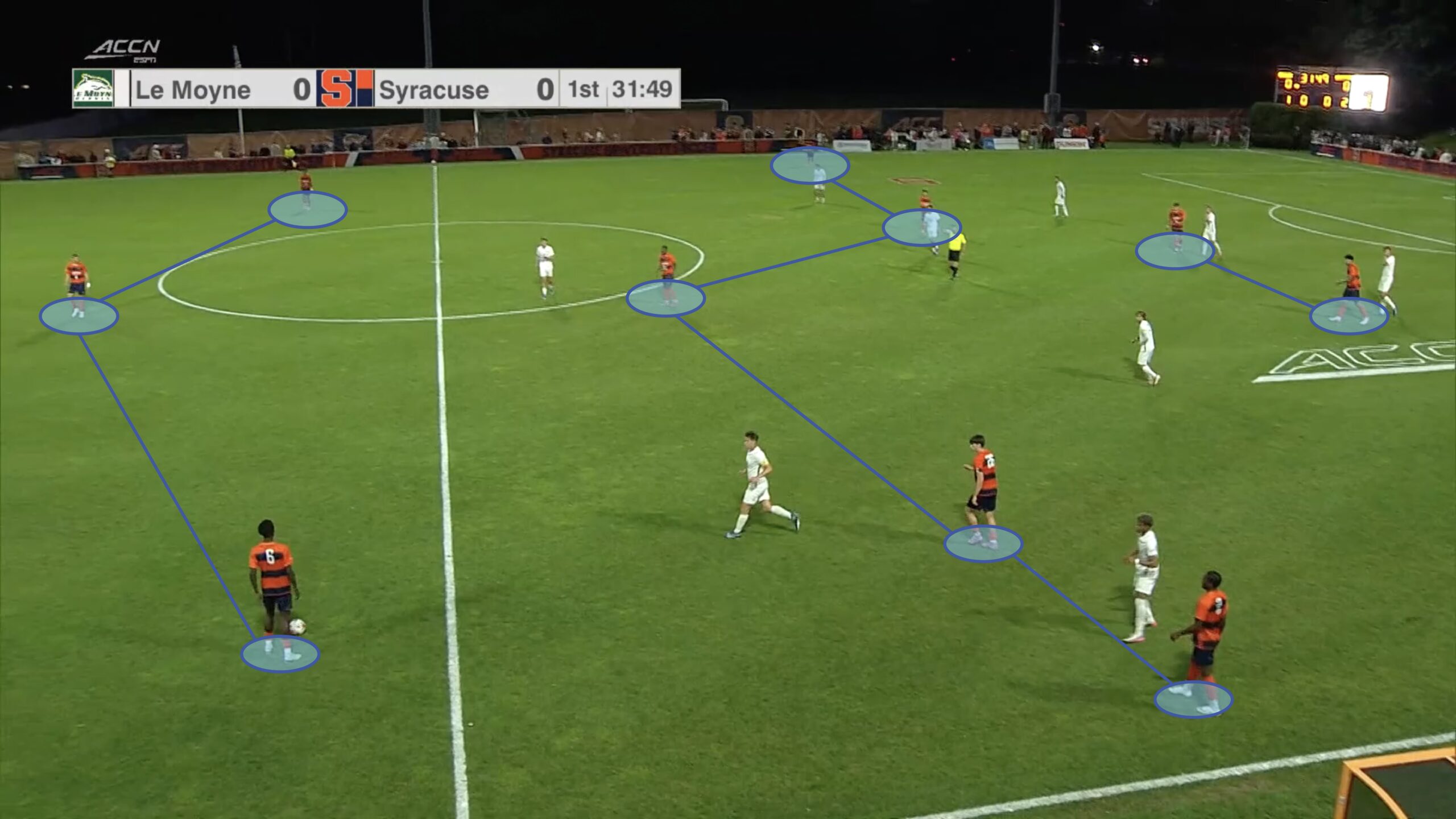
Syracuse typically lines up in a 3-5-2, although it’s also used a 3-4-3 this season. Below is an example of the base 3-5-2 from SU’s 2-0 win over Le Moyne on Sept. 19. Anchoring its back three is Buster Honeywood, who joins Ivan Irinimbabazi and Sachiel Ming as one of Syracuse’s three players to start every game this season.
Peter Hua Radosh | Asst. Digital Editor
Honeywood provides physicality in the back, while Garrett Holman excels in one-on-one situations. Their prowess gives Irinimbabazi — who moved to center back due to injuries to Pablo Patrick-Galvez and Dominic Bell in the spring — the flexibility to join the central midfield, usually alongside Kristjan Fortier, Kelvin Da Costa and Bryson Rodriguez.
Irinimbabazi and Rodriguez pace the Orange with 1.5 key passes per match — passes leading directly to teammates’ shots or assists — according to Sofascore. Adding Irinimbabazi to the midfield gives Syracuse an extra man there and lets Rodriguez push forward to attack.
Rodriguez’s three goals and two assists lead Syracuse, and he’s SU’s only midfielder among its top four shot creators.
Wing fluidity provides attacking, defensive stability
Watch any of Syracuse’s matches this season, and it’ll seem that Ming and Chimere Omeze never leave your view. Wide midfielders Ming, Omeze, Gabriel Oksanen and Dario White have scored or assisted 10 of SU’s 20 goals.
Ming leads Syracuse with three assists, while White has two. Oksanen has scored the tie-breaking goal twice this season, against then-No. 24 UConn and Le Moyne, while Omeze did the same at Colgate.
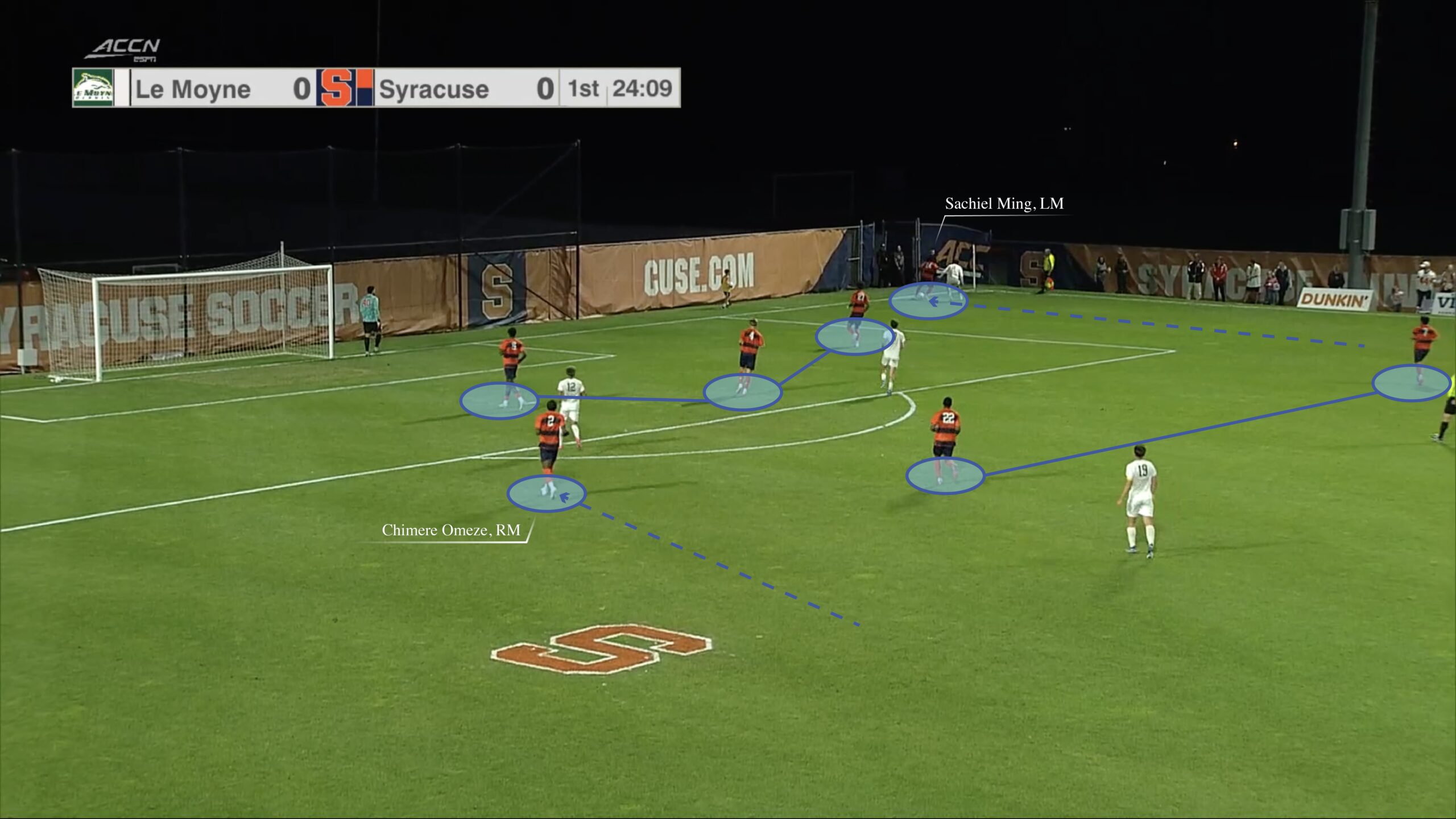
When possession is lost, the wide midfielders don’t hesitate to drop back on their respective flanks despite their nominal left- and right-midfield roles. Omeze and Oksanen are listed as defenders on the roster, and White is a forward, making Ming Syracuse’s only named midfielder. The wide midfielders’ versatility creates a back five when SU’s opponents have possession.
Below, Ming drops to his endline to recover a deep Le Moyne free kick. Omeze treks from his midfield spot closer to the three centerbacks, supporting them alongside midfielders Da Costa and Nathan Scott if an attack materializes.
Peter Hua Radosh | Asst. Digital Editor
Their work rate has been crucial in conference play. SU’s defense has allowed just 1.5 goals per game in ACC matches, ranking sixth in the conference.
Most notably, McIntyre moved Omeze into a back four against then-No. 18 Clemson, since Tigers midfielder Ransford Gyan had the second-most goals in the country at the time.
Ming frequently dropped in line with the defense, and although Gyan created Clemson’s sole goal, SU’s defense held him to one shot. Against Boston College, the Orange held the Eagles to just three shots on target.
Goals distributed among multiple strikers
Syracuse’s ACC and nonconference attacking metrics show a clear disparity.
The Orange are the only ACC team yet to score in conference play. Shift the focus to nonconference play, and Syracuse’s 20 goals lead its conference foes.
It’s no secret SU has struggled to find a striker to lead the scoresheet since Nathan Opoku and Levonte Johnson each scored 11 goals in 2022. Only one forward has led SU in scoring over the last three years: Nicholas Kaloukian in 2023, whose six goals tied with midfielder Lorenzo Boselli.
Early this season, McIntyre ameliorated the issue with transfers Jordan Grey, Pedro Gulli and Dakota Jonke. Adding in Badr Laghjibi, Landon Darko and Ming, Syracuse has a revolving ensemble of strikers who have scored half of its goals. Ming, Grey and Darko have started the most up top, but the Orange have rotated between six starting forward combinations.
SU’s forwards have thrived inside the box, scoring 13 of its goals there. Grey and Gulli provide the largest presence close to the net, standing at 6-foot-6 and 6-foot-3, respectively. Darko and Laghjibi, with two assists each, are central playmakers, while Ming has been electric on the left flank. Jonke has shown he can score free kicks.
Every player to start a game as a forward this year has at least one goal contribution. It’s all culminated in SU’s 3.13 expected goals per game.
But in conference play, the figure drops to an average of 1.50 xG, per Sofascore. In its 2-0 loss to Boston College, SU had an xG of 2.53 compared to BC’s 0.91. Syracuse had 19 shots, six on target, compared to the Eagles’ eight and three.
The Orange have had chances to get out in front in the ACC. They just haven’t converted.