‘Canal as Collaborator’ exhibit dissects people’s relationship with water
Get the latest Syracuse news delivered right to your inbox.
Subscribe to our newsletter here.
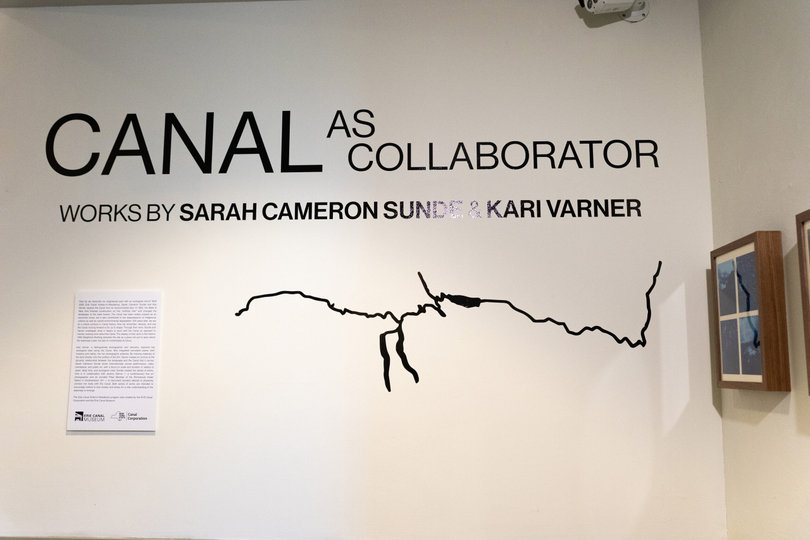
At Syracuse’s Erie Canal Museum on Sept. 18, artists Sarah Cameron Sunde and Kari Varner asked the public to examine how their identity is tied to water in the closing event of the museum’s “Canal as Collaborator” exhibit.
The exhibit is built around one question: “Will you surrender to the water?” — asking participants to put their bodies into the natural environment.
“The water is my collaborator,” Sunde said.
Since April 17, the exhibit, which closed Sunday, encouraged visitors to slow down and notice their relationship with water. The museum will continue to hold rotating exhibits with interactive displays, artifacts and programs to engage people with the Erie Canal’s impact, Angelyn Chandler, vice president of Planning for the New York Power Authority, said.
In 2023, Chandler’s team collaborated with the Erie Canal Museum, where Sunde and Varner were selected for a residency in 2025, including an exhibit of their multimedia projects.
“Sarah and Kari allowed all of us to see aspects of the canal that we weren’t so familiar with previously,” Chandler said.
Syracuse’s relationship with the Erie Canalway dates back over 100 years, but its presence remains relevant. In 2000, Congress adopted the Erie Canalway National Heritage Corridor Act. It designates 524 miles of waterway as the National Heritage Corridor across upstate New York, including the Erie, Champlain, Cayuga-Seneca and Oswego Canals, and it’s home to 3.2 million people. The Erie Canal, a significant work of engineering, ran through Syracuse until it was filled in around 1924.
The “Canal as Collaborator” exhibit contained two rooms; both explored how Sunde and Varner’s work engaged with the canal and water. The first room was covered in photos of Sunde posing on the canal — from a zoomed-in frame to a drone view. In one photo, Sunde is reaching for the canal with her hand. In another, she’s hugging a bollard.
The other room held a wooden replica of a barge, which displayed Varner’s work in an accordion-style photo book.
“It feels as though the photographs, the placement of Sarah’s body and these environments, it really does tell a story that helps you connect with history and the canal together,” attendee Laura Reeder said.
Reeder, who visited the exhibit earlier this month, said it resonated with her because she’s also an artist, and she finds it easy to surrender to nature. Reed believes that’s an important part of being an artist: physically putting oneself in their artistic project, like the canal.
On Sept. 18, Varner took viewers through her year-long artistic process, which included selecting three sites on the canal and observing them over different seasons.
Varner’s work on the canal also required her to study native and invasive species and plants. Much of her studies occupied Oneida Lake and the Northern Montezuma Wildlife Management Area, which inspired her to harvest plants on the canal and store them at her house for an extensive period of time.
“It’s utterly fascinating because each plant has its own story, and some of them are well established to the extent that they have been there since the 1700s,” Varner said.
During the first portion, Sunde and Joey Latka led a “Deep Listening Water Walk,” bringing visitors to a space outside where the canal would’ve been if it were still present in Syracuse. Latka, a Deep Listening facilitator from the Rensselaer Polytechnic Institute, brought attention to the physical surface attendees stood on.
Latka insisted on immersing oneself completely in their surroundings, hoping to gain a deeper understanding of one’s existence within a particular environment. He also asked attendees to focus on the smallest sounds in their environment and embody the history of the canal.
“Can you imagine the sound of water rushing as though we were actually standing in the canal?” Latka asked attendees during the session.
At one point, Sunde laid on the ground, and Latka encouraged people to sit with him, showing how bodies could physically connect to the environment.
“Imagine that the bottom of your souls are reaching down like the roots in a tree, as though you’re grabbing the core of the earth and you are so grounded,” Latka said.
Sunde and Latka reminded attendees of the 363 miles of concrete, steel, water and weather cutting through the canal’s landscape. Then, they asked attendees to think about their ancestors.
“What is your relationship with water? What is your relationship to the sea? What is your relationship to rivers and streams?” Sunde said.
WHAT YOU SHOULD READ NEXT
‘Patterns of Migration’ illuminates immigrants’ perseverance in adversity
Syracuse University alum Helen Zughaib’s latest exhibition showcases artwork focused on migration and American diversity.
Following the walk, Sunde and Latka led everyone to Clinton Square, where attendees applied the questions to the environment around them to practice awareness.
“What do you hear, touch, smell and, if you’re so bold, taste?” Latka said.
Many attendees walked around, soaked their feet in the fountain, closed their eyes, took photos and continued to socialize. The practice lasted for approximately 10 minutes.
Some found inspiration, but others like Edgar Westerhof, who works in urban and industrial planning, interpreted the square differently.
“You see all these majestic buildings and think ‘Wow, if only those buildings would’ve been at the water, and how much value those buildings would have been,’” Westerhof said.
Westerhof said he believed still having the canal in Syracuse would’ve sparked more economic growth. He said the immersive exercise made him sad because the Clinton Square fountain sits where the canal would’ve been.
After the Clinton Square experience, Reeder explained her differing view.
“It’s important to not to see the canal as just a vehicle for goods and industrialization,” Reeder said. “But it helped me reconcile how much damage the canal did to Indigenous peoples and how it functioned as a form of colonization.”
“Canal As Collaborator” felt different from Sunde’s previous projects, she said. “36.5 / A Durational Performance With The Sea,” one of her past works, involved being physically in water. But her approach with the canal changed on this project because she wasn’t able to physically spend time in it.
“You can see me (in the photo) literally trying to touch and reach for the water, so the barriers became a big part of it and dictated in many ways what my action was,” Sunde said.
Sunde hopes her art inspires people to ask new questions and to pay attention in a different way about their surrounding environments. Being aware of the canal’s significance and its history might be easy to understand if it’s taught in a classroom, but for Sunde, she believes art can educate in a deeper way.
Following the exhibit viewing and reception, Syracuse University professor of architecture and engineering Sinéad Mac Namara led a conversation with Sunde, Varner and other collaborators about their work on the project.
In the classroom, Mac Namara wants students to think about the Erie Canal’s history and significance beyond how it was built. Mac Namara believes students sometimes approach architecture or engineering with a limited perspective, which is why she worked on the project.
“I hope to create experiences that allow people to ask questions they might’ve not asked before,” Sunde said. “It’s really about how do we pay attention in a different way.”