SU College of Law hosts 1st-ever Syracuse NIL negotiation competition
Get the latest Syracuse news delivered right to your inbox. Subscribe to our sports newsletter here.
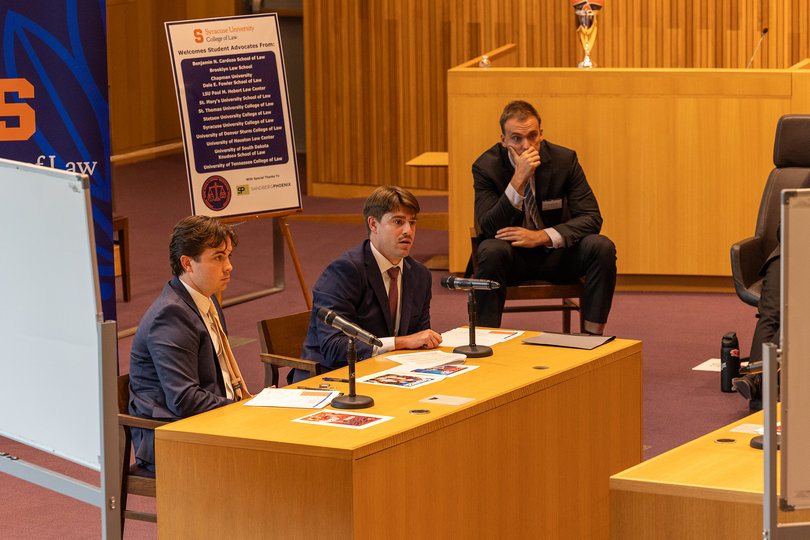
On Friday and Saturday, Dineen Hall became a hub of activity as law students from across the United States came to the Syracuse University College of Law for the first-ever Syracuse Name, Image and Likeness competition.
The two-day tournament, organized by third-year law students Will Baldwin and Cody Pearson, took inspiration from similar negotiation competitions the pair attended while at different law schools in New York and Louisiana.
“We were at a similar competition in New York, and as we were driving back, we were having a conversation in the car,” Pearson said. “We realized that, with Syracuse’s alumni connections in college sports, we could have a really good competition.”
“It was also close to when we were at another competition at Tulane, who are known for their sports negotiation competitions,” Baldwin added. “They have competitions for a lot of sports, but not for NIL, and we decided to fill that gap.”
Sixteen teams of two from 12 law schools as far as California competed in the two-day event. The first day revolved around three different fact patterns, each involving a different college athlete and company looking to strike a sponsorship deal. Syracuse law student Alejandro Kreimerman said the teams had a few weeks to study the fact patterns. But in just 45 minutes, teams were expected to agree on terms between the athlete and company.
The aim of the first day was simple. Post three scores as high as possible and earn a spot in the bracket stage on Saturday by finishing in the top half. A ticket to Saturday, however, added an extra wrinkle.
While teams had three weeks to prepare for Friday’s preliminary rounds, the fact patterns for the second day of competition were available only to those who advanced, giving them just 12 hours to prepare for the quarterfinals and 90 minutes for each subsequent round.
“When it came down to the 90 minutes, it became about narrowing down to information, like identifying our key terms, what we want and what’s our bottom line,” said Chapman University student and eventual champion Nate Montilino.
The nervous energy was palpable among the eight teams remaining in the competition on Saturday. The fact patterns departed from the athlete-company negotiations of Friday to simulate transfer portal negotiations.
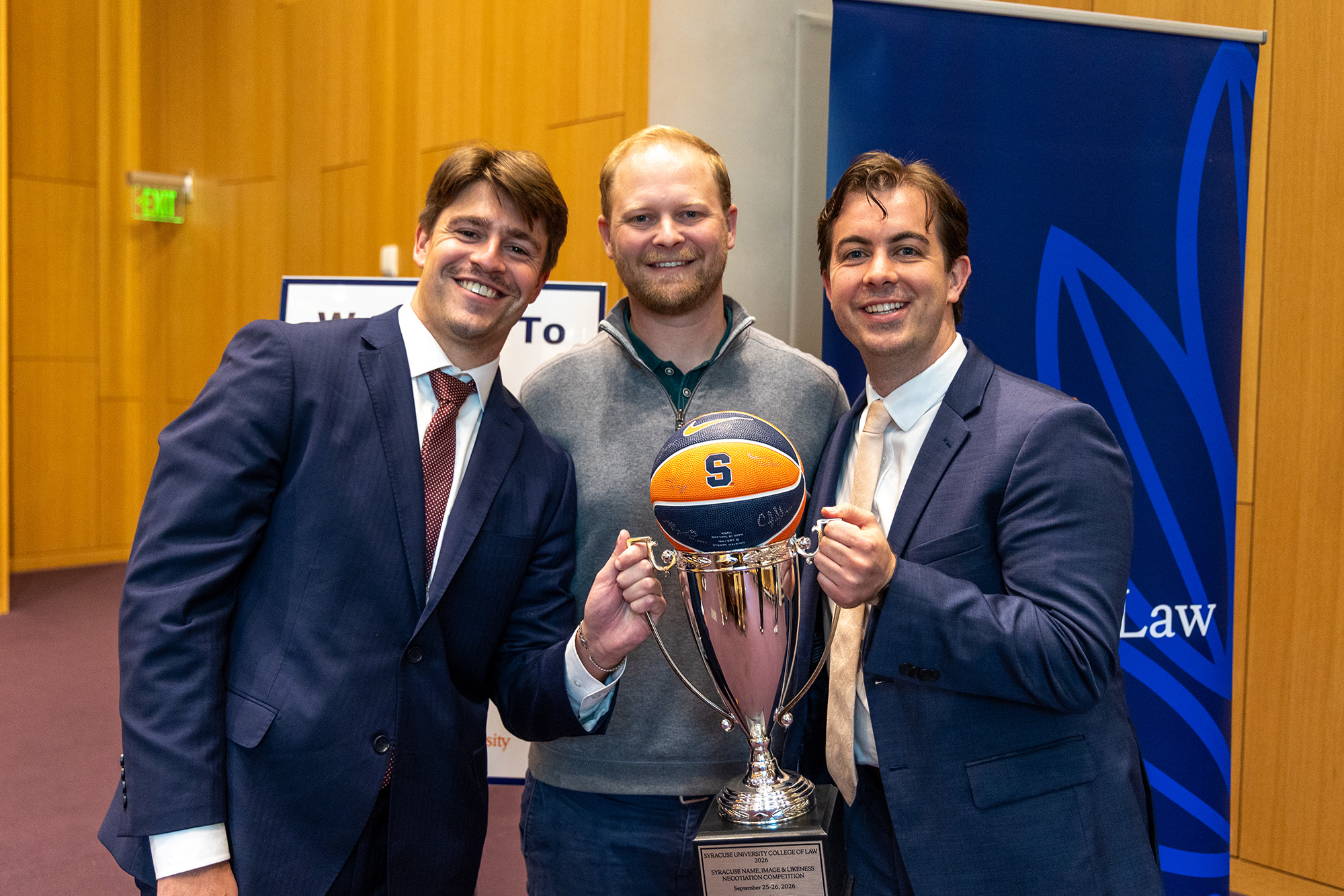
Chapman’s Nate Montilino and Harper Clayton pose with a trophy after winning the Syracuse Name, Image and Likeness negotiation competition. Chapman’s representatives won the overall tournament, while one student from St. Mary’s earned the award for best advocate. Eli Schwartz | Asst. Photo Editor
While the athletes in the fact patterns on Friday were lesser-known athletes outside of their respective sports, Day 2’s simulations included massive stars like Kentucky basketball marquee transfer Milan Momcilovic and LSU quarterback Sam Leavitt. The quarterfinal and semifinal negotiations asked teams to simulate what it might’ve looked like between players and the teams they ended up with as transfer details were finalized.
“These negotiation competitions can get really repetitive,” Baldwin said. “We didn’t want our competition to be six rounds of the same negotiation. That gets boring quickly.”
After two transfer portal negotiations, the competition narrowed to two teams. The final fact pattern was far different than the first two.
The two finalists, students from St. Mary’s and Chapman University, battled over a hypothetical negotiation, “based on the Josh Allen Wegman’s cereal box,” Baldwin said. The two pairs hypothetically represented Wegman’s and Syracuse men’s basketball, as the simulation revolved around a “special edition cereal box.”
The final took nearly an hour, 15 minutes longer than any other round. For almost 50 minutes, the two sides seemed too far apart to reach a deal, yet right as time ran out, they closed.
In the nearly 15-minute deliberation following the round, the two pairs dropped the adversarial tone that hung over the negotiations for friendly conversation about the competition.
At long last, the panel of three judges returned to share their overwhelmingly positive feedback with the teams and announce the winner. Despite Chapman’s representatives winning the overall tournament, one student from St. Mary’s earned the award for best advocate, given to the student who did the best job negotiating on behalf of the hypothetical clients.
For all the teams, NIL’s relevance was impossible to ignore as they moved through the bracket. The competition allowed teams to test the many gray areas around NIL, according to Harper Clayton, the other member of Chapman’s team.
“When you dive into the research for this competition and look to see what’s allowed and what isn’t, the answer more often than not is maybe,” Clayton said. “A big part of this is ‘How do you define what’s allowed here?’”