‘Salt City Responds’ to political climate through exhibit’s visual messaging
Get the latest Syracuse news delivered right to your inbox.
Subscribe to our newsletter here.
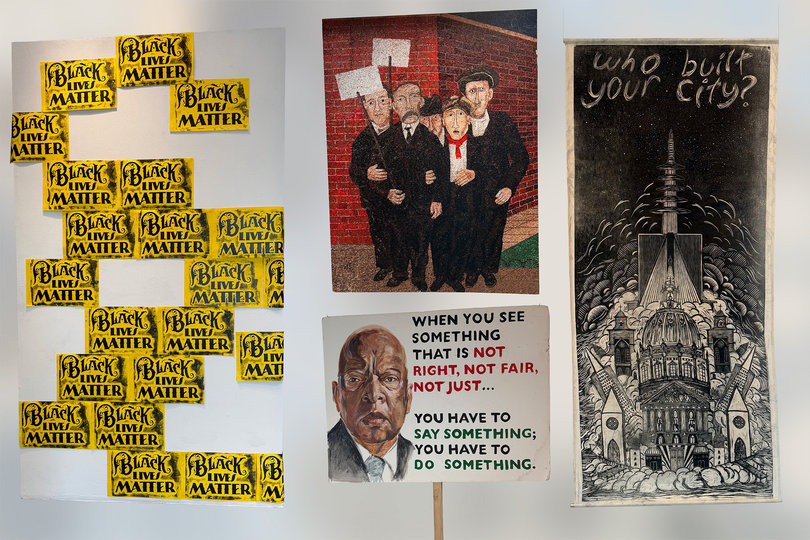
Bright yellow and black letterpress posters line a wall of Syracuse University’s Warehouse Gallery. Across the room, banners, musical instruments and artwork document decades of artistic activism. Between them is something less expected – empty space.
The space is intentional, Andrew J. Saluti, associate professor and program coordinator for museum studies at SU, said. Rather than filling the gallery with artwork, the organizers of “Salt City Responds” designed it to function as both an exhibition and a gathering place.
“It’s both creatively and visually about this idea of response, but it’s also going to be a functional center for response,” Saluti said. “There are going to be many events, many programs, performances, activities that are meant to bring people together in the space.”
“Salt City Responds,” on display at the Warehouse Gallery from Sept. 25 to Nov. 7, highlights Syracuse artists’ responses to social and political issues through public murals and printed protest works. Performances and workshops will also be hosted in the space.
The exhibition came together last spring after a previously planned show fell through, Saluti said. He and Lauren Baker, art exhibition operations coordinator for the Warehouse Gallery, then began considering how to use the newly available space.
Saluti looked to SU’s history of inviting artists to make statements about what they believe in, specifically “The Passion of Sacco and Vanzetti Mural” by Ben Shahn, which is located on the facade of Huntington Beard Crouse Hall. A reproduction of the mural is displayed in the exhibition.
For him, the show reflects a larger history that extends beyond the university itself. The city of Syracuse has always been an incubator for artists who want to create art about current events, he said. Saluti hopes the exhibition will make that history visible to students
“I think it’s going to illustrate to current students this long history that Syracuse has had with artists making work in response and being politically active,” Saluti said.
The exhibition includes a Black Lives Matter poster created in 2020 by Syracuse printmaker Carrie Valenzuela and her brother Cayetano Valenzuela.
In 2020, when protests followed the killing of George Floyd, Valenzuela, a single mother, wanted to contribute the only way she knew how – through art. A conversation she had with Syracuse arts advocate Cjala Surratt about printing protest posters gave her an idea.
Valenzuela called her brother and with his help, she was handing out the finished posters to people attending rallies by the end of the week.
“It was really powerful to see these prints that we made out in the world,” Valenzuela said. “It was really powerful to see how the visuals affect change.”
The experience strengthened Valenzuela’s belief that people don’t need to make large gestures for their actions to matter, she said. Her Black Lives Matter poster now hangs inside the gallery.
“Even if you think you’re only doing a small part, every small part matters,” she said. “Anybody can do it. Anybody can do something.”
Art can pave the way for conversations that might otherwise begin with disagreement, Saluti said. Rather than arguing across a table or asking a combative question at a lecture, artwork can become a stepping stone for debate and discourse, he added.
For Saluti, that role goes beyond the individual artist or viewer.
“It creates a communal engagement,” he said. “It’s an opportunity to engage with a community rather than a singular voice.”
The exhibition’s open floor reinforces that idea, leaving room for people to gather among the works instead of viewing them from a distance.
Zeke Leonard, an associate professor and program coordinator at SU’s School of Design, said the connection between art and collective action often happens through music. He contributed a 1920s Slingerland ‘May Bell’ tenor banjo to the exhibition. Leonard began carrying the instrument to protests because it is loud enough to be heard without amplification, he said.
Leonard believes that artists have a particular ability, as well as responsibility, to engage with the world around them.
“Our role as creative people is not just to exist in the world, but to engage the world,” Leonard said. “And a lot of time artists can say things that no one else can.”
The work displayed in “Salt City Responds” is not meant to act as a museum but instead a display of current artwork combating relevant issues, he said. That’s why the organizers emphasize the importance of the space being used to bring community together.
For Leonard, those gatherings matter because the exhibition can offer a reason to believe that individual and collective actions still have meaning.
“So many people that I know right now are feeling so hopeless about how the world is put together, about our role in it,” he said. “People are feeling hopeless about their ability to have a voice and be heard.”
Leonard said he wants the exhibition to be a beacon of hope for attendees and community members. Saluti also hopes the show encourages younger artists to think about what their own work can communicate.
“Artwork really does create this voice and this visibility to support what you believe in,” Saluti said.