
Spoons, whisks create experimental ‘noise music’ at Syracuse ArtRage Gallery
Get the latest Syracuse news delivered right to your inbox.
Subscribe to our newsletter here.
Frank Derrigo often travels over 45 minutes from Adams to Syracuse for the Salt City’s music scene. On Friday, he trekked to the ArtRage Gallery to listen to noise music — an experimental genre composed of nonmusical sounds from traditional objects or experiences — at the Experimental Music Night: Featuring Flose, Matt Weston, Paige Driass and Caleb Crittenden.
Derrigo said he loves “all flavors of music,” going from classical music events like the Pacifica String Quartet to the Experimental Music Night. He described noise music as challenging and “abrasive,” but not in a negative way.
“Elements of it I’ve heard since the Beatles put ‘Revolution 9’ on the ‘White Album,’” Derrigo said. “People have been doing this for a long time.”
On Friday, ArtRage Gallery — a nonprofit art gallery that focuses on social justice — hosted three experimental music artists from across New York state. Curated by Crittenden, a Syracuse local, the event displayed an avant-garde sound — noise music.
The show had three performances: the first by Crittenden, the second by Albany-based drumming duo Matt Weston and Paige Draiss, and a third performance by Brooklyn-based artist Charles Chatman and their noise project Flose.
From Pink Floyd’s “Ummagumma” and “The Dark Side of the Moon” to the modern rise of ASMR, the concept of noise composition isn’t new to the music scene.
“Flose,” the noise project and Chatman’s performing alias, was the central performer on this show. From studying music at Cornell University to starting their own “nondenominational live noise project,” Chatman became Flose in 2017. Chatman merges “found sounds” — electric toothbrushes, plastic spoons, computer sounds and toy instruments in their music. They describe the noise music they make to be “finding the space of noise where all different musical tendencies can live together.”
Chatman said there’s a certain “catharsis” from “extreme music.” At the ArtRage Gallery’s Friday show, the approximately 20-minute Flose performance flowed in and out of cluttered and smooth sounds. During Flose’s spotlight, some audience members closed their eyes, tapped their feet or did their best to nod along — even if they didn’t know where the music was heading.
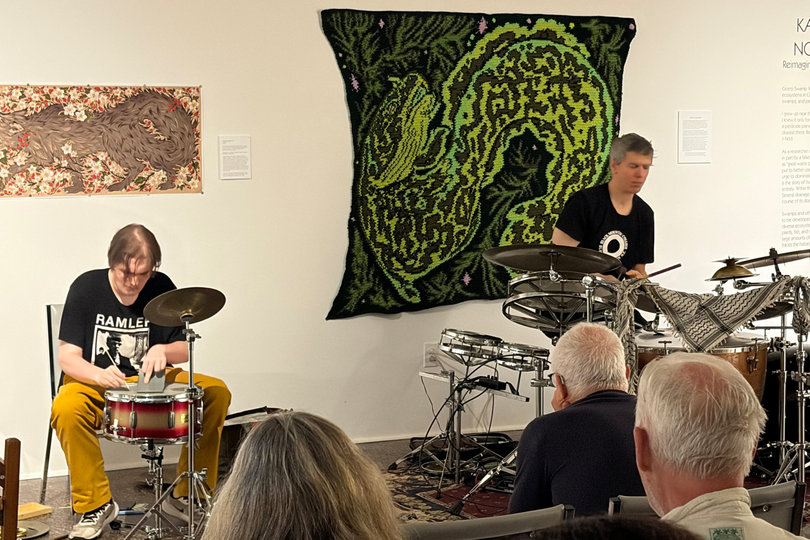
Matt Weston and Paige Draiss were the second act of the show. Their improvisational performance consisted of drum sets and various other instruments, like the lid of a kitchen pot, a violin bow, a whisk and a trumpet. Coincidentally, both Weston and Draiss started playing the drums at 8 years old.
Draiss described a growing and innate urge to play experimental “noise” music after being introduced to it through musicians like Ornette Coleman. Before Draiss discovered noise music, they said the music they were playing wasn’t very imaginative for them.
“Playing all this complicated rock drum stuff, I just didn’t feel satisfied by it,” Draiss said. “It felt much more of a physical endurance thing rather than anything that was like mentally stimulating or aurally stimulating.”
Crittenden, who performed and curated the show, said the New York State Council on the Arts funds various music projects around the state, including the Experimental Music Night Friday. Crittenden previously performed at Slanty Shanty, which was a popular, makeshift music venue located in a Syracuse basement, along with various other “secret locations.”
At Experimental Music Night, Crittenden’s piece was oriented around the science of naturally occurring sounds, according to the handout passed around before his performance. Projected on the gallery’s wall, a display of various dots shifted with the noise controlled by Crittenden. The music heard was “something between an instrument and a weather system.”
Crittenden is drawn to noise music because he can listen to “weird songs forever,” he said. His pull toward “weird” and unconventional sounds comes from being in punk bands as a teenager and, as Crittenden describes it, humans’ natural tendency to question themselves in their listening.
WHAT YOU SHOULD READ NEXT
BareRoots Music Festival hosts CNY talents as love letter to Syracuse
On Saturday, BareRoots Music Festival returned to the Thornden Park Amphitheater for its second year, showcasing local musicians and vendors.
“We like sounds, there’s a lot of ways that the world we live in is tailored to making pleasant sounds, the sound design of life, like the sound your car makes,” Critterden said. “We make some investment into these sounds, even though it’s just a tactile sound.”
Crittenden recalled one of his earliest experiences being drawn to sound as a pleasing hum from a school radiator.
“I didn’t know it then, but the act of listening to something nonmusical and recontextualizing it as music is what I was going to do later in my life,” Crittenden said.
Ellis Clay, co-director of the gallery, believes experimental music and sound has a special place in social justice movements.
“For me, what Caleb and the people were doing last night is larger into the structure of social justice movements, even though their specific way of using sound is not how I’ve seen artists do it.”
Noise music has been pushing boundaries and expectations since the early 1900s, from Luigi Russolo’s noise symphonies to the Beatles’ “Revolution 9.” Experimental Music Night invited artists and audience members alike to rethink the boundaries of music.
“We’re all doing sound for the joy of sound,” Crittenden said. “And we’re rejecting a lot of limitations.”