Syracuse artist reimagines Cicero Swamp’s nuanced legacy in ‘No Man’s Land’

Get the latest Syracuse news delivered right to your inbox.
Subscribe to our newsletter here.
Syracuse-based artist Katie Mulligan, 29, grew up about 10 miles from the Cicero Swamp Wildlife Management Area, but she doesn’t necessarily remember it fondly. Her first impressions of the wetlands involved running back inside her house while a pesticide plane flew overhead and hearing local stories of rattlesnakes living around the area.
“Initially, I was really kind of terrified of the swamp,” Mulligan said.
But now, Mulligan embraces the wetlands.
Mulligan’s “No Man’s Land: Reimagining the Myth of Cicero Swamp” is on display at Syracuse’s ArtRage Gallery through Oct. 24. The exhibition examines the history of Cicero Swamp through colorful illustrations, fiber work, archival research and environmental history. Mulligan said the display challenges the idea of wetlands being dangerous or unproductive spaces. Instead, Cicero Swamp is presented as a complex ecosystem that has supported life for thousands of years.
Cicero Swamp is a nearly 5,000-acre network of scrublands, forested swamps and peat-filled bogs in Cicero. For Mulligan, who completed her undergraduate studies in illustration at Syracuse University in 2020, the swamp carries personal significance.
“I’d been drawing the swamp a little bit,” Mulligan said. “I’d been thinking about the project and I just never had time to explore it or do the research.”
Now, as a current third-year graduate illustration student at SU, Mulligan had the chance to dive into the project. She began investigating the landscape through the Onondaga Historical Association’s archival materials, environmental research and art.
She found a history much richer than the one she remembered from her childhood.
Beginning in the 19th century, local Syracuse publications like the Post-Standard repeatedly described the swamp as a “great waste place” and “No Man’s Land,” according to Mulligan’s exhibit. There’s been a lasting perception that swamps should be made into something more productive or useful, Mulligan said.
Mulligan’s research shows this negative perception of wetlands isn’t isolated to Cicero. The swamp’s history reflects a broader trend of treating wetlands as obstacles to development, she said. Through Mulligan’s research, she found that over half of the wetlands that once existed in the United States have been drained.
Her exhibit uncovers how the public’s wasteland label obscures the wetland’s biodiversity. The Cicero swamp contains rare plants, fish, migrating birds and other wildlife depicted in Mulligan’s illustrations. Paired with her illustrations is additional information about the benefits of the swamp. The wetlands filter water, reduce flooding and store carbon and can help fight climate change.
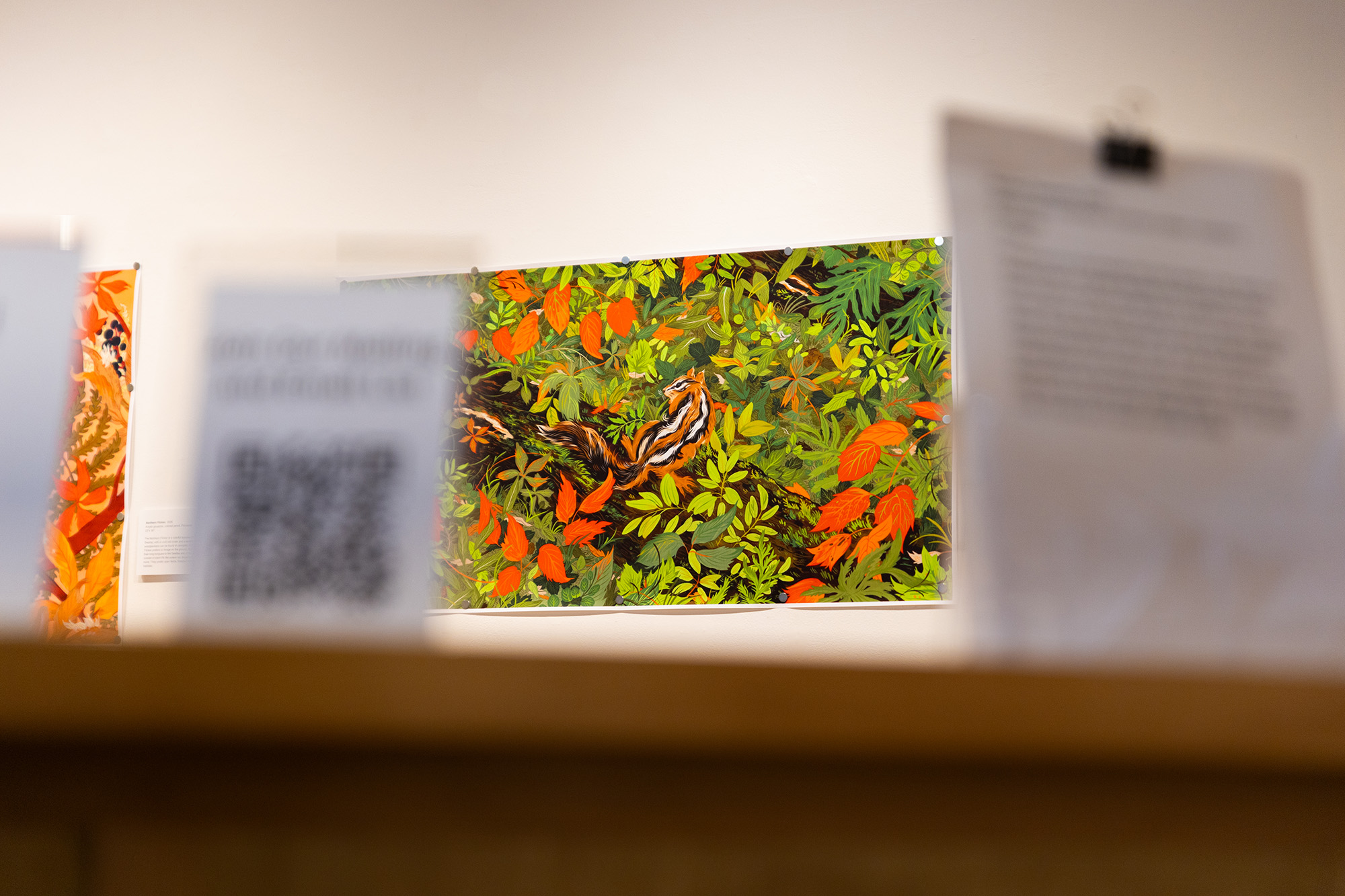
Created by Katie Mulligan, this piece of art features a squirrel traversing vegetation. Mulligan’s exhibition at Syracuse’s ArtRage Gallery highlights the biodiversity of wetlands. Kedar Nair | Staff Photographer
John Haritatos, who has been volunteering at ArtRage for about 15 years, said Mulligan’s local connection to Syracuse makes the exhibition especially meaningful.
“I’m very impressed that the artist is local and grew up close to Cicero Swamp,” Haritatos said. “She’s a terrific detailer and I like the fact that she’s ecology-based and she’s throwing the importance on the swamp because it’s an eco thing.”
Mulligan documents the swamp’s history through colorful illustrations, acrylic gouache, colored pencils, digital work, wire, recycled materials and fiber, like crocheted yarn.
Mulligan’s choice to work with fiber began during her time at SU, partly inspired by her grandmother’s crocheting. But she also became interested in how fiber could challenge the threatening image traditionally associated with the swamp.
“A lot of people really want to touch the fiber sculptures,” Mulligan said. “I wanted to play with this idea that the swamp is really uninviting and sort of evil and scary. And I think depicting swamp things in fiber is almost inviting people in.”
As she researched Cicero Swamp, Mulligan noticed that many historical accounts centered on men entering the swamp and attempting to conquer it. She used fiber as a medium to introduce her own perspective as a woman into that history.
By using fiber — typically used by women — Mulligan hoped to challenge the stereotype she saw with males dominating swamp research. Mulligan wanted to use her art to critique gender dynamics.
One of the pieces on display, “Burbot Tapestry,” a 57-by-58 inch tapestry depicting a burbot (a cold-water fish), took about two months to complete. She created an illustration, turned it into a pattern and translated it into fiber, drawing on her admiration for the fish’s story. The burbot’s population has declined significantly in recent decades, one of the small but steady signals of stress on Cicero Swamp’s ecosystem.
The materials themselves also carry an environmental consideration. Mulligan said about 95% of the yarn used in her work was donated or community sourced — in part because acrylic yarn is environmentally harmful.
For some visitors, like Miranda Hein, the exhibition’s history is strongly tied to what is happening around the city today.
Hein, a Syracuse resident and elementary school teacher who often visits ArtRage’s exhibitions with her students, said she was struck by the connection between Mulligan’s work and the Micron Technology development happening nearby.
WHAT YOU SHOULD READ NEXT
Spoons, whisks create experimental ‘noise music’ at Syracuse ArtRage Gallery
At ArtRage Gallery’s Experimental Music Night, Flose, Matt Weston, Paige Driass and Caleb Crittenden performed noise music, an experimental genre that incorporates nonmusical sounds.
“I just drove down from Cicero, and I passed the new Micron. And that is terrifying,” Hein said. “This huge area is just leveled. And what we’re doing to nature is pretty upsetting when you look at these and you think, ‘These are animals that had homes.’”
Hein plans to bring her students to the exhibition at the end of October to show them how Mulligan’s colorful illustrations teach viewers about the swamp.
For Mulligan, the exhibition is not only about telling people what has been lost. It’s about encouraging them to become curious about what remains, while showing the years of ecological history that shaped the swamp.
“I think often (wetlands) are not really thought of or they’re kind of in the background,” Mulligan said. “I would really love it if people left with more of a sort of understanding or curiosity about wetlands.”