SU alum presents We Are Social agency, shares AI strategy at speaker series
Get the latest Syracuse news delivered right to your inbox.
Subscribe to our newsletter here.
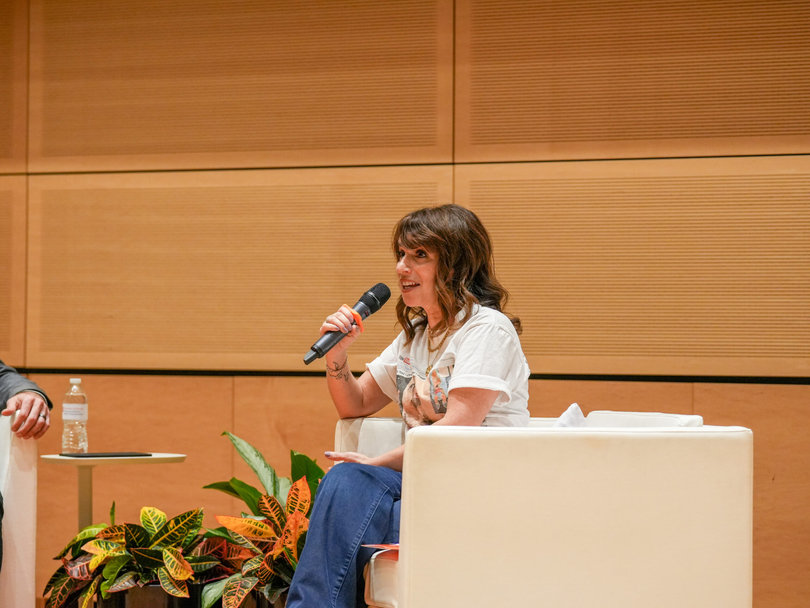
Even if they didn’t know it, many audience members may have already been familiar with Rebecca Coleman’s work before attending her event Wednesday. The Syracuse University alum is behind many well-known advertising campaigns, including McDonald’s celebrity meals, the #GentleMinions trend and Visa’s “Tap In” campaign with Jason Sudeikis.
Coleman, CEO of advertising agency We Are Social, spoke as part of the Leaders in Communications speaker series, hosted by the Newhouse School of Public Communications. Adam Peruta, Newhouse’s director of advanced media management and interim chair of advertising, moderated the event.
The pair discussed how to engage audiences and create social media momentum, as well as how artificial intelligence technology is reshaping the advertising industry, drawing on Coleman’s experience at We Are Social.
Coleman began by presenting some of We Are Social’s most recognizable campaigns to give the audience context on the agency’s prior work. The agency focuses on using social-led thinking to create cultural momentum online, Peruta said. It has worked on many notable campaigns, with brands including YouTube, Adidas, Visa and McDonald’s.
Coleman referenced We Are Social’s involvement in Adidas’s “You Got This” campaign, which launched during Super Bowl 2024.
The campaign aimed to help Adidas leverage the Super Bowl’s audience to gain visibility for their new platform without a TV advertisement spot during the game. We Are Social combined an internet trend, where people throw a football over their house and run through the house to catch it on the other side, with an iconic venue, the Las Vegas Sphere. A video featuring Kansas City Chiefs quarterback Patrick Mahomes playing a game of catch with his younger self was played on the screen at the Sphere.
According to a case study Coleman shared during the presentation, aerial footage of the Sphere received 97 million views on Instagram and 58.8 million views on TikTok.
Peruta said the program chose to bring Coleman in because We Are Social has learned to “hijack” popular culture in order to create more engagement from audiences.
“Their approach to advertising and building campaigns for brands and services is about being relevant and tapping into present-day culture and trends, and so they’ve had some really amazing success by taking that approach,” Peruta said.
During a Q&A at the end of the event, one student asked Coleman if she has a specific memory or piece of advice from a professor that she still applies to her job today. Coleman, who graduated from SU in 1998, shared that Professor Robert Thompson told her a story about how Bruce Paltrow would put Easter eggs into various episodes of St. Elsewhere, a show he directed and produced. Coleman said this taught her to look for the little things in her work that can bring joy to both herself and the audience.
In another campaign, We Are Social used artificial intelligence to create an interactive dining experience, actualizing the fictional restaurant WcDonald’s, that appears in anime and manga culture. Coleman said the team used AI to create the projection mapping that brought the WcDonald’s world to life for customers.
“It’s one of those things that blew me away, and something that wouldn’t have been possible before we had this advanced technology,” Coleman said.
Coleman said rather than taking over jobs, AI technology is actually encouraging an increase of human touch in advertising. Agencies are working to tell brand stories, incorporate human-made art and utilize episodic content. The challenge for agencies now is to determine how to incorporate AI to increase efficiency, Coleman said.
Peruta said AI isn’t going to disappear, and therefore can not and should not be avoided. Students entering the workforce in the era of AI are at an advantage because they can leverage their knowledge and experience with AI, Coleman said.
Sophomore Sophia Hasch said the event gave her tangible advice on how she can use artificial intelligence to think outside the box and stand out in internships.
“(Coleman) talked a lot about how (AI’s) not taking our jobs, and it can be used to think outside the box and stand out in internships,” Hasch said.
It’s important to understand how to use AI as a tool, no matter what major you’re studying, Peruta said. He said it’s crucial for students to enter the workforce with an understanding of this technology.
“As much as AI is bad at some of the creative things right now, if you’re studying advertising or PR and even journalism, unfortunately or fortunately, you’re going to be expected to hit the ground running and join that agency and be familiar with the AI tools and capabilities,” Peruta said.
AI is changing advertising, not taking over, Coleman said. She said she has never done better work in her life than in the age of AI.
“AI is pushing our clients into a creative renaissance,” Coleman said during the event. “They’re letting us do things they haven’t let us do for the past 10 years.”