
‘The Social Reckoning’ is messy, but its questions on social media matter
Get the latest Syracuse news delivered right to your inbox.
Subscribe to our newsletter here.
From the opening of Aaron Sorkin’s “The Social Reckoning,” the story is convoluted. Sorkin, who graduated from Syracuse University in 1983, depicts a woman filming police officers and accusing them of racism. The audience understands the message right away: Social media can twist narratives. However, the scene is dragged out and makes a clear message unnecessarily confusing.
Although the movie stumbles over pacing issues, cliche moments and confusing dialogue, Sorkin’s “The Social Reckoning,” the sequel to Sorkin’s Academy Award-winning “The Social Network,” asks questions about social media regulation, journalism ethics and the reality of big tech in the 2020s.
The film’s inconsistent and random time jumps — flipping between 2019, 2020 and 2021 — make the story hard to follow. Despite providing thought-provoking messages, they’re confusing and cliche.
Launched in Oct. 2010, “The Social Network” told the true story of Mark Zuckerberg — a genius Harvard University student depicted as a selfish innovator. “The Social Reckoning,” set in the modern-day, tells the story of journalist Jeff Horwitz (Jeremy Allen White) and Facebook whistleblower Frances Haugen (Mikey Madison) as they break the “Facebook Files,” a series of reports published in 2021.
White plays a Wall Street Journal reporter who gets assigned to cover technology — though he knows next to nothing about it. In one remark, White’s character doesn’t even know how to work a GPS.
Haugen is an engineer at Facebook on the Civic Integrity team. When she starts investigating Facebook’s algorithm, she becomes skeptical of how posts are shared on the platform. That serves as the catalyst for the movie’s story.
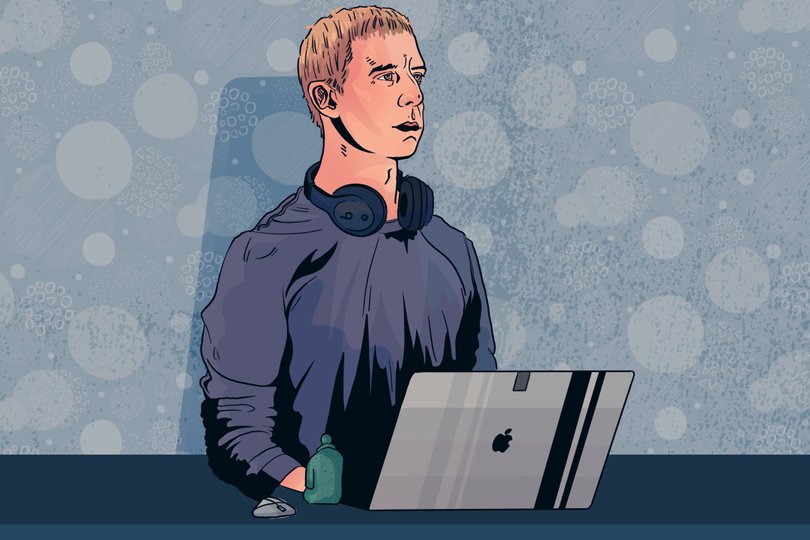
The film’s best moments take place in 2021, when Zuckerberg (Jeremy Strong), is preparing and practicing lines for an upcoming congressional hearing. There, we learn about the movie’s central conflict: Facebook’s Meaningful Social Interaction ranking.
Jesse Eisenberg, the actor for Zuckerberg in The Social Network, refused to return to his role for the sequel, which I would’ve preferred as a way to connect the two films.
The Facebook metric scores posts based on comment quality, shares, reactions and relationship strength, influencing how content appears in a user’s news feed.
In order to improve the platform, Zuckerberg weighs allocating more metric points to reposts, although engagement and profit would decrease. However, the most shared content on Facebook includes misinformation and content made to make people angry, which Zuckerberg and executives knew before pushing reposts.
The move to emphasize shares couldn’t come at a worse time amid worsening political violence in the United States during the early 2020s, headlined by the COVID-19 pandemic and Jan. 6 Capitol insurrection.
Those real-world events are mentioned in the film but feel brought in for next to no reason.
Although both served as examples of events rattled by misinformation specifically shared on Facebook, the way the events serve as the climax of the film leaves much to be desired.
Instead of an ending focused on Horwitz and Haugen, the movie instead focuses on the Jan. 6 insurrection, which is introduced in the film’s final 10 minutes.
Haugen hoped to prove Facebook executives knew about the dangers of the ranking system when they implemented the feature. The film follows her as she meets with Horwitz and leaks internal documents proving the danger of the technology.
Although the ranking algorithm is an important issue, Instagram — also owned by Zuckerberg — and its dangers for teens, specifically young girls, is lightly touched upon in the movie. If “The Social Reckoning” focused more on those issues, which matter more to Gen Z, maybe it would be doing better at the box office than its predecessor.
My favorite moments in the movie were the scenes that provoked a crucial question: Should social media be regulated? Or should it serve as a democracy without restrictions?
Bill Burr plays Charlie Garrigan, a former Facebook investor and member of Zuckerberg’s legal counsel. Burr asks Zuckerberg to do one-simple thing: fact-check all political ads on the platform.
Zuckerberg argues that Facebook serves as a “public square,” not a regulator. He calls himself a “prophet” of free speech, refusing to regulate content on the platform. Garrigan argues that the lack of fact-checking misinforms millions of Americans and harms the public.
Based on acting alone, Strong and Burr stand out in stellar roles. Strong’s impersonation of an older Zuckerberg that is cold and awkward was so spot on that it made me feel like I was watching the tech billionaire himself. Garrigan’s dynamic with Zuckerberg made me rather want to watch that hypothetical movie instead.
Strong and Burr’s back and forth arguing in multiple scenes is when the movie presents you with its core messages, all stemming from a dispute over fact-checking political ads.
Unlike Garrigan and Zuckerberg, Horwitz and Haugen’s interactions are marked with so much confusing dialogue that I’m not sure the actors even understand what they’re saying.
Every conversation is marked with statistics that add nothing to the story and odd references that miss the mark.
WHAT YOU SHOULD READ NEXT
Robert Pattinson lands chilling ‘Primetime’ portrayal despite tepid framing
Despite Robert Pattinson’s unnerving performance, the muddled message of “Primetime” keeps the film from becoming one of 2026’s greats.
Although the acting in The Social Reckoning could’ve been better, both Haugen and Zuckerberg achieve notable character arcs by the end of the movie.
Haugen believes in her role at Facebook, preaching the company’s drive to connect people. However, when she realizes the work she’s doing is causing more damage than good, she gives up her role at Facebook and stands up against the giant tech company.
Along the way, she becomes more confident in herself, more open and fearless for what might happen to her.
On the contrary, during the Capitol insurrection, Zuckerberg finally gives in to some regulation. President Donald Trump, who denied the 2020 election results, posts encouraging videos for the rioters on Facebook, while executives urge Zuckerberg to take them down.
After minutes of silence, Zuckerberg finally gives in, taking down Trump’s posts and banning him from the platform. Although never mentioned by name, the film directly references Trump multiple times, adding more complexity to Zuckerberg’s regulation dilemma.
Anyone with concern over social media and the current state of tech should watch this movie. In recent years, Facebook has been the subject of numerous mental health lawsuits and criticisms. Facebook proves to be bigger than any oversight in the movie.
The film ends with a jarring statistic: 43% of American adults receive their news from Facebook. After watching, I was left wondering: If major news publications go through rigorous fact-checking (including the one you’re reading right now), why doesn’t Facebook?