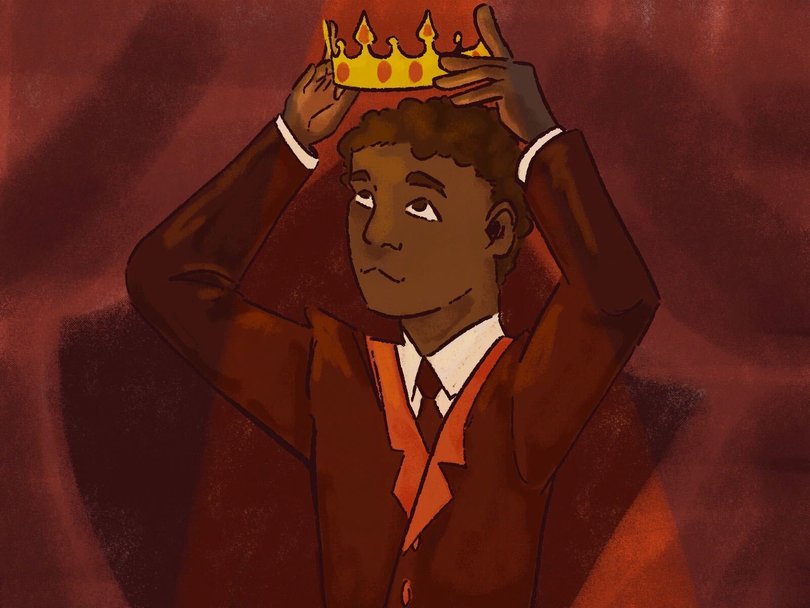
Black excellence at SU is rooted in community. We must continue to show up.
Get the latest Syracuse news delivered right to your inbox.
Subscribe to our newsletter here.
I never grasped how small Syracuse University’s Black student population was until I attended this past May’s Black Graduation ceremony in the JMA Wireless Dome.
Watching my two fraternity brothers saunter across the stage, I estimated there couldn’t have been more than 150 other Black faces sitting in Section G.
I knew I attended a predominantly white institution, but seeing how few of us were gathered in one section made that reality more concrete. During the 2025-26 academic year, 1,877 of SU’s 21,922 students were Black or African American, making up 8.6% of the university population.
Watching my brothers cross the stage made me question what success looks like for Black students at SU and how much we expect from ourselves to achieve it. I never questioned what Black excellence meant growing up. To me, graduating from college was what defined excellence alongside being talented, driven or wealthy.
I’ve come to realize that Black excellence at SU is rooted in community.
This excellence exists alongside a history of racist events on SU’s campus. In November 2019, racial slurs targeting Black students were found in Day Hall. Days later, a Black woman reported a group yelled the N-word at her near College Place. These incidents helped spark the #NotAgainSU protests, as students demanded the safer and more inclusive campus they deserved.
Black students facing racism at SU means we might feel we must aim for excellence to be perceived as competent for ordinary opportunities.
Showing up, for yourself and others, is the first step to excellence. Without consistently doing so, you miss opportunities to showcase your best work or meet someone new.
This can be challenging, however, when you’re part of a minority.
“You’re probably going to see one or two other people like yourself, and that’s a small number in a class of 30 or 40 students,” said Cecelia Garcia, a member of the Caribbean Student Association.
With few Black faces in classes, sometimes Black students may not have experience communicating with white peers, leading to feelings of isolation. Due to our relative minority, it’s easy to feel overlooked if you aren’t going out of your way to stand out.
As Black students, we must continue to be ambitious, loud, witty, intelligent and unapologetically ourselves, and do so together.Trayson Blain, Columnist
“I feel like a lot of attention goes to white students who do small stuff and get recognized for it, while we’re doing big stuff on campus and no one knows about it,” Garcia said.
That pressure extends beyond institutional recognition. Hannah Wilson, a SU junior in student government, said she feels extra pressure to succeed.
“It’s like we have to work 10 times harder, not only for ourselves, but for our entire community,” Wilson said.
The pursuit of becoming better is both liberating and suffocating. There’s fulfillment in working toward something greater than yourself. But when your self-worth depends on achievement, it’s easy to measure your progress against others instead of appreciating how far you’ve come.
I felt that pressure when I first came to SU. I thought everyone was much smarter and wealthier than me. My academics suffered during my freshman year because I was figuring out how to pay for college. When I finally figured it out, it felt like I had to play catch-up to improve my GPA. Once it was above 3.0, I wanted to continue achieving more and more.
Out of our desire to achieve, Black students have managed to curate meaningful spaces on the SU campus.
“Even though I know we’re on a PWI campus, I feel like I have my own little HBCU,” said Karrington Stewart, a member of Delta Sigma Theta Sorority, Inc.
Stewart pointed to the Barner-McDuffie House, where she sees students studying, dancing, researching and organizing events with peers who share their experiences. This space houses paintings and artwork that function as a reminder of the pride we should carry within ourselves.
When asked whether Black people have to be excellent, Garcia answered, “I think we do.” And she’s right.
When I think back to Black Graduation, I no longer see excellence solely in the diplomas my fraternity brothers received. Those degrees matter, but so do the relationships they’ve built and the community they’ve helped create.
SU must continue to help us foster community. It has done a great job fostering spaces such as the Barner McDuffie House, but amid program restructuring, our university must continue to invest in African American Studies.
Information taught in these classes isn’t easily accessible — it’s curated by experts.
The responsibility isn’t all on SU, though. We must continue to show up for our community, both for ourselves and future students. If we don’t, we risk losing it.
As Black students, we must continue to be ambitious, loud, witty, intelligent and unapologetically ourselves, and do so together.
Trayson Blain is a senior majoring in psychology. He can be reached at tblain@syr.edu.