SU grad student’s exhibit reclaims stories from Spain’s censored history

Get the latest Syracuse news delivered right to your inbox.
Subscribe to our newsletter here.
On Bird Library’s fourth floor, visitors are invited to study alongside Biblio Gallery’s newest showcase: “Celia: A Story that Persists.” Inside the gallery space, attendees are first introduced to a large, print illustration of Celia — a little girl with curly hair, a large bow and a polka-dot dress. Below her, a message greets viewers and invites them to follow along with the exhibition.
“(Celia) represents all the girls and teenagers in that moment,” Syracuse University graduate student Juliana Acosta said. “They want to be whatever they want. But what they want, they can’t.”
On view through Nov. 5 and created by Acosta, the exhibit tells the story of Celia Gálvez de Montalbán, a fictional girl who entertained generations of Spanish children before being censored by the dictatorship of Francisco Franco. Viewers are taken through Celia’s journey as they learn about her stories, history and eventual censorship. The gallery contained a mix of original and reimagined work.
SU freshman Anna McMahon said she was drawn to the exhibition because of the contrast between the cartoon-style of the books’ illustrations and their underlying themes. As an Illustration and Animation major, McMahon is especially interested in the power of storytelling.
“People look at children’s books a lot of the time as something that is only for a younger generation, but their message can be universal,” McMahon said.
Viewers then learn about Celia’s creator: Encarnación Aragoneses, a Spanish children’s literature author who went by the pseudonym Elena Fortún. According to the exhibit, Fortún wrote during a time of enormous political change in Spain. As a female author in the early 20th century, she originally hid in bathrooms to safely write. When the Spanish Civil War upended her life and work, she went into self-exile in Argentina. After the war, Spain became a dictatorship under Franco, and publications, like the Celia series, were reviewed and subject to censorship.
“It was very powerful to learn about a woman in another country in the early 20th century, trying to do her thing as a woman,” SU freshman Lyla Snyder said.
Acosta, a Colombian-born artist, first found Celia after studying censorship under Franco in a literary research class. She wondered what children were allowed to read during the era, and that question led her to Spain’s censorship archive.
The contents of the archive surprised her. Acosta said authorities didn’t just review Fortún’s books. Police raided libraries, confiscated novels and sent them to a national propaganda office where they were destroyed.
For Acosta, there’s something fitting about displaying Celia in a library.
“She’s back,” Acosta said. “She never went away.”
McMahon, too, found meaning in the exhibit’s location, tucked into a quiet corner of the fourth floor.
“The way that (the exhibit is) kind of secluded makes it interesting, because it shows this connection to how the book itself was banned and how maybe not as many people are exposed to these kinds of works of literature,” McMahon said.
In a series of over 20 novels, Fortún has only two books translated into English. Most of the series, first published in 1929, exists only in Spanish and was popular mainly in Spain, Acosta said. However, new material is still turning up.
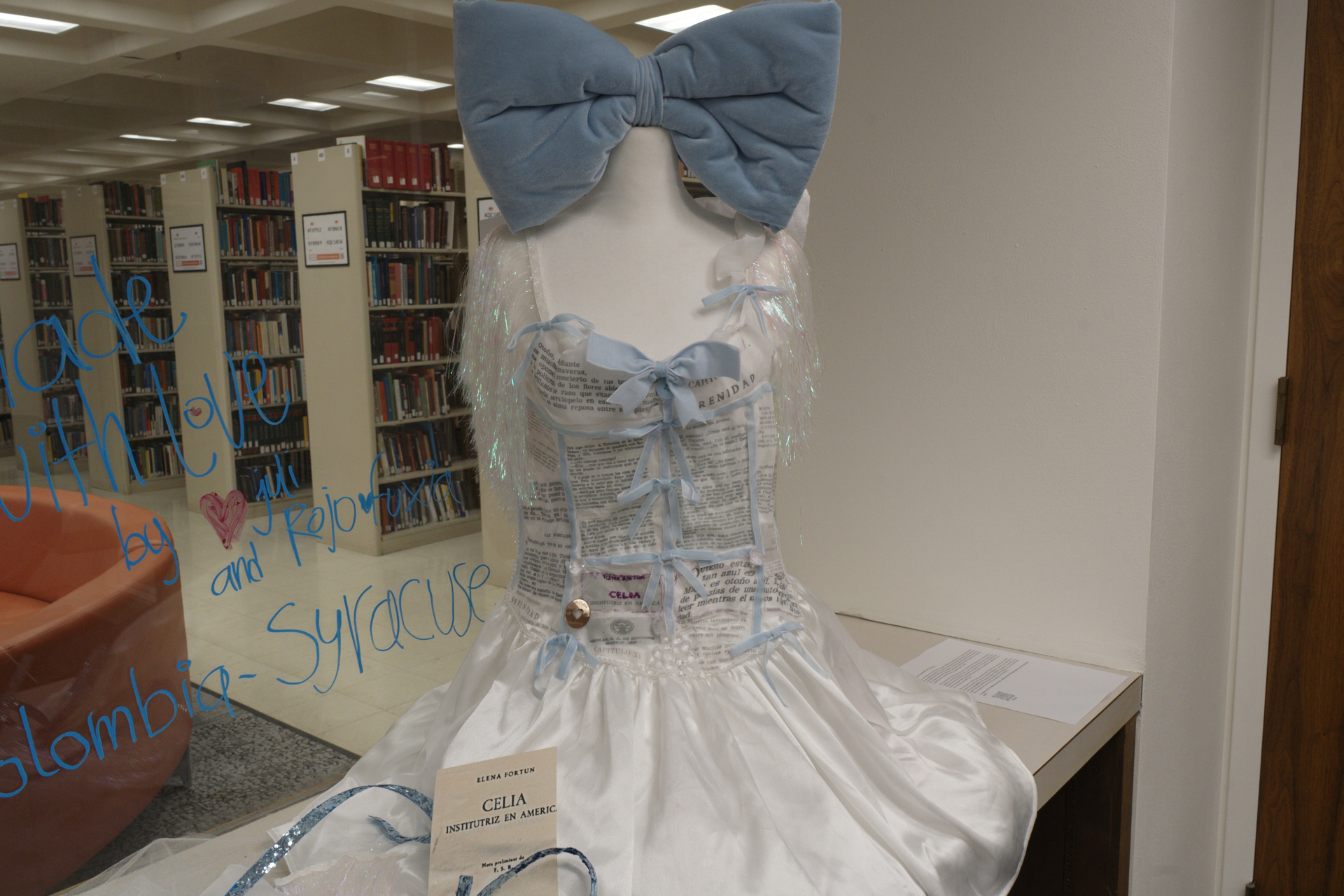
Syracuse University graduate student Juliana Acosta used fragments of Spanish author Elena Fortún’s Celia books to create this dress. Acosta first learned out about the fictional character Celia Gálvez de Montalbán during a literary research class. Calvin Wood | Contributing Photographer
According to the exhibit, in the 1980s, researcher and biographer Marisol Dorao received a suitcase from Fortún’s daughter-in-law containing lost literary papers. “Celia en la revolución,” the first story from these findings to be published, departed from the whimsical tone of earlier Celia books and focused on the day-to-day survival during wartime. While “Celia en la revolución” was published posthumously in 1987, other manuscripts remained unrevealed.
Released in 2016 and 2022, respectively, Fortún’s novels “Oculto sendero” and “El pensionado de Santa Casilda” finally saw the light of day. However, these two stories, which were written under the pseudonym Rosa María Castaños, were originally left unpublished due to their semiautobiographical sapphic themes. Dorao, who received the papers, was unsure how to approach Fortún’s sexuality. Decades later, University of Exeter professor Nuria Capdevila-Argüelles rediscovered and published the novels.
The centerpiece of the exhibit, a blue and white dress, came from another of Acosta’s archive discoveries. “Celia institutriz,” originally published in 1944 and written by Fortún when she was in Argentina, details Celia as she witnesses the erasure of female writers and feminists active before the Spanish Civil War. This novel was monitored and censored by the Franco dictatorship in 1946.
Years later, Acosta combined various pages and fragments of it with ribbons and other materials to create a piece of wearable clothing. Acosta described the exhibit as transforming written work into a physical object, emphasizing the power of tangibility.
“They don’t want it?” Acosta said. “Now I want to bring them a dress.”
After leading viewers around the room, the end of the exhibit invites participation in two ways. First, using lettering borrowed from official censorship documents, visitors can paste together their own messages to Celia, Fortún or Acosta. Visitors are also encouraged to contribute a word, drawing, piece of fabric, memory or small object they can place into large hollow letters spelling out Celia’s name.
“Every contribution becomes part of the artwork,” Acosta said. “Celia is no longer one voice. She is many voices.”
Visitors like McMahon and Snyder said the hands-on design shaped their experience.
“I really appreciate that it’s interactive, so you’re looking into the curious mind of the character and bringing out your more childish side,” McMahon said.
Snyder said it kept the exhibit from feeling like a typical walkthrough and let visitors immerse themselves in the story. Acosta added making the show interactive was central to her idea. She wanted it to be open to everyone, including children, parents and older visitors.
“There is a place for everybody,” Acosta said. “It doesn’t matter if you think differently. It’s respect. I want to give Celia respect, because nobody gave her respect.”
WHAT YOU SHOULD READ NEXT
La Casita hosts ‘Quinceañera Dreams’ to mark cultural hub’s coming of age
On Saturday night, La Casita Cultural Center celebrated 15-year-old Escarlett Navarrete’s quinceañera and launched the “Quinceañera Dreams” exhibition.
Acosta sees clear connections between Celia’s story and recent book bans in the United States.
“Now the books are censored too, in Florida, in our schools,” she said. “We must continue fighting.”
The show wasn’t easy to bring to life. Acosta said she approached several spaces that turned her down, in some cases due to a lengthy bureaucratic approval process. She credited the Moynihan Graduate Student Research Grant for enabling her to visit Spain and examine the archives.
Snyder noted that the gallery is easy to overlook, as the artwork is tucked off to the side of the room. Still, she appreciates that students can display their work around campus.
Acosta encourages viewers to connect with her on Instagram to share their thoughts on the exhibit. She believes it can reach people and teach them about the dangers of censorship.
“We are privileged people,” Acosta said. “But we never think about how difficult it is for others.