SU professors underscore mental health advocacy on Emmy-nominated ‘Spiral’
Get the latest Syracuse news delivered right to your inbox.
Subscribe to our newsletter here.
David Tarleton and Adria Dawn, professors at Syracuse University’s College of Visual and Performing Arts, were traversing a Puerto Rican rainforest on vacation when they found out they’d been nominated for a New York Emmy Award in July.
The husband-and-wife duo of 20 years thought they received only one nomination for their 2025 short film “Spiral.” Later, they realized it was selected for two categories: Best Director and Societal Concerns.
While Tarleton, 55, and Dawn, 52, were honored by the recognition, they said their work on the film meant more than receiving the nominations.
“The awards and everything, that’s amazing and so flattering,” Tarleton, who’s also the chair of VPA’s Department of Film and Media Arts, said. “But really for us, it’s doing the work. It’s working with students. It’s seeing the work get out there and seeing it move people.”
“Spiral,” a 14-minute film raising awareness about college students’ mental health, was created by co-directors Tarleton and Dawn and students from their spring 2025 Acting and Filmmaking for Social Change course. The project, which featured VPA students in the cast and crew, was nominated for two New York Emmys, but it didn’t take home any hardware at the Oct. 10 ceremony.
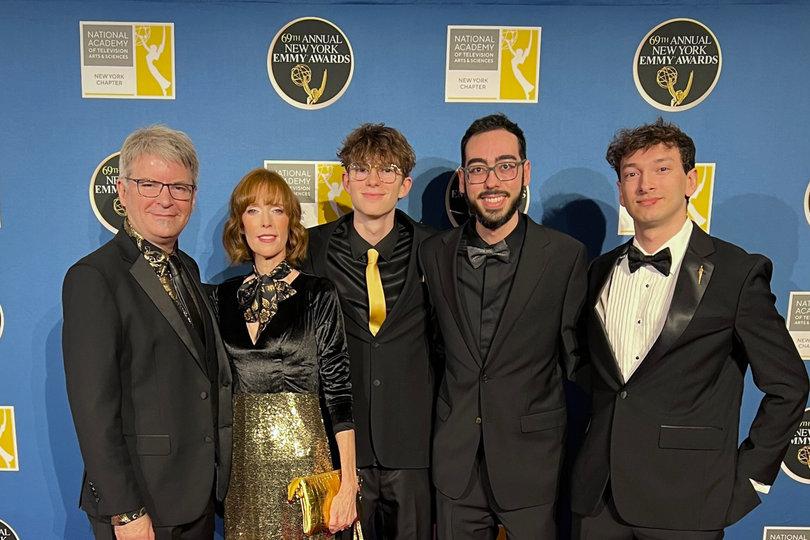
Still, Dawn was grateful for the chance to attend the ceremony, which she and Tarleton shared with two SU alums who were also part of the cast and crew: Philip Martins and Jonah Kaminsky.
“Maybe someday we’ll get (an Emmy), but the goal isn’t to get one,” Dawn said. “The goal is to keep making and trying to make it better than the thing you just made.”
For the last 12 years, the couple has primarily made films for social change, like “Karen” in 2020 and “Gray Area” in 2022. But “Spiral” was their first project that focused on college-aged students.
The film follows a college student, Emma, who is so bogged down by school and social stressors that she turns to alcohol instead of seeking help from family and friends. By the end, Emma leaves school to focus on her mental well-being.
Tarleton said it’s important to tell stories that reflect the realities college students face — like social challenges, the online world and economic uncertainties post-graduation — while trying to give them a voice.
“Current college students need to be supported,” Tarleton said. “I think for people in our generation, it’s just important for us to have empathy for the world that college students exist in.”
While writing the script, Tarleton and Dawn received input from their students at SU.
Dawn brought a full draft to the class that helped make the film, receiving feedback that it was too broad and unfocused. In the class, students read the script aloud and offered critiques, ideas and their own experiences. Dawn may be the primary writer, but she said the students helped develop the story.
SU senior and acting major Connor Mozart Tell said the audition process for “Spiral” was unlike his previous experiences. Tarleton and Dawn made students write a monologue in the voice of a character they’d want to play — something Tell hadn’t done before. Dawn said she taught Tell in a previous class and had him in mind for the antagonist, a slimy character named Matthew. In the film, Matthew makes inappropriate contact with Emma at a party but is quickly stopped by an intervening character.
Then a sophomore, Tell said he was accustomed to playing protagonists but felt like Dawn wanted him for this role. So, Tell wrote a monologue for his audition where Matthew hesitantly apologizes for his actions at the party and eventually comes to terms with how egregious his behavior was. Tell, who has two sisters, said he tries to stay aware and vigilant because of “sleazy” guys in the real world.
As a self-described mental health advocate, Tell hopes the film inspires people to accept, understand and support others struggling with their mental health. Tell also wants viewers to take away a sense of feeling seen — to know there’s always support somewhere.
“I hope that more people, especially young women coming into college, they realize that you don’t have to have it all figured out coming in,” Tell said. “It’s going to be scary, and there’s going to be times that it feels like the world is ending, but there’s always a step forward in finding a new path and getting better.”
“Spiral” was filmed over six days during spring break in March 2025, Dawn said. The cast and crew shot on many locations in and around SU’s campus, including the Nancy Cantor Warehouse and two off-campus houses.
Tarleton said the couple screened a rough cut of the film for the class in April 2025. In the summer, the final touches were added, like editing, sound design and color grading. In September 2025, the film was ready for a complete screening with its cast and crew.
WHAT YOU SHOULD READ NEXT
Beyond star ratings, Letterboxd acts as personalized outlet for SU students
Despite uncertainty surrounding Letterboxd’s future ownership, SU film enthusiasts continue to use the app to share their personal tastes.
Xiwen Luo, a third-year graduate film student, worked as the project’s art director during her first year of graduate school at VPA. The prop budget was $200 for the whole film, Luo said. So, she dug through thrift stores and texted everyone she could to find the film’s props. Dawn, who taught Luo in a different class, recognized Luo’s organizational skills and encouraged her to take the social change course.
Luo arrived in Syracuse from Hong Kong — her first time in the United States. Sometimes, it was hard for Luo to understand and communicate with professors because her English wasn’t the best, she said. But “Spiral” taught her to take a rest when she’s overwhelmed, which has helped improve her mood and creativity.
Dawn wants students to realize that there’s no grade, class or person that should hinder you from taking care of yourself, because you’re worth it, she said.
“As a society we’re trying to get better about self-help and reaching out and getting help when we need it, but I also just wanted to show that it’s OK if you need a break,” Dawn said. “It’s OK if you need to take time off because nothing is more important than you getting past something that’s been really hard for you.”
Tarleton said he wants people to take care of themselves. With “Spiral,” he hopes viewers recognize that they shouldn’t feel bad for facing struggles.
“It’s OK to ask for help,” he said. “It’s OK to do what you have to do for your own mental health, to not be ashamed of that, to find ways to pull out of the spiral.”