Felisha Legette-Jack wants Syracuse to ‘punch 1st,’ but what does it mean?

Get the latest Syracuse news delivered right to your inbox.
Subscribe to our newsletter here.
Eight seconds of silence followed when Felisha Legette-Jack and her three captains were asked at the preseason press conference what lesson they learned from last year.
Angelica Velez took a deep breath and dropped her gaze. SU’s head coach turned left toward Olivia Schmitt and Keira Scott, as Schmitt stared into the space in front of her. But Scott, after a moment to think, turned and locked eyes with Legette-Jack. She had an answer.
“It’s throwing the first punch,” Scott said at the Oct. 7 presser. “We emphasized that a lot last season. This team has all of the aspects to do that and come out strong. I think we lacked a little bit; we took too long to get to our peak performance.”
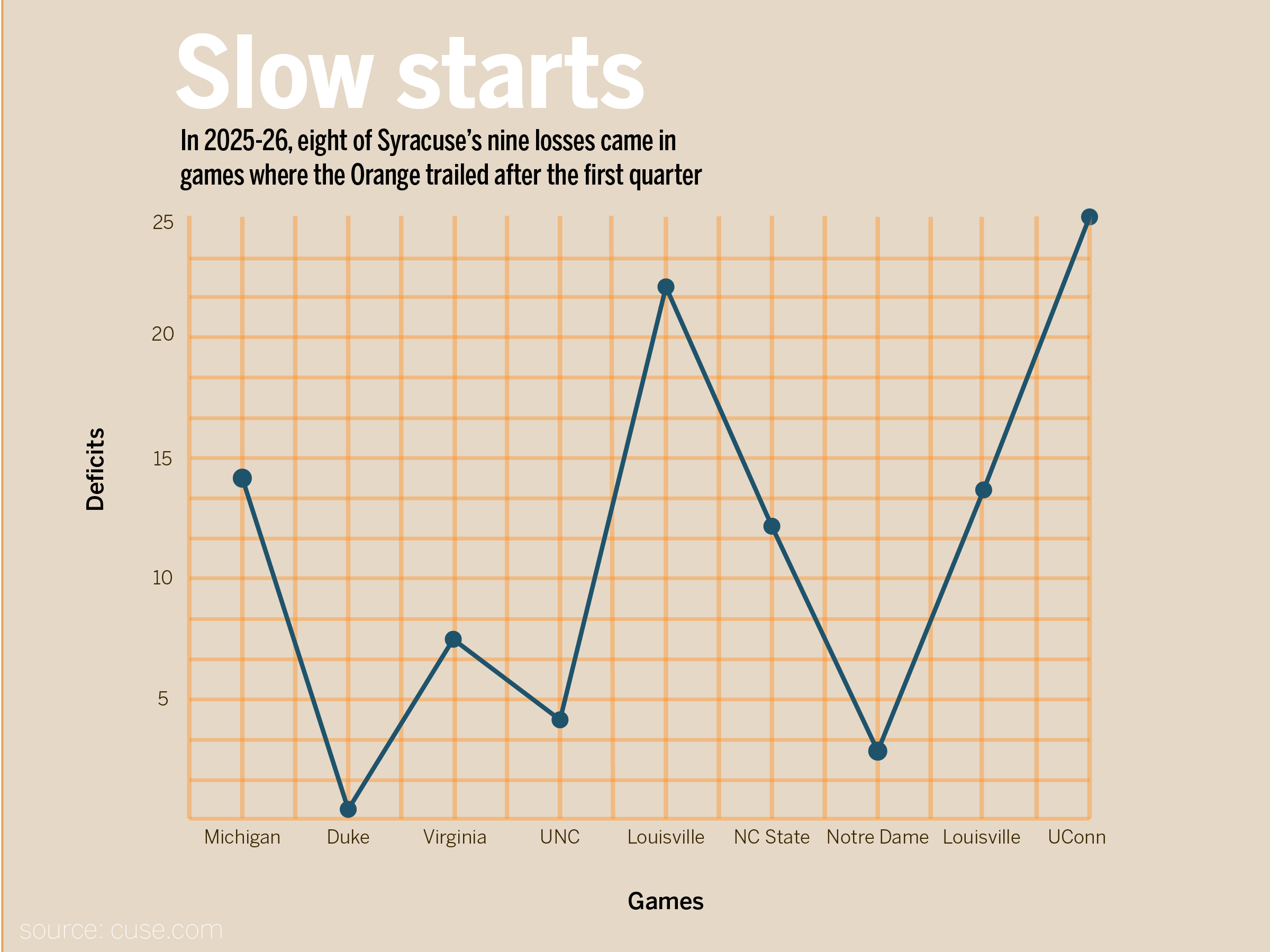
Last season, Legette-Jack stressed her team needed to “punch first.” And no, Syracuse isn’t physically hitting its opponents, at least not with fists. But Legette-Jack does want her team to play physical, jump out on the scoreboard early and never let up. In 11 of Syracuse’s 33 games last year, it finished the first quarter behind. Six were against Atlantic Coast Conference teams.
Syracuse went 3-8 in those contests. In wins over Auburn and Virginia, SU finished the first quarter down five. In the NCAA Tournament First Round win over Iowa State, perhaps the Orange’s marquee victory, they left the frame down three.
But beyond those select games, when Syracuse ended the first quarter trailing, it fell behind by an average of 12.5 points, leading to a 21.6-point average final-score deficit in such games.
“We wait, and all of a sudden we were down by five. We wait, and we up by seven, but it was nonchalant, and the other team comes back,” Legette-Jack said. “We got to have a moxie about ourselves and know that our story matters and that team in front of us is trying to deny our story to be told.”
The foremost example is UConn. The Orange trailed 65-12 at halftime of the NCAA Tournament Second Round, and despite matching the Huskies in the second half, they lost 98-45.
Elise Flannery | Design Editor
Legette-Jack is determined not to let that happen again.
“You wait two minutes in our conference this year, you could be down by 50,” Legette-Jack said. “We’ve been there already. We don’t want that story to be told again.”
She’s seen improvements within the ACC this year. UNC recruited Kate Harpring, Clemson signed Trinity Jones and Notre Dame added Jacy Abii to its star-studded roster, which includes Hannah Hidalgo, the three-time reigning All-ACC Preseason Player of the Year.
So Legette-Jack molded her team like “clay” to build upon last season. She’s tailored the nonconference schedule to test Syracuse. After the 53-point loss to UConn last year, Legette-Jack scheduled the first exhibition before the 2026-27 campaign against the Huskies.
When the Orange traveled to Uncasville, Connecticut, last week, they responded better to the early deficit than they did in March. Syracuse fell behind 23-8 after the first quarter, but powered by newcomers Emely Rodriguez and Jaleesa Molina off the bench, it outscored the Huskies by six in the second. Rodriguez and Molina scored five and four, respectively.
Although SU lost 88-60, the game showed what the Orange’s bench can provide. Legette-Jack has said she believes Syracuse can go “nine or 10 deep this year.”
The Orange’s average height is 5-foot-11. Adding Sarah Rambus complements Uche Izoje, who finished last year with 14 double-doubles, in the frontcourt.
“(My wingspan) is six-seven, hers is six-six,” Rambus said. “It’s going to be harder to get past that. So, just being able to play with her, every time I throw it up, she catches it.”
Rambus provides a second scoring outlet for Syracuse in the paint. Playing efficiently with a high tempo could be key to the Orange getting out on the front foot this season.
Historically, both metrics have been strengths for Legette-Jack’s Syracuse teams. Bart Torvik’s adjusted tempo estimates the number of possessions per 40 minutes a team has against one that plays at an average Division I tempo.
Last season, the highest adjusted tempo was 77.5 (Oklahoma), the average was 69.1 and UAlbany had the lowest at 61.3. Syracuse played at 71, two possessions above average.
WHAT YOU SHOULD READ NEXT
Sophie Burrows’ homecoming, Puerto Rico trip accent SU’s 2026-27 schedule
Syracuse women’s basketball begins its regular season Nov. 3 with a home game against Sacred Heart. Our beat writer has four dates to mark down on SU’s 2026-27 schedule, which includes a trip to Puerto Rico and 18 ACC games.
Because each team has only 30 seconds to take a shot, having a faster tempo and more possessions typically leads to more field-goal attempts. Of course, those attempts have to go in. So adjusted tempo can be paired with adjusted offensive efficiency — which estimates how many points a team would score over 100 possessions against the average defense — to understand an offense’s effectiveness.
Across Legette-Jack’s four seasons at the helm, SU has never ranked outside the top 60 in the country in adjusted offensive efficiency. Last year, Syracuse’s 105.5 ranked 49th of 363 teams in the nation. Legette-Jack’s emphasis on recruiting 3-point shooters, especially power forwards, enables the Orange to continue this trend.
“I like our size,” Legette-Jack said. “I like our moxie. We’re not going to be, ‘Oh, look at us,’ but we’re going to show you who we are on a daily basis.”
So, ask Legette-Jack how she’s approaching her fifth campaign as Syracuse’s head coach. Ask her how she’ll repeat last year’s successes. She won’t stray from the overarching philosophy she’s used in her first four seasons at SU.
“We’re going to be aggressive,” Legette-Jack said. “We’re going to tell our story in a very impressive way. We’re going to punch first.”