Runway pieces dissect anatomy at PhiDE, FADS’ fundraising fashion show

Get the latest Syracuse news delivered right to your inbox.
Subscribe to our newsletter here.
In the Schine Student Center’s Underground, the human body became more than a subject in an anatomy textbook. Human skeletons, muscles and organs inspired fashion runway looks.
Through painted bodysuits and original outfits inspired by each anatomical system, attendees witnessed how medicine met student-designed fashion. Models brought the inner workings of the human body to the stage, turning a traditional fashion show into a combination of science and creativity.
Syracuse University’s Phi Delta Epsilon chapter, a pre-medical professional fraternity, partnered with the Fashion And Design Society to host its second annual Anatomy Fashion Show on Sunday. The event combined fashion and medicine to raise funds for the Upstate Golisano Children’s Hospital through the Children’s Miracle Network.
“It gives the Syracuse community, students and peers and other local members of the medical field, (a chance) to come out and see something different,” said Sarah Prowak, a member of Phi Delta Epsilon’s programming committee.
The show featured designs inspired by 11 anatomical systems, such as the reproductive, respiratory, skeletal, muscular and cardiovascular, among others. At the beginning of each category, a model wore a bodysuit with the respective system drawn onto it. After that introduction — two outfits by FADS designers followed — combining educational presentations with creative interpretations of the human body.
The fashion show was PhiDE’s final installment of its annual Stand for the Kids week. The week includes a series of fundraising initiatives to support the fraternity’s national philanthropic partner, Children’s Miracle Network. By Sunday, the fraternity raised over $3,000 in donations for Upstate Golisano, PhiDE’s president Kabir Kalia said.
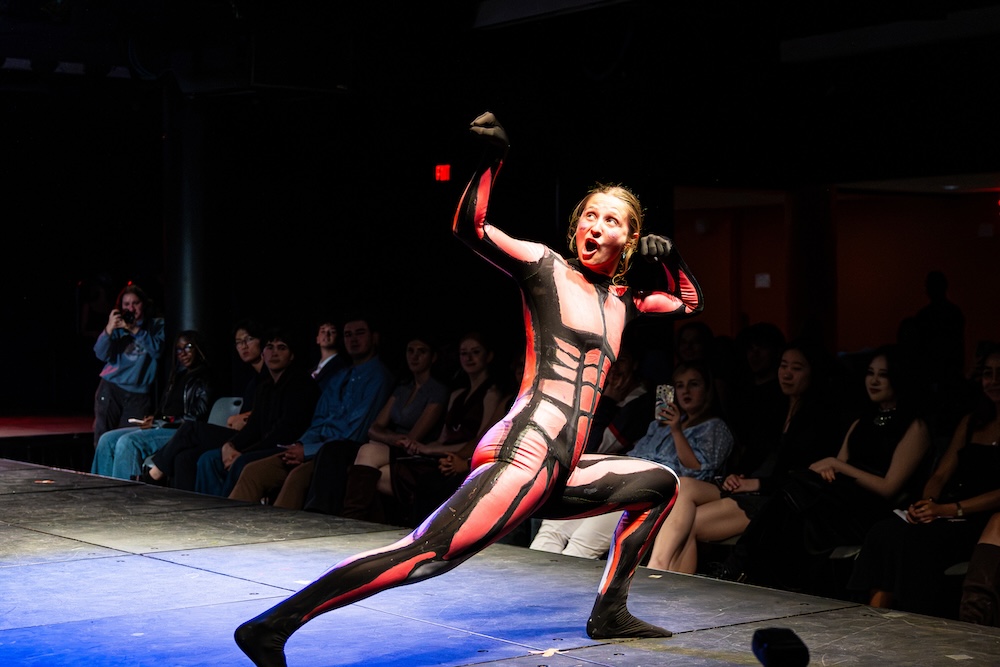
A model in a painted bodysuit flexes onstage at the Anatomy Fashion Show. Syracuse University’s Phi Delta Epsilon chapter worked with SU’s Fashion and Design Society to raise funds for the Upstate Golisano Children’s Hospital through the Children’s Miracle Network. Zabdyl Koffa | Staff Photographer
The collaboration between PhiDE and FADS is a way to make anatomy and how the human body works more accessible to SU students, even those studying in different fields, Kalia said. While pre-medical students regularly study human anatomy, other majors may have fewer opportunities to learn how their bodies function.
“I think that learning aspect that we run throughout the show of what the system looks like, how it works in your body, and some fun facts about it, is very beneficial to the broader population of Syracuse,” Kalia said.
Before each bodily system, the show’s hosts and SU students Natalie Risley and AJ Borgos introduced the structure, explaining their functions and connections to everyday health. They even interacted with the audience by asking trivia questions about the human body. From skeletal and cardiovascular to the endocrine and respiratory systems, the runway became an unconventional classroom.
Cadence Murphy, PhiDE’s secretary and safety and risk management officer who helped paint the anatomical bodysuits at last year’s show, said watching the finished designs appear on the runway last year made the experience fulfilling. This year she mostly focused on administrative work.
“Last year, I remember thinking that it was so well done and it was so rewarding to see the work that I had painted on the suits walking down the runway,” Murphy said.
But for Murphy, the event’s significance extends beyond the runway.
As a volunteer in the Child Life Unit at the Upstate Golisano, Murphy has spent time with the children the fraternity hopes to support through its fundraising efforts. She said her experience at the hospital made the event especially meaningful.
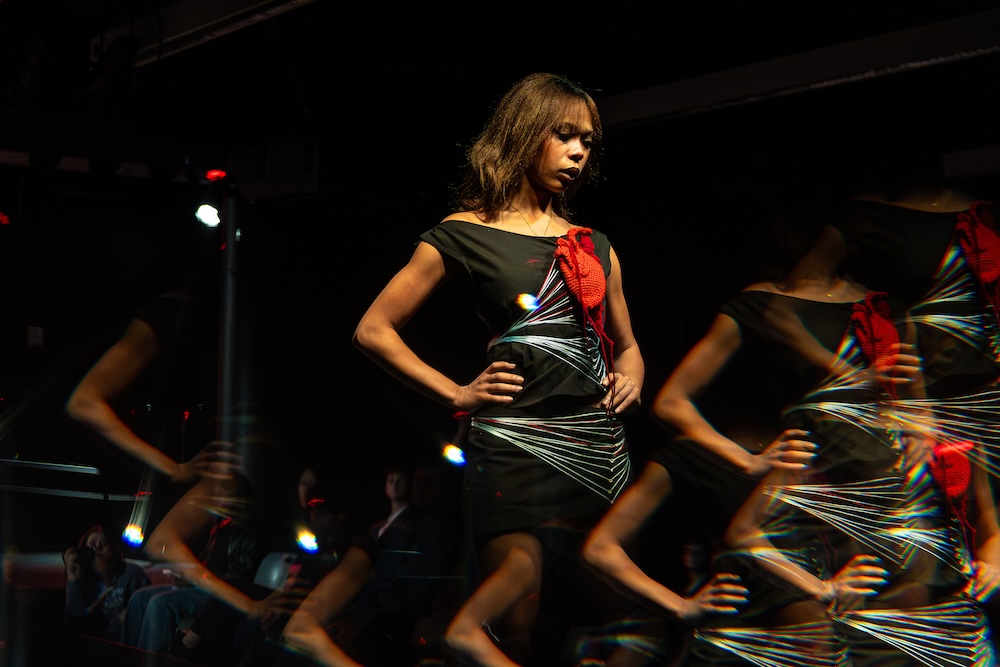
A model at the Anatomy Fashion Show dons an outfit resembling the cardiovascular system. The event’s hosts even asked the audience trivia questions about the human body during the show. Zabdyl Koffa | Staff Photographer
“I get to see firsthand the community that our fundraising hopefully positively affects,” Murphy said.
Prowak shares a similar connection to the hospital. Having also volunteered in the Child Life Program, she spent weekly four-hour shifts at the hospital’s Family Resource Center, helping children check out books and participate in activities. She also visited patients’ rooms to check whether children and their families needed additional resources. Through those interactions, Prowak learned how donations can impact the lives of young patients.
“When I was volunteering, they had tons of donations, and they were able to do the events and put on the activities that they had for the patients because of all their donations,” Prowak said.
Now, as a member of the fraternity’s programming committee, she has experienced the other side of that process: organizing the events that drive those contributions. Ahead of the show, Prowak and other organizers from PhiDE worked with FADS members to coordinate its layout, develop promotional materials and find an audience.
For her, the hospital’s proximity to campus adds another layer of significance to the fraternity’s philanthropy. Many PhiDE members volunteer at Upstate University Hospital, creating personal connections with the community they’re trying to support.
WHAT YOU SHOULD READ NEXT
Models flaunt cultural designs at SU’s African Student Union Fashion Show
Syracuse University’s African Student Union held its annual fashion show Saturday in the Schine Student Center’s Goldstein Auditorium.
“Having seen (and) having been on the other side of it, I can see what the money goes towards,” Prowak said.
Although the fashion show brought together students from different academic backgrounds, its organizers shared a goal that extended beyond the event.
For Kalia, the runway provided an opportunity to teach students about the human body. Meanwhile, for Murphy and Prowak, it offered a way to support children whose experiences they had witnessed firsthand.
“Being able to see how different each little thing can kind of make these contributions, I think really has made it meaningful to me,” Prowak said.