SU’s End Overdose holds Narcan training to limit deaths, push intervention
Get the latest Syracuse news delivered right to your inbox.
Subscribe to our newsletter here.
In its first year on campus, Syracuse University’s chapter of End Overdose provides free naloxone training to help prevent overdose deaths through awareness and education.
End Overdose is a national nonprofit organization with a mission to address the opioid epidemic and overdose crisis in the United States by training people how to use naloxone or Narcan, a drug that acts as an “opioid antagonist.” The organization also trains people how to use additional resources like fentanyl test strips.
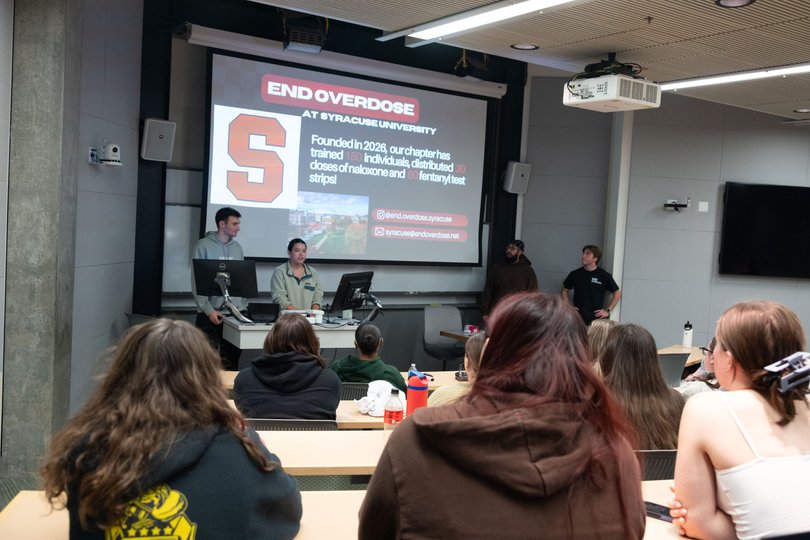
The chapter provided naloxone training to the professional engineering sorority Alpha Omega Epsilon on Tuesday, one of multiple student organizations on SU’s campus that End Overdose Syracuse has trained.
“I think the education about defeating the stigma about overdose and opioid use is something that’s super important on a college campus, where maybe recreational drugs are apparent,” End Overdose Syracuse Co-President Kabir Kalia said.
Established in 2026, bringing End Overdose’s mission statement that “no one has to die” to SU’s campus was important, especially after seeing how college students are affected, End Overdose Syracuse Co-President Max Lachut said.
“If you look in the news, obviously what happened at Ole Miss is horribly tragic, and it was caused by an opioid overdose,” Lachut said. “That’s something in the national spotlight that really shows the urgency of why this is so important.”
The Syracuse chapter cited that while fentanyl-related overdose is the leading cause of death for Americans ages 18-45, 40% of those deaths are preventable with the resources End Overdose provides. This is why the organization aims to provide training to as many student organizations as possible, Lachut explained.
“We’ve already trained over 100 people on campus,” Lachut said. “That’s something that we’re very, very proud of.”
As a current emergency medical technician and aspiring doctor and educator, Kalia described his experiences teaching students so far as “absolutely amazing.”
“I think education is a vital part of our society, and I think that’s very important for people to have the knowledge of information so they can act on it,” Kalia said. “That’s kind of what drew me in.”
The chapter said it has already distributed over 30 doses of naloxone and 60 fentanyl test strips during its training.
WHAT YOU SHOULD READ NEXT
How to stay mindful, keep yourself and others safe throughout Halloween
As Halloween nears, The Daily Orange has compiled safety tips to help SU students responsibly navigate the weekend.
The organization offers both short and long-form training. The short-form option, which can be completed within five minutes, provides students with an educational base, covering basic opioid education, as well as proper Narcan use. It also teaches participants how to identify an opioid overdose based on the opioid “triad”: unresponsiveness, pinpoint pupils and difficulty or slowed breathing.
The long-form training, which takes about 30 minutes, includes a slideshow and interactive presentation that goes more in-depth on how to respond to an overdose. The presentation details how to move a person to the recovery position, administer Narcan and provide rescue breaths. The training also explains the Good Samaritan Law, which protects the person who provides care in an emergency situation from civil liability, as well as how to identify the physiological effects and risks of drugs.
While the long-form training does provide students with Narcan certification, the organization gives a disclaimer that its training is not a substitute for medical attention in the event of an overdose.
“It’s important for SU students to receive this training because you don’t know what’s going on,” AOE member Irene Zheng said after she received training. “It’s really important that we are trained and aware that this is a problem that’s happening, and that we are able to do something about it.”
Lachut and Kalia both said one of the main problems with overdoses is that anything can be laced, including drugs commonly found on college campuses, like marijuana and cocaine.
“It’s something that, in my opinion, everybody on this campus should know how to use. At least every RSO should have naloxone on hand in order to reverse any drug overdose,” Lachut said. “Really anything can be laced with deadly drugs.”
Moving forward, the organization plans to train more student organizations, as well as consider ways to move the initiative to an off-campus audience.
“It’s important to take a second and be educated on things like this. They’re so apparent on a college campus,” Kalia said. “That 30 seconds or one minute of education can save a life.”