As an SU pre-med student, I hope AI can help doctors without replacing them
Have you had an experience with Syracuse University’s Title IX office? Share your story with The Daily Orange’s anonymous tip line.
At a recent medical visit, one of my physicians asked to record our conversation with an artificial intelligence note-taking software.
“No,” I firmly responded, a word I don’t often say to a doctor.
She yielded but was visibly frustrated, complaining AI would be faster.
In just a couple of years, AI has enabled physicians to transition away from taking notes on their computers.
As a Syracuse University pre-med student in the BS/MD Program with early assurance to medical school, I’m curious about the impact of AI on medicine. While AI can support doctors, they shouldn’t solely rely on it to maintain patients’ trust, ensure medical accuracy and preserve clinical skills.
But AI use is becoming the norm for doctors. Of 1,342 physicians, 72% reported they use AI in their practice.
Some doctors are using AI to record conversations with patients and create detailed summaries. A 2024 research study found a majority of primary care physicians believe a generative AI tool reduced note-taking time and relieved the worry of remembering details. But physicians also reported AI misgendering or imagining patients, suggesting unsolicited diagnoses and mistaking details.
I’m concerned that patients occasionally share sensitive information or make off-hand comments that don’t belong in medical records. How will they know if the AI is still transcribing? AI note-taking could disrupt patient trust, causing concerns about privacy similar to my experience with my doctor.
I interviewed Dr. Jivan Lamichhane, a hospitalist faculty member at Upstate University Hospital, who explained that using an AI scribe has helped reduce “pajama time,” referring to the time doctors spend completing administrative work after hours.
“It has definitely helped with efficiency as well as helping with the reduction of burnout on the healthcare providers,” Lamichhane said.
Of 1,262 physicians, 73% expect reducing administrative workload with AI could relieve burnout.
By efficiently using AI for note-taking, doctors could give their full attention to patients instead of focusing on a computer. I appreciate when my doctors look at me directly and listen compassionately to my concerns, but the idea of a third party listening and storing information is hard to grasp, even if it’s well-protected. It’s a trade-off that doctors and patients must consider.
Ironically, the current limitations of AI could ultimately increase physician workload. To be responsible and cautious, a physician would have to carefully review each line that AI transcribed for accuracy and remove unnecessary information.
In an article by Dr. Helen Ouyang, she acknowledges editing AI’s notes eliminated the act of interpreting a conversation with a patient and thinking through her own words, methods she once used when writing the notes herself.
“The process of note-writing helps me formulate my medical decision-making and then check whether it really holds up,” Ouyang writes. “When that cognitive labor is offloaded to a machine, I’ve come to see, my job shifts.”
AI could positively change medicine by reading X-rays and images to assist physicians in the diagnosis and treatment of patients. Researchers from Mass General Brigham in Boston have developed AI models, trained on millions of facial images, that they say assess various parts of the face to gauge a cancer patient’s biological age and signs of their survival rate.
In a critical care setting, timely intervention is needed, such as a chest-tube placement for a tension pneumothorax or collapsed lung. AI could immediately read an X-ray, allowing doctors to confidently take action when the radiologist’s reading is delayed. Radiologists should check the accuracy of AI’s imaging reports.
Physicians should verify information and cautiously explore new technology to determine the best AI tool, if needed, to serve their patients.OlaRose Ndubuisi, Columnist
No matter how advanced AI gets, we shouldn’t stop verifying it. You wouldn’t skip proofreading your essay for errors, even as a confident writer.
AI could also automate certain clinical and administrative tasks, giving physicians more time for patient interaction.
Lamichhane said physicians use AI within the hospital healthcare delivery system to give them “different ideas about prediction of mortality, morbidity, length of stay and the chance of readmission for any patient that’s admitted to the hospital.”
While promising, I worry that physicians’ skills could gradually diminish due to the automation of tasks. Of 1,163 physicians, 88% are worried about skill loss. Forty-six percent are very concerned about the loss of skills in doctors in training.
An article by Dr. Rachael Bedard expressed that residents don’t yet have the experience that an attending does to fact-check AI and will need to learn to think critically alongside medical AI tools like Open Evidence.
“When I skim a chatbot’s response to a question about back pain, I’m intuitively testing its suggestions against my hard-won mental model for how to approach back pain,” Bedard writes.
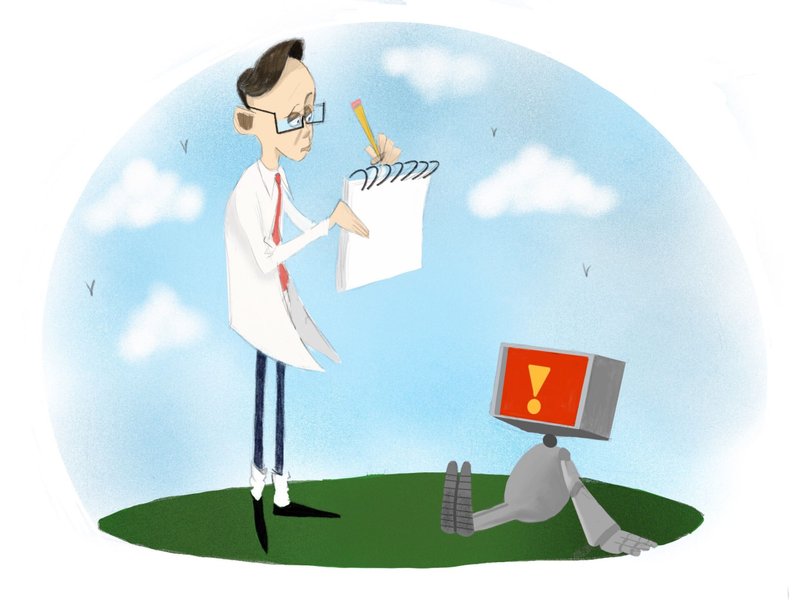
A doctor must exhibit curiosity, think critically, research, reference knowledge from previous cases, communicate effectively, listen patiently and admit when they don’t know the answer. Outsourcing certain tasks to AI would make doctors robotic and underutilize critical human skills.
AI is rapidly changing medicine. Therefore, we must regulate it. Physicians should verify information and cautiously explore new technology to determine the best AI tool, if needed, to serve their patients. Whether pursuing a medical career or otherwise and regardless of your stance on AI, students can benefit from researching AI’s impact on their chosen fields, like I have.
OlaRose Ndubuisi is a sophomore majoring in biology and journalism. She can be reached at oandubui@syr.edu.