Everson’s ‘America 250’ exhibit unveils full stories behind iconic images
Get the latest Syracuse news delivered right to your inbox.
Subscribe to our newsletter here.
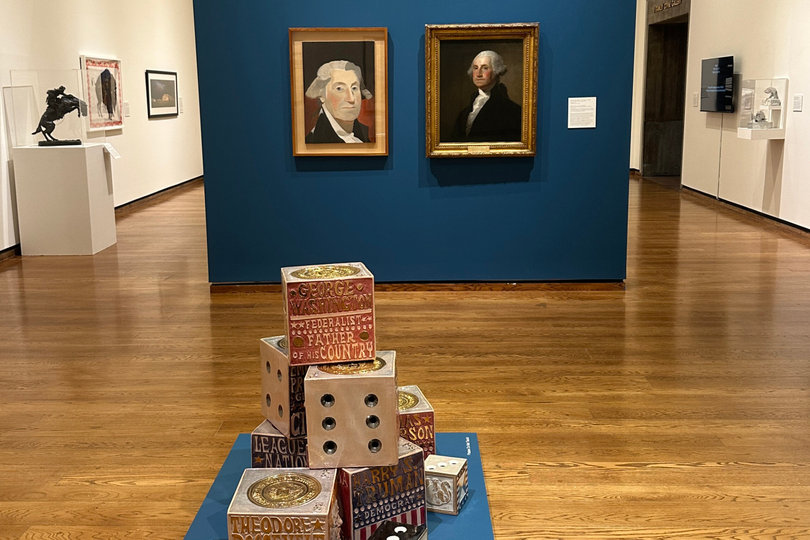
On the second floor gallery of the Everson Museum of Art in Syracuse, a stack of nine ceramic dice sit on the gallery floor. Representing former presidents of the United States George Washington, Abraham Lincoln, Franklin D. Roosevelt and others, each die explores one presidency through specific portraits, quotes and political symbols. Moments of triumph are displayed alongside controversies.
“It’s just about telling that whole story, regardless of what it makes the person look like,” the Everson’s Director of Curatorial Affairs Steffi Chappell said.
The 1977 ceramic piece by Ruth Rippon, titled “The U.S. Presidents,” is one of many works in the Everson’s new temporary exhibition: “America 250: Rebels, Radicals, and Revolutionaries.” The display, organized for the nation’s 250th anniversary and showcasing around 75 artworks, opened Oct. 17 and is on view through March 28, 2027.
The exhibition features works drawn from the museum’s permanent collection in an effort to explore the nation’s contradictory history, Chappell said. The staff realized during planning that the midterm elections would fall near the opening, and the show fits the country’s current “political moment.”
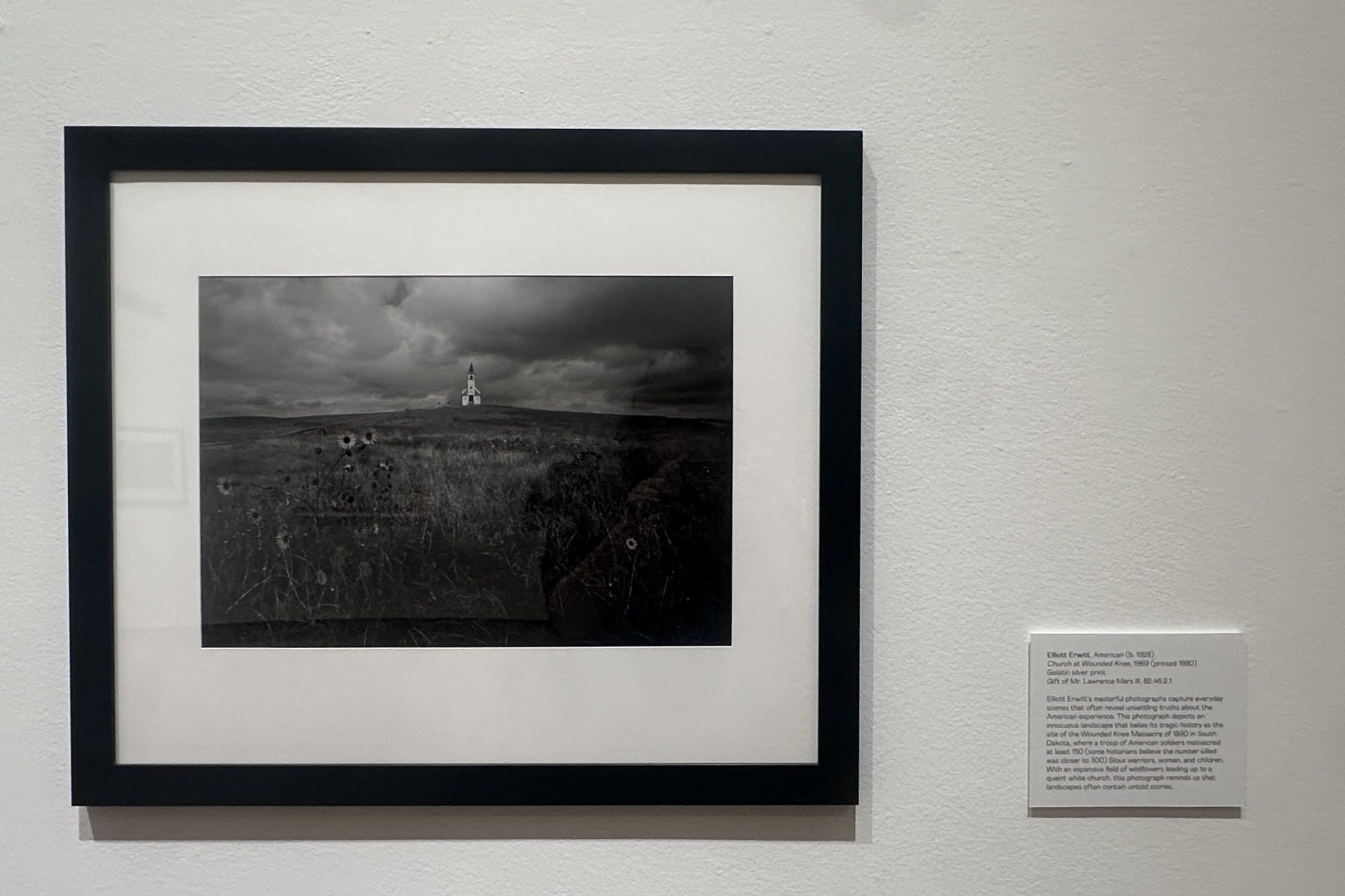
Elliott Erwitt’s 1969 photograph “Church at Wounded Knee” depicts the site of the 1890 Wounded Knee Massacre. “America 250: Rebels, Radicals, and Revolutionaries,” an exhibit at Syracuse’s Everson Museum of Art, also features paintings, ceramics and installation art. Rozalia Finkelstein | Staff Writer
Monica Orwan, a visitor from northern Virginia, said the show offered a different view from the presidential portraits common around Washington, D.C. Orwan appreciated the exhibit’s inclusion of leaders from across the political spectrum.
“Both Democrats and Republicans built this, and they were both revolutionaries,” Orwan said when discussing Rippon’s work.
Chappell, a Syracuse University alum, curated the exhibition, along with Garth Johnson, the Everson’s ceramics curator. While the show was originally going to be displayed chronologically, Chappell said it felt “too basic.” The team decided to instead scramble the layout and group related works into small clusters rather than a single timeline. Now, pieces from different decades hang side by side along the gallery walls.
“When we really started to break up that linear narrative, that’s when the show started to feel powerful,” Chappell said.
The exhibition includes paintings, photographs, ceramics and installation art, which allows the show to tell many stories at once, Chappell said. The multimedia aspect is especially popular with visitors, she added.
Many pieces in the gallery, like Larry Rivers’ 1975 screen print “An Outline of History,” draws on iconic American imagery and reinterprets it visually. Rivers’ print reimagines Robert Edge Pine’s “Congress Voting Independence” painting by reducing the founding fathers to stark, colored outlines. The print is part of a series of works commissioned by the Lorillard Tobacco Co. for the 1976 bicentennial, in which 12 artists were asked to answer the question “What does independence mean to you?” Five of those prints are included in the Everson’s exhibition.
WHAT YOU SHOULD READ NEXT
CNY Arts Gallery maps progression of Yoichi Okamoto’s political photography
Works from former White House photographer Yoichi Okamoto will be on display at the CNY Arts Gallery until Nov. 15.
Nearly every work has an extended label that gives broader context to the piece’s backstory and meaning. This choice was deliberate; while Chappell said the Everson often uses longer labels, they rarely do on almost every piece in a show. The added context about the artist and time period can change how a viewer reads an image, Chappell said.
At first glance, Elliott Erwitt’s 1969 photograph “Church at Wounded Knee” seems to capture a serene view of a church amid a field of flowers. However, the gallery text reveals the piece is actually depicting the site of the 1890 Wounded Knee Massacre, where a group of U.S. soldiers killed at least 150 Lakota warriors, women and children.
For attendee Steven Howell, additional context gave the exhibit its weight.
“You can’t just say, ‘bicentennial, 250, rah rah, America until you start really reading the passages,’” Howell said.
For some viewers, like Orwan, there’s not always an explanation for art, she said.
“When you talk about art, you’re trying to verbalize something that is just an intrinsic feeling,” Orwan said. “And sometimes you don’t know why something appeals to you or doesn’t appeal to you.”
Argenis Alas, a Cornell University sophomore, attended the exhibit during a visit to SU for Halloween weekend. He said a friend had pointed out that 250 years amounts to only about three generations.
“It feels as though our country has been here longer, but really 250 is such a short amount of time in the grand scheme of things,” Alas said.
Alas, whose family is Indigenous Salvadoran from the Lenca tribe, said the works amplifying Native American voices mattered most to him.
Chappell said the exhibition includes Black and Native American artists, like Dawn Williams Boyd and Wendy Red Star, because those communities have been part of the story from the start.
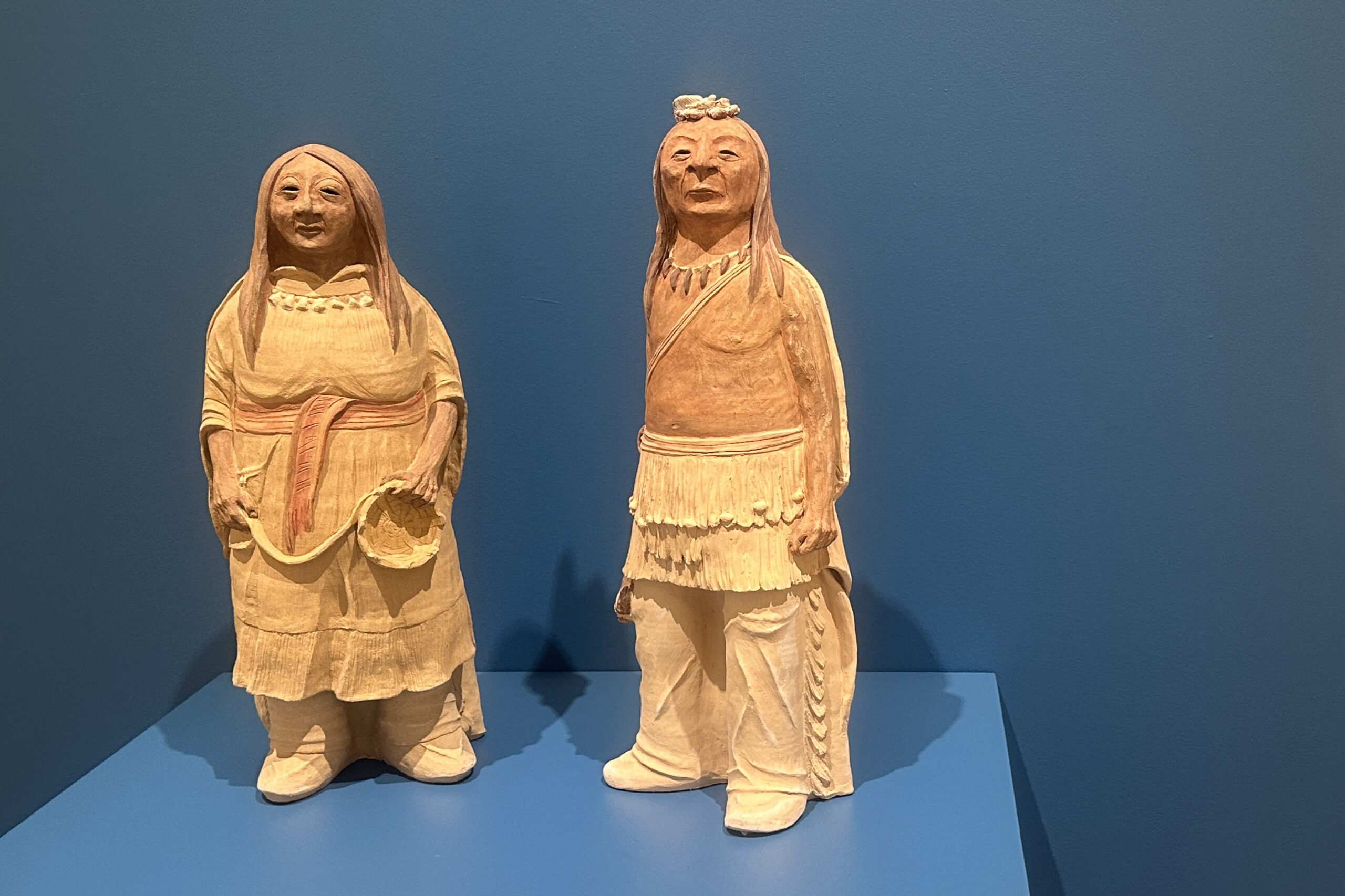
Peter B. Jones’ “Basket Woman” and “Salem Man” sculptures embrace traditional Indigenous clothing and regalia. Steffi Chappell, the Everson Museum of Art’s Director of Curatorial Affairs, said the “America 250: Rebels, Radicals, and Revolutionaries” exhibit focuses on multiple perspectives throughout American history. Rozalia Finkelstein | Staff Writer
“To only tell American history from a single perspective, it’s just wrong,” Chappell said. “It’s not truthful.”
When Chappell planned the museum’s calendar year, she realized Everson didn’t have anything to celebrate the U.S.’ 250th anniversary. That’s how the exhibition was born. Its title came from the museum’s director, who started by brainstorming words for the people who built the country. Chappell said the staff liked how the words cut both ways.
“There are good rebels and there are bad rebels,” Chappell said. “There are good radicals and there are bad radicals.”
Ambiguity runs through the show, which Chappell said confronts parts of history some people “just don’t want to acknowledge.”
“We can’t be better if we’re not recognizing those truths from our past,” Chappell said.