Aaron Sorkin draws ‘straight line back’ to SU for shaping writing career
Get the latest Syracuse news delivered right to your inbox.
Subscribe to our newsletter here.
When Aaron Sorkin writes scripts, he reads each line of dialogue aloud, acting out scenes and performing the parts the way he was taught when he was a student at Syracuse University.
“As a playwright, as a screenwriter, I can draw a straight line back to the things I learned at Syracuse,” Sorkin said.
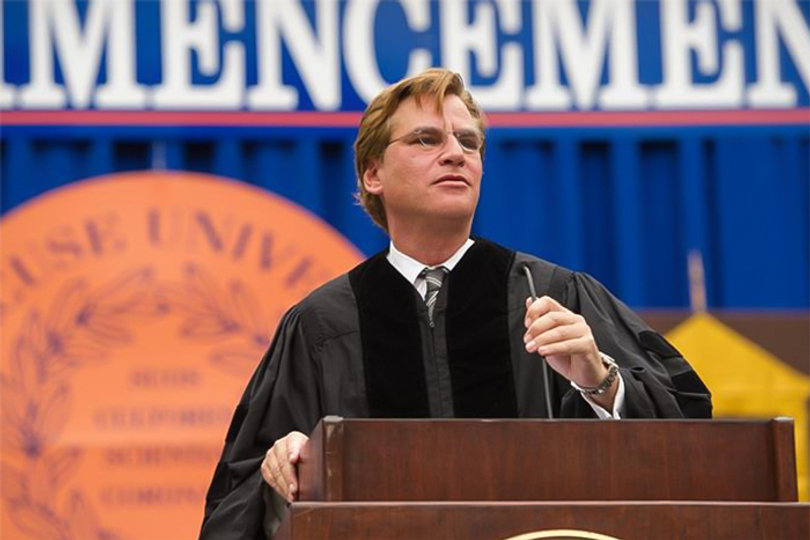
Sorkin is an award-winning screenwriter and playwright known for works like “The West Wing,” “The Social Network” and “Moneyball.” He graduated from SU’s College of Visual and Performing Arts in 1983 with a bachelor’s degree in musical theater. In 2012, he received an honorary doctorate of fine arts before delivering the school’s commencement address.
Sorkin’s play, “A Few Good Men,” opened for its first-ever Broadway revival on Oct. 29 and runs until Jan. 10, 2027. At 25 years old, “A Few Good Men” was the first play Sorkin ever wrote, just a few years after he graduated from SU. It wasn’t until after graduation that Sorkin began writing for pleasure, or anything that wasn’t a VPA class assignment. Still, he said his time at SU influenced the writing of the play.
“Suddenly all these lessons I learned at Syracuse, which I thought were about being an actor, were, for me, instead about being a playwright,” Sorkin said. “All throughout ‘A Few Good Men’ are my teachers from Syracuse.”
The 1989 play “A Few Good Men” tells the story of two United States Marines charged with the murder of a fellow marine, and the young Navy lawyer assigned to their case. In 1992, Sorkin adapted the play into an Oscar-winning film directed by Rob Reiner and starring Tom Cruise, Jack Nicholson and Demi Moore. Now, nearly 40 years since its inception, the play is being revived on Broadway for the first time.
The story is relevant now because it focuses on illegal orders from high authority figures, Sorkin said. He said he hopes students who see the show are inspired to find their “inner courage” like the play’s characters.
Since “A Few Good Men” was his first play, Sorkin said he felt like he never quite finished it. One of his conditions in agreeing to revive the show was that it would be treated as a new play, with the opportunity to rewrite parts he didn’t feel were working.
When Sorkin was an SU student, he formed relationships with his professors in the musical theater program, including Brent Wagner. Wagner, a Robertson Emeritus Professor of Musical Theatre at the University of Michigan, taught Sorkin during Wagner’s eight-year stint in SU’s program. Sorkin referenced Wagner as one of the professors who had the most profound impact on his time at SU; without the lessons Sorkin learned from professors like Wagner, Sorkin said he wouldn’t have become a screenwriter.
When Sorkin was Wagner’s student, Sorkin was an actor rather than a writer. Wagner said he remembers being impressed by Sorkin’s ability to speak about stage works in class, and his understanding of how they were constructed. At the time, he wouldn’t have guessed Sorkin would become a playwright; he remembers being caught by Sorkin’s strong ability as a stage performer.
But Wagner remembers Sorkin’s love for the entire musical theater industry, not necessarily just acting. Wagner said that was evident in class discussions.
“He was very witty and very funny and spoke with a really full scale use of the English language,” Wagner said. “I just remember he really had a command of language that you wouldn’t necessarily notice about a performer, but just in talking with them.”
This verbal skill is apparent in Sorkin’s work to this day, Wagner said. His portfolio has become known for fast-paced, walk-and-talk witty dialogue between his characters. When Wagner watches one of Sorkin’s movies, plays or TV shows, he can still hear young Sorkin’s voice. It’s a sound he remembers well.
Wagner remembers watching the original production of “A Few Good Men,” feeling a sense of pride for his former student. The experience was especially meaningful because the show was performed in the Music Box Theatre, a historic Broadway venue Wagner had talked about in his classes. Sorkin was now a part of the theater’s legacy.
After seeing the play, Wagner wrote Sorkin a letter to express his pride. Over the years, the student-professor pair have maintained communication, Wagner said, with email and letter exchanges after various milestones in Sorkin’s career.
In his 2012 commencement speech, Sorkin encouraged graduates to take risks, learn to fail and think of themselves as part of a community. His advice would be the same now: Take chances at something you love and you’ll find the thing you’re good at. Sorkin’s career is “inspiration with a capital I” for SU students, Wagner said. His story is a reminder that anything is possible if you follow your interests and let them lead you where you’re meant to go.
Since 2006, Sorkin has supported “Sorkin Week,” a week-long immersion program in Los Angeles through the VPA school. Students meet Sorkin and learn from successful alumni working in entertainment. Sorkin said he was excited to give back to students and help the industry feel less intimidating.
“I thought if I could give seniors just a week out here to look around and meet people and just see what it’s like, it won’t feel like a far-off planet,” Sorkin said.
WHAT YOU SHOULD READ NEXT
Nickelodeon star Victoria Justice navigates success alongside Latina identity
University Union hosted a conversation with Victoria Justice, known for starring in Nickelodeon’s “Victorious,” in the Goldstein Auditorium Wednesday.
If it weren’t for Sorkin, Barbara Deutsch wouldn’t be teaching in SU’s L.A. program. In 2012, Deutsch was invited to teach acting as a part of Sorkin Week, and she agreed for the chance to meet Sorkin. A decade later, she was asked to come back as an adjunct professor.
In March, Deutsch and Sorkin’s paths crossed again when Sorkin spoke to students studying in the L.A. program at the most recent Sorkin Week. Deutsch said she thanked Sorkin for the unknown impact he’d made on her life, and he was appreciative of their connection.
Rather than urging students to think of their audiences when they write, Sorkin encouraged students to write what they wanted to. Deutsch said she sat in the back of the room, listening intently.
“He was very gracious to every single question. No question was silly,” Deutsch said. “You got someone like Aaron Sorkin in front of you, and you’re embarrassed to ask a question that might be considered not smart enough, but he encouraged them to ask anything.”
Deutsch said Sorkin stood out from other guest speakers, who sometimes feel too removed from their beginnings to provide helpful advice for students. He appreciates his roots and gives back, which came through in the way he spoke, she said.
“It’s gratitude for your beginning,” Deutsch said. “That’s why he’s so humble when he’s talking. There’s no arrogance. You could just feel the time he took with each person’s question and the way he answered the questions was more than a quick fix.”
With “truth bombs” and honesty, Sorkin encouraged students to commit to their writing and push through moments where they get stuck, Deutsch said.
“He really inspired people,” Deutsch said. “We saw the humanity in him. Even though he’s famous, and an icon, you just felt when he was talking that your creativity is as important as his.”
Sorkin told students not to be afraid to fail and to take chances, Deutsch said. It’s the same advice he’d give college-aged Sorkin, though he doesn’t think his younger self would’ve followed it, Sorkin said.
Wagner said many of the topics covered in his and other SU musical theater acting classes translated into strong screenwriting skills. Learning how characters are formed and songs are put together are things apparent in Sorkin’s work that they “would talk about back in the day,” Wagner said.
Many of Sorkin’s characters and dialogue have a musical quality and theatrical side, Wagner noticed. Wagner said he believes this comes from Sorkin’s deep love of theater, something he cultivated at SU. There are many references to songs or theater in his works, something Wagner gets excited about when he sees them on screen.
“While all of my friends were learning how to be actors, it was just going into a different part of my brain,” Sorkin said. “I was learning what a play was.”
Wagner remembers Sorkin’s love and respect for history, a “defining element” of his filmography that comes out in his historical works about real events or institutions, he said. Deutsch said Sorkin writes about timeless issues, something he told the students in March.
In Deutsch’s TRF 415 “Acting for Writers, Producers and Directors” class, she had her students put on the well-known courtroom scene in “A Few Good Men” that takes place between Lt. Daniel Kaffee and Col. Nathan R. Jessep. She said teaching the scene was like teaching students to cook and starting with a quiche — difficult, but exciting and worthwhile.
There’s a certain idealism to Sorkin’s writing, Wagner said, a heroic quality that feels like he’s fighting for the good of the country, the government or even mankind. It’s the same bright-eyed attitude he saw in Sorkin as his student. College comes with a feeling that anything is possible, and Wagner thinks some of the optimism Sorkin had at SU is still his work.
Sorkin said he likes to write about everyday people, superheroes without supernatural powers or capes. It’s a story that should always be told, he said.
“It’s pretty easy to be cynical and pessimistic, it’s well earned. But the only way to combat it is optimism,” Sorkin said. “It’s not delusional. It’s fuel in the tank.”