SU Art Museum’s ‘Reclaimed’ asks visitors to view trash as treasure
Get the latest Syracuse news delivered right to your inbox.
Subscribe to our newsletter here.
Alicia Santiago believes that not enough people recycle, especially in Syracuse. Santiago has noticed this through the amount of trash in the city and the various boxes or cans thrown onto the street. After visiting Syracuse University Art Museum’s “Reclaimed: The Art of Recology” exhibit, Santiago, a business student at Le Moyne College, admired various art pieces — all made from trash.
“It’s all connected to spreading awareness and trying to uplift the environment or people or society in general,” Santiago said.
Open until Dec. 11, “Reclaimed: The Art of Recology” invites students to see once-everyday trash in the artwork displayed in the exhibit. The SU Art Museum is the traveling exhibition’s last of 12 stops made across the country since 2023.
San Francisco-based recycling program Recology serves Oregon, California and Washington with a mission to recover and reuse materials in ways that benefit the community. Through an Artist in Residence program, Recology allows artists from the San Francisco Bay Area to make artwork from materials in San Francisco Transfer Station and Hazardous Waste Facility. Artists have their studios on site of this recycling center that artists lovingly call “the dump,” Bedford Gallery exhibit curator Emilee Enders said.
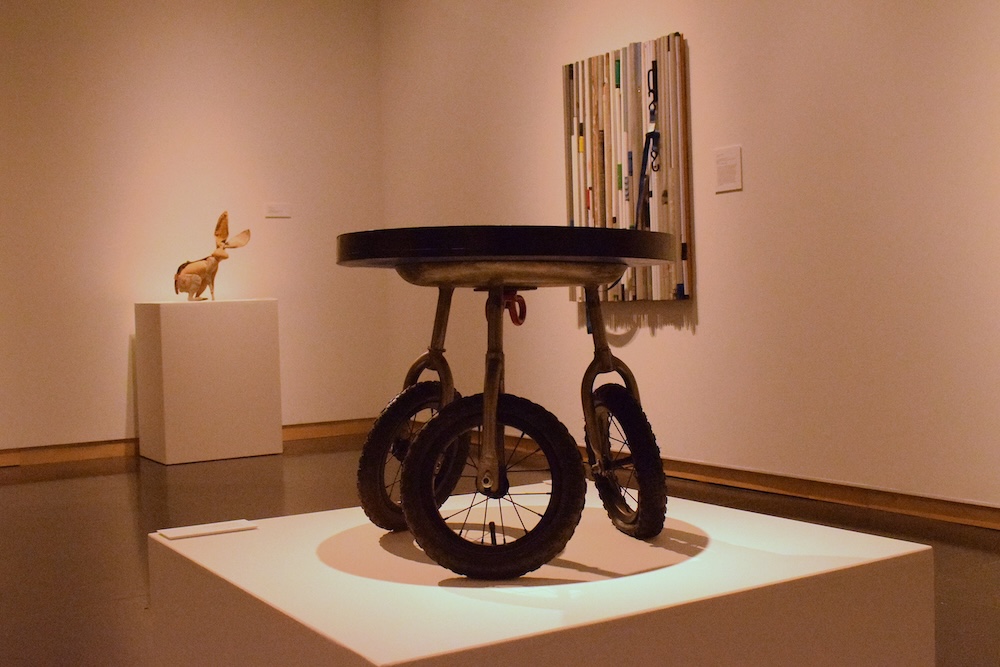
A piece made of three tires sits on display at “Reclaimed: The Art of Recology.” The exhibition showcased artwork created from materials recycled over the last 35 years. Andrew Ewanitz | Contributing Photographer
Materials go from “the dump” to being displayed in the form of paintings, sculptures and vases. Recology’s residency program partnered with the Bedford Gallery in San Francisco, where Enders selected from 35 years-worth of art created in Recology’s residence program to showcase on the national tour. Artists in the exhibit included Andrew Junge, Imin Yeh and Weston Teruya.
Enders emphasized that “one man’s trash is another man’s treasure.” One particular part of the exhibit that stood out to Enders was James Sansing’s collection: eight photographs collected from “the dump” placed in electrical boxes, all with a person cut out of the picture.
According to Sansing’s written description, the photographs show the fragility of life and how the act of throwing objects away can be similar to throwing out or erasing the memories of a person. Enders expressed how sad she felt by the idea of someone finding discarded family photographs.
“I think the exhibit is not only connecting to our planet and trying to make steps towards being more ecologically minded, but it’s also just this human connection of being connected through our trash, which is a really weird thing to think about, but also can be very emotional,” Enders said.
The exhibit’s SU stop brought business students, art students, an engineering class and a student from a neighboring college.
The consensus from Enders and Santiago is that this exhibit makes visitors confront their own consumption practices and be mindful of how they treat their purchased material.
WHAT YOU SHOULD READ NEXT
Students revel in colorful powder, enrich Holi traditions at SASA event
On Saturday afternoon, the South Asian Student Association hosted its annual Holi celebration at the Women’s Building field.
Janet Pacheco, an SU sophomore, visited the show with her engineering class, where they analyzed the exhibit’s different materials.
Bringing her engineering background and analytical approach to the exhibit, Pacheco focused on the structure of the different pieces on display. She emphasized the importance of understanding what the different parts and materials, such as metals, contribute to the collection.
While Pacheco’s engineering perspective helped her analyze the objects, she also personally reflected on her own consumption and the importance of reusing materials.
“Our world is just people consuming things, and this artwork was reusing many things,” Pacheco said.
Enders saw the exhibit as a call to action for people to be more mindful of how they treat not only material items, but also the meaningful relationships in their lives.
“Art is inherently political. It shines a mirror back to us, right on who we are as a people and a society,” Enders said.