ArtRage’s ‘The Women’s Grass’ educates, honors sacred Indigenous knowledge
Have you had an experience with Syracuse University’s Title IX office? Share your story with The Daily Orange’s anonymous tip line.
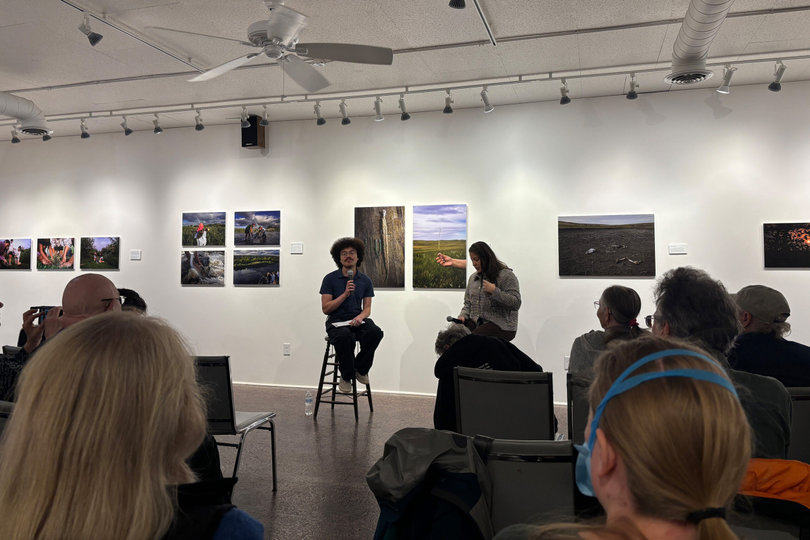
Whitney Snow, a documentary photographer and member of the Blackfeet Nation, spoke Sunday about preserving ceremonial Indigenous practices at ArtRage Gallery, where her photos are currently displayed.
Snow’s work, which will be displayed at ArtRage until Jan. 16, is focused on capturing the “essence” of her community and the surrounding environment. On Sunday, Snow came to the gallery to talk about her featured work.
The exhibit, titled “The Women’s Grass,” focuses on the effort to revitalize the sweetgrass plant, which the Blackfeet Nation considers sacred. Snow said she crafted the project to be a reflection of the Blackfeet Nation community.
“I titled it ‘The Women’s Grass’ because it is, in a way, a woman’s grass,” Snow said. “Women pass down the knowledge of how to use it in ceremonies and medicinally. Women are the ones who go out and gather it and render it…we are the keepers of this knowledge, and it’s up to us to pass down this knowledge of sweetgrass.”
Snow said she balanced creating a piece to educate a larger community, while also maintaining that some aspects of the traditions with sweetgrass are meant to remain “sacred knowledge” within the Blackfeet Nation community.
Sweetgrass requires a high-moisture environment, and due to the droughts in Montana which Snow said have lasted nearly a decade, the plant is no longer thriving as it did for previous generations.
“Sweetgrass is a plant that is utilized in every single one of our ceremonies,” Snow said. “Over time since colonization and industrialization, it has been dwindling more and more in the (Great) Plains areas.”
The people of the Blackfeet Nation aren’t the only group attempting to revitalize the sweetgrass population, but Snow said their protocols and efforts to educate younger generations about the proper ways to collect and render the sweetgrass are unique.
Co-Director of ArtRage Ellis Clay helps facilitate the exhibits to be featured by the gallery. He said he prefers to work with artists directly to ensure they “fit the mission” of ArtRage.
Their mission, Clay said, is to highlight work that is a “call to action” for the “social ills” happening within the community.
“We view it as an educational mindset, too,” Clay said. “How can we use art as a catalyst for change, and that’s what we’re about here.”
Although Snow’s work isn’t directly related to Syracuse, as the Blackfeet nation is from Montana, Clay noted a connection. He mentioned the work being done in Syracuse by the Onondaga Nation to revitalize sweetgrass along with Robin Wall Kimmerer’s book “Braiding Sweetgrass.” Kimmerer is currently a visiting assistant professor of environmental biology at SUNY ESF.
“We wanted to ensure that we weren’t just having this conversation focused upon the work of Onondaga Nation, but ensuring that we’re highlighting different Indigenous tribes here in America,” Clay said. “We’re extremely happy to highlight Indigenous artists, especially here, as we are on Indigenous land.”
Snow is a recipient of the Madonna Thunder Hawk Environmental Photography Fellowship through Vital Impacts, a group providing funds and mentorship to “empower local photographers.” She said the yearlong mentorship enabled her to “see a scene” and “paint” the story within every subject.
“I’m a big overthinker,” Snow said. “It helps me to also step back and to try and process the scene and not think so much about getting the perfect photography, but more about capturing the essence of what I feel at the time.”
Despite being featured at ArtRage is Snow’s first solo exhibition, Snow said she’d like to expand the show to more cities, and locally in Montana, eventually hoping to turn her projects into a coffee table-style photobook.
Co-Director of ArtRage Kimberly McCoy said they reached out to Snow less than a year ago after learning about her project. She was surprised when she learned this would be Snow’s first solo exhibition.
“I think there’s some similar themes in the understanding of how to work within the natural environment and pay respect to the natural environment,” McCoy said.
Snow described herself as a “slow photographer” and someone who takes time to “pay attention to the scene” to evoke emotion from her audience.
“I am not in a big rush when I photograph, especially when working with Indigenous people, a lot of them are camera shy,” Snow said. “I don’t want to have a camera in their face snapping away if it’s going to make someone uncomfortable.”
Sacred tradition and people fueled much of Snow’s inspiration for this project.
“I really wanted to honor the women in my life that I learned from over the years, and the ancestors that came before me and taught these ways,” Snow said. “So, in a way, it honors the grass, but it also honors the women in my life.”