
Indigenous members discuss democracy’s impact on sovereignty in SU panel
Have you had an experience with Syracuse University’s Title IX office? Share your story with The Daily Orange’s anonymous tip line.
Elder Regina Jones, member of the Oneida Nation Turtle Clan, chose a specific ribbon skirt to wear to Syracuse University’s “American and Indigenous Democracy” panel on Tuesday, symbolizing a historical agreement between Indigenous nations and visitors from across the ocean.
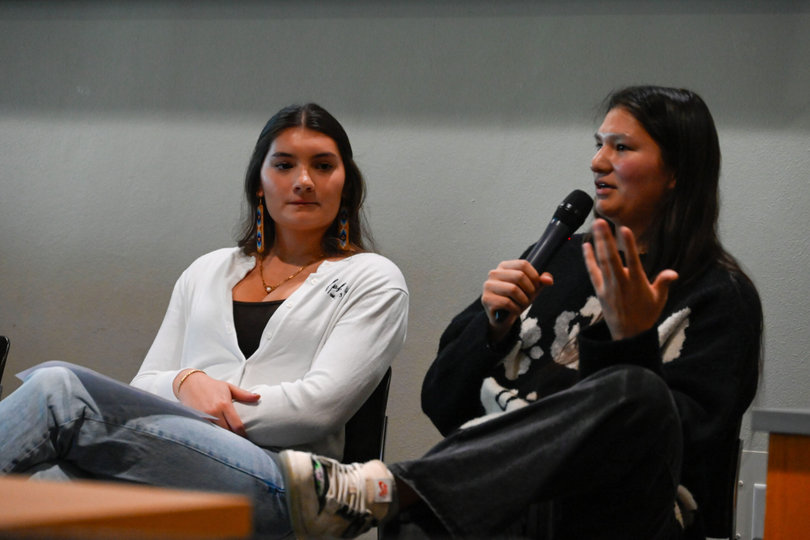
The Native Student Program at SU hosted the discussion as part of a series of events celebrating Native Heritage Month. The panel dove into the contributions of Indigenous democracy to American democracy and its lasting impacts.
Jones said she sewed the skirt herself, weaving two purple rows at its hem to represent the Two Row Wampum treaty, signed between the Haudenosaunee and Dutch in 1613. The treaty established principles of friendship and peace for future generations.
The parallel rows are designed to appear endless, representing the binding nature of the agreement despite the two groups living separately. While the treaty was not made with the United States, Jones said it was open to everyone who was agreeable to living alongside the Haudenosaunee’s ideals and stewardship.
“(The treaty) will always be binding. Our way of life and our instructions of how we’re supposed to be in this world are the same,” Jones said. “We still live as we were instructed, and we still follow that, even though America doesn’t.”
The discussion began by defining Haudenosaunee democracy and other systems of Indigenous democracy.
Panelist and SU professor Scott Manning Stevens, citizen of the Akwesasne Mohawk nation, highlighted that Haudenosaunee democracy was one of the oldest continuously practiced systems of democracy, and mentioned its inclusion of women is something absent in the early days of American democracy.
“If you think of what (the system’s) been through, what we’ve been through as a culture from invasion, conquest, subjugation by various colonial powers, including the United States, and yet we are still here,” Stevens said. “We’re still active. We still proceed the way that we traditionally have.”
Panelists discussed the role of clan mothers in Indigenous sovereignty, comparing their ability to remove leaders they deemed unsuitable to the American system of checks and balances.
Jones said the main disparity between Indigenous democracy and the American representative republic was its reliance on consensus, meaning decisions were not finalized until all participants agreed. Stevens argued that America’s reliance on majorities fostered the country’s polarized environment.
Regarding the Indigenous democracy’s influence in American politics today, panelist Lylla Schindler, member of the Seneca Nation Wolf Clan, said she found inclusions of Indigenous symbols, such as the eagle and olive branch, “really aggravating” without proper representation.
Panelist and SU professor Danika Medak-Saltzman, descendant of the Turtle Mountain Chippewa Nation, added that the history of disenfranchisement in the U.S. that kept women and people of color away from polls spoke to the role of exclusion in American democracy.
“It lets you know that they aren’t actually interested in hearing what everybody thinks,” Medak-Saltzman said. “They aren’t actually interested or committed to addressing the concerns of the people, even though we’re told that that’s the goal and that we can make our voices heard at the voting box.”
The panel concluded with a discussion over the role of Indigenous education in American schools and its importance for undergraduate students.
Panelist and Junior Aubrie Heron, member of the Seneca Nation Wolf Clan, spoke about the difficulty she’s faced explaining Native American culture to people who have never experienced it before, especially professors.
“When you try to bring in this idea of relations with the land and being one with it, a lot of them butt heads with you about it because they have this idea about money and power,” Heron said.
Stevens said the average grade when American students stop learning Native American history is fourth grade. He said Native American history should be taught to young students like other difficult topics, such as American slavery and the Civil War.
“There needs to be a consistency throughout their education,” Stevens said. “They don’t just learn about it (for) one year and they’re done.”
Medak-Saltzman highlighted Montana’s “Indian Education For All” initiative as a successful model for integrating Indigenous history into all grade levels.
Each panelist encouraged students to question the fairness of American democracy and the idea of “one person, one vote.”
Junior Lauren Steinberg said she attended the panel out of interest in matriarchy within Indigenous nations from her anthropology course. She said she left with a desire to explore the intricacies of both Indigenous and American democracies.
“I’m gonna go home and think about American democracy, my way of thinking and do research,” Steinberg said. “It’s important to always (question) my voice.”
Stevens said he was glad forums at SU exist to host open discussion regarding Indigenous culture and sovereignty.
“When I look at what’s been happening in the South and in certain other states where they’re shutting down any kind of diversity, I just don’t see it here, and I’m very glad that it’s not (here),” Stevens said.