County legislators express frustration surrounding aquarium project delays
Have you had an experience with Syracuse University’s Title IX office? Share your story with The Daily Orange’s anonymous tip line.
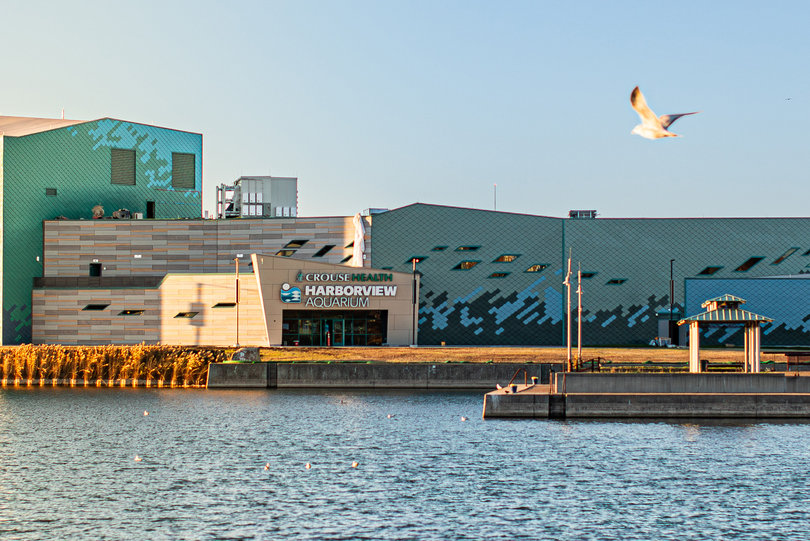
In Oct. 2021, Onondaga County Executive Ryan McMahon announced plans for an $85 million aquarium to be built at Syracuse’s Inner Harbor, promising the project would create hundreds of jobs and transform the neighborhood. Over five years and several funding controversies later, the aquarium remains without a confirmed opening date.
Onondaga County’s Harborview Aquarium will be an 80,000-square foot facility managed by the ZoOceanarium Group, an aquarium and zoological-facility development and management company. The project faced scrutiny due to high costs and criticism that the county had more pressing issues.
The original $85 million investment has increased to approximately $104 million. The investment came from the county’s public funds, a portion of which is made up of tax dollars.
Several Onondaga County legislators said they’ve felt uninformed throughout the development process and haven’t received a straight answer about the aquarium’s opening date. Multiple legislators said when they asked the County Executive’s office what a “fall opening” meant, the response was before Dec. 21.
In a statement to The Daily Orange, Executive Communications Director for Onondaga County and the County Executive Justin Sayles wrote that the aquarium will officially open “in the coming weeks.”
“We never ever said it was definitely going to open in October,” Sayles wrote. “We said that was the goal at the time.”
Chad Ryan, legislator for Onondaga County’s 8th District, said there’s been a lack of transparency from the county Republicans that approved the project at the time.
“(The project) was an extremely unpopular undertaking and the Republican administration was very aware that any information on this was going to be some sort of story, even if it had no negative spin,” Ryan said. “They’re number one position from the start was ‘Stifle, stifle, stifle.’”
Public criticism of the project has remained high since its approval, with many questioning the county’s priorities given the project’s costs. When the project was approved by lawmakers in Aug. 2022, the public hearing was filled with protestors. After the vote, McMahon told reporters that the protest was a politically organized campaign.
All but one Democrat voted against funding the project, with Charles Garland voting yes because he was promised a housing project in his district.
For State Assembly Elect and former County legislator Maurice “Mo” Brown, approving the $85 million in funds was always a mistake.
“(The legislature was) not transparent with the cost up front and I didn’t think we should have committed to the project without having all of the money available,” Brown said. “We committed $85 million with full knowledge it was going to cost more than that.”
The project’s increased costs forced the county to divert funds from other projects, including a $5.7 million transfer from the Greater Syracuse Soundstage Development Corporation. This sparked controversy because it was done largely outside of the purview of the county legislature.
Brown said the money was initially made available for film production in the city of Syracuse, but the county was able to justify using it for the aquarium project instead due to the vague wording of “film production.” Legislators had no say in the transfer, he said.
“We didn’t know about (the transfer) until after it happened, and that in itself is disappointing,” Brown said.
The Soundstage Development Corporation transfer wasn’t the only source the project drew from, as the county also diverted funds from the Onondaga Lake cleanup and Onondaga County Industrial Development Agency, according to an April press release.
Onondaga County Legislator and Majority Leader Nodesia Hernandez’s main concern has remained preventing the use of additional taxpayer dollars on the aquarium.
“I’m not going to be voting for more money from our taxpayers to be spent because when do we say enough is enough and turn (the money) into housing?” Hernandez said.
Hernandez said accountability for any additional costs has been a major focus since Democrats took control of the legislature in 2025. She said she’ll continue to advocate for accountability in the aquarium’s funding as the opening nears.
“We will not be moving any money without coming together, listening, having public hearings, listening to our constituents and making sure that money isn’t just taken from one place to another,” Hernandez said.
Ryan isn’t as confident that taxpayers won’t have to bear more of the load of the project.
“My gut, my intuition says that down the road, (the aquarium’s) running lean and when we need to make capital improvements, we’re going to need to invest in it on county taxpayers’ money,” Ryan said.
Hernandez said she hopes the aquarium is a success for the city despite disagreeing with the development process.
“We want to make sure that we have economic development within Onondaga County,” Hernandez said. “We want this aquarium to be successful. If it’s not successful, it affects us all, right?”
Brown agreed with hoping for the aquarium’s success, but said he was skeptical the project would deliver on its economic promises.
“The numbers on the aquarium project don’t add up, but I want to believe in my team,” Brown said. “I want it to go well.”
Brown added that if the aquarium does become “this great northeastern attraction,” that many people, including himself, would have to “eat humble pie.”
Ryan said the aquarium will add another amenity to the city, but expressed skepticism about the project’s economic viability.
“If you were to sit there and talk about the metrics of it paying for itself: no,” Ryan said. “But it’s tough, it’s going to be another asset.”