Columbus statue replacement plans aim to reflect ‘nuanced’ Syracuse history

Have you had an experience with Syracuse University’s Title IX office? Share your story with The Daily Orange’s anonymous tip line.
The Christopher Columbus monument has remained a controversial subject among residents after former Syracuse Mayor Ben Walsh first announced plans to remove the statue in 2020. Six years later, Syracuse residents have the opportunity to see the possible future designs for the space.
The monument has stood in St. Mary’s Circle for over 90 years since its dedication in 1934. The three finalists of The Full Circle Design Competition, led by the Onondaga Historical Association, revealed their plans Tuesday night for St. Mary’s, or “Columbus Circle,” and the Powelson site, a vacant lot across the street.
The presentation took place at St. Paul’s Episcopal Cathedral, and the designs will be displayed at the OHA for the next two weeks. OHA Board of Directors President Darcy DiBiase said admission to the museum will be free during that time and expressed the competition’s importance.
“Public art can become a destination,” DiBiase said. “We see it in large and small cities across the nation, especially in this digital age when social media platforms attract activity to public parks and streetscapes.”
All three of the finalists said they considered keeping the statue but decided against it, hoping to create a new space that represents all Syracuse communities in a more nuanced way.
The proposal of removing the statue has been met with resistance from The Columbus Monument Corporation, which announced Wednesday it will be taking legal action against the OHA to comply with its requests under the Freedom of Information Law. The CMC previously said it planned to sue but formally announced it in a Wednesday press release.
CMC Board Members Nick Pirro and Frank Malfitano challenged the motives behind the competition and “discredited the entire process as secretive and deceptive,” the release reads.
OHA Executive Director Lisa Romano Moore said the CMC has the right to be unhappy with this project but noted it was invited to be part of it from “the very beginning.” Moore said she thought they would’ve “definitely” contributed to the process.
In regards to the lawsuit, Moore said the OHA will see how things play out, but they did their best to engage the CMC.
The CMC has also explained its frustration with removing the statue, saying it’s a point of pride for the Italian-American community.
Malfitano noted in the release that the “beautiful artwork” created by an Italian artist is a “Syracuse treasure” and a “beautiful living memorial to our immigrant ancestors.”
Michael Messina-Yauchzy, member of the steering committee of Neighbors of the Onondaga Nation and WISH CNY, said Columbus doesn’t represent the values of Italian Americans: loving your neighbor, peace and justice.
He highlighted the harm and suffering caused by Columbus and drew attention to the specific issues on the Syracuse monument.
The “Indian heads” that adorn the statue are wearing Plains Indian headdresses, which he said aren’t representative of this area’s Indigenous groups. Messina-Yauchzy said it’s a “disrespect to our neighbors, who we actually have quite a bit to learn from in terms of living peacefully.”
“We feel that Columbus represents an injustice, we have a very vocal segment of Italian Americans who want to honor Columbus and who really don’t seem to appreciate what he represents to our Indigenous neighbors, and that’s what concerns us,” he said.
Romano Moore said the OHA’s jury, a curatorial committee, will review the qualifications and designs in December. Its criteria, which includes community feedback, will inform its decision in choosing a winning project. She said the design then has to be turned into a “schematic design,” which the city can choose to move forward with fundraising if they wish.
She explained multiple administrative processes will be necessary as the final decision is under the “auspices” of the city because it’s a public space.
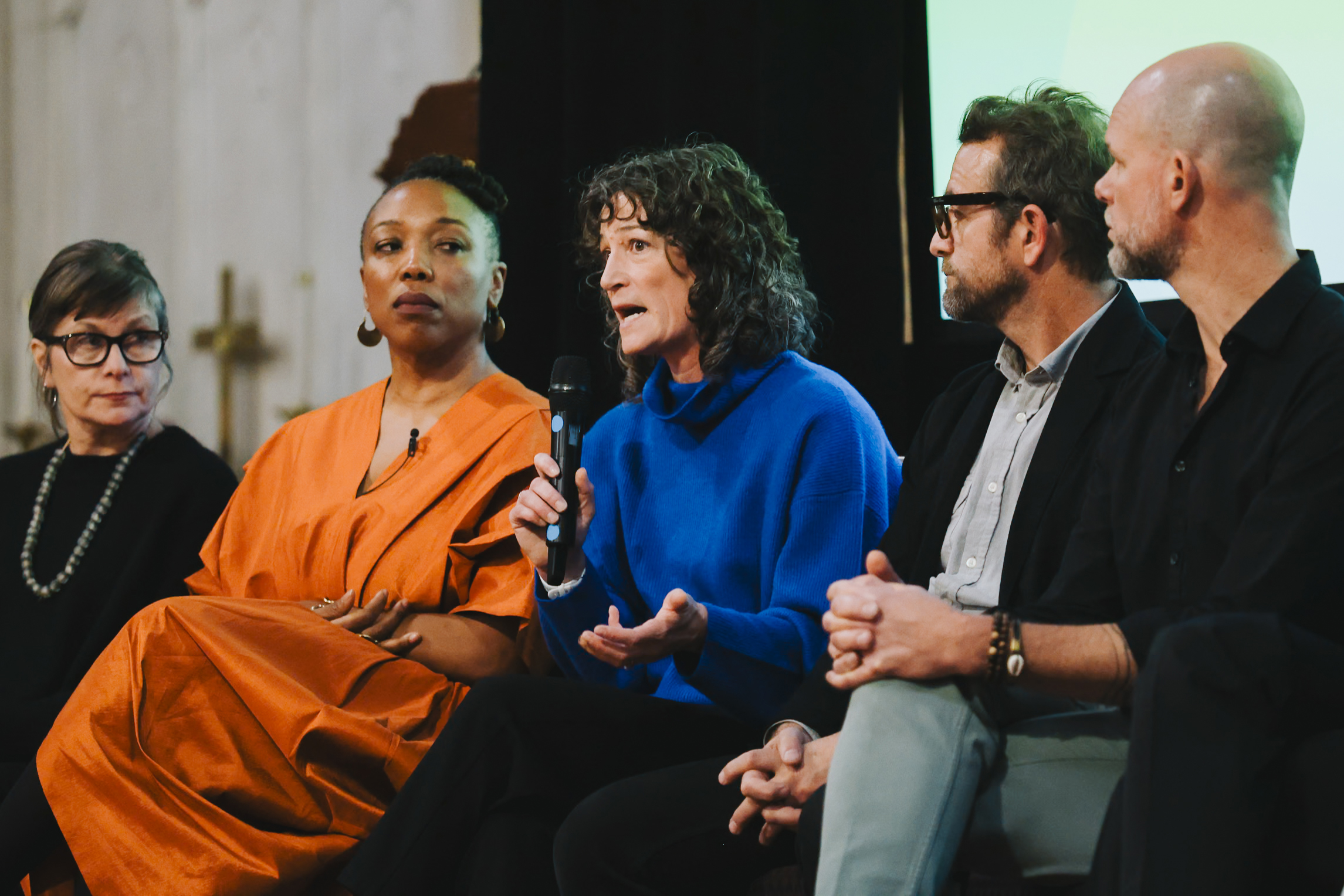
Finalists of The Full Circle Design Competition answer questions during the Q&A portion of the presentation. Attendees asked about the team’s different approaches and vision for the future space. Logan DeBolt | Contributing Photographer
Creative Urban Alchemy Collective
Ifeoma Ebo, Rodney Leon and Kelly Britt comprised the team from the Creative Urban Alchemy Collective. They proposed the “Unity Circle + Heritage Walk” for the space as “a single civic landscape where land, memory and community converge,” Ebo explained.
Their “Unity Circle” would replace the current Columbus Circle, with native trees and flowers surrounding the area and a water fountain in the middle, inspired by the Great Law of Peace. The circle would include an electric snowmelt system to keep the seating areas and paths clear.
Across the way, in the Powelson site, their design features the Heritage Walk, including a native wetland, more native trees and historic stories of Syracuse communities etched into the walls.
The team said permanent artwork will be dispersed through the space and will connect through the handcrafted, mosaic-laid pathways of the Heritage Walk.
They explained their vision includes a more nuanced Italian American community story as part of a broader narrative of migration, belonging and civic contribution.
“This framework has the potential to nurture civic pride while also cultivating ongoing interpretation of the site,” the team said. “This approach transforms commemoration from a static record of the past into an ongoing civic process.”
Rafael Lozano-Hemmer
Rafael Lozano-Hemmer’s team proposed “Memory Park” along with Michael Nardone and Tina Rivers Ryan. Their idea focuses on three main components: “Pulse garden,” “Voice Tree” and “Syracuse Mirror” to create a more interactive space.
They said “Memory Park” was partially inspired by Aldo Tambellini, an Italian American artist who was born and studied in Syracuse. The team said he was a “key pioneer” in 1960s media art.
The “Pulse Garden” will feature 3,000 light bulbs that can read a heartbeat. When the bulb reads the pulse of the person touching it, it flashes with the heartbeat’s rhythm, the newest heartbeat replacing the oldest.
Lozano-Hemmer said the section is “a reminder that we are only here for a little while.”
The “Voice Tree” will stand in the heart of St. Mary’s Circle in place of the Columbus statue.
“The tree would be made of 50 feet of steel, aluminum, wood and light,” Lozano-Hemmer said. “When you press an intercom and speak, the words become pulses of light that climb the branches, and the tree answers.”
When no one speaks, it replays voices from its past from a built-in archive system, including stories from the Haudenosaunee Confederacy, Italian Americans and other local communities.
The third piece is the “Syracuse Mirror,” which would stand near Montgomery and East Jefferson Street. A clearly marked area will be in front of the digital mirror for visitors to step on and be recorded. The idea is to look in the mirror and see their face alongside previous users.
“New portraits erase older ones, and nothing is stored for good. This is a shared short-term memory,” Lozano-Hemmer said. “With local historians, we will add portraits of figures from Syracuse history. They are never forgotten. From time to time, they reappear amongst today’s space.”

Attendees explore the finalists designs at the Onondaga Historical Association. The exhibits will be open to the public for the next two weeks with free admission. Logan DeBolt | Contributing Photographer
TEN X TEN and MASARY Studios
Maura Rockcastle, Ross Altheimer and Ryan Edwards said they proposed “Living Circles: A Garden of Memory” seeking to recognize overlooked histories, especially the communities with deep ancestral ties to the land.
“We exist inside systems of relationships that exceed our individual perspectives,” the team said. “Many living circles.”
The garden engages three types of cycles: human, ecological and celestial.
Their design features a circular sculpture to create a new space for gathering and celebration with two concentric rings that would be lifted up, holding thousands of luminaires and suspended by four cones.
The design would have an ellipse of limestone benches as part of an open plaza beneath the sculpture, where traces of St. Mary’s Circle are embedded in the ground.
The team said this weaves human and cultural stories into an evolving record of place.
Additionally, the team mentioned a water circle would mark where the Christopher Columbus statue stood. They said the calm and reflective water would create a moment for healing as well as an opportunity to symbolize the resilience and roots for both the Italian American community and the Onondaga people.
A native woodland garden and cedar wetland will also be included along with story stones, which will be placed throughout the garden to serve as “emotional anchors and ensure all visitors feel seen, heard and valued,” the team explained.
In addition to attending the exhibit at OHA, anyone can fill out their community feedback survey here. Syracuse University’s Maxwell School of Citizen and Public Affairs’ Community Link Program will have students collect and organize the feedback, which the committee will consider when selecting a winner.
Messina-Yauchzy said that designs open the opportunity to have something striking in Syracuse that “represents all of us.” He mentioned the historical song he wrote about this issue, saying it’s important to take down the statue as a sign of respect for the Haudenosaunee Confederacy.
“Let’s recognize and honor all of the people who have built Syracuse,” Messina-Yachuzy said. “We have some families here in Syracuse that go back several generations, who have contributed a lot to our community. Let’s honor those people.”