Military musicians perform patriotic classics at Hendricks’ America 250
Get the latest Syracuse news delivered right to your inbox.
Subscribe to our newsletter here.
The Hendricks Chapel pews were filled with audience members of different generations Friday night. From families and students to veterans and longtime community members, they quietly anticipated an evening of celebration.
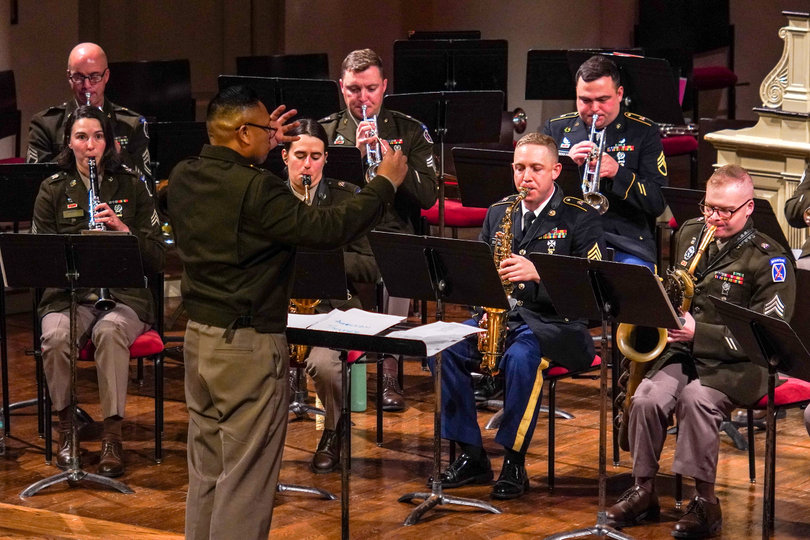
The sound of brass and percussion filled Hendricks as members of the Syracuse University Brass Ensemble and the 10th Mountain Division Band performed together for the America 250 Concert.
“I hope that people just go away with music in their heart,” Mary Kasprzyk, principal percussionist of the SU Brass Ensemble, said.
As the U.S. celebrates its semiquincentennial this year, communities across the country are finding ways to commemorate 250 years of American history. Hendricks’ America 250 Concert tied together those years of history through showcasing classic American composers spanning different eras. Including songs like Samuel A. Ward’s “America the Beautiful” and Irving Berlin’s “God Bless America” in the concert helped the show acknowledge the country’s arts, members and service. The performance used music to revisit the country’s past while creating an opportunity for musicians from different backgrounds and generations to perform alongside one another.
Members of SU’s Brass Ensemble opened the concert with five songs, followed by seven songs by the 10th Mountain Division Band. The concert closed with a finale featuring “Service Medley” and “The Stars and Stripes Forever,” performed by both groups.
“Music is the throughline that connects all of us in this country, regardless of your politics,” Jeff Passetti, chair of the SU Brass Ensemble board and trumpet player, said.
That connection was reflected in the two ensembles’ collaboration. The SU Brass Ensemble is made up of university faculty, staff, students and alumni, alongside local music educators and community members. The 10th Mountain Division Band is composed of U.S. Army soldier-musicians based at Fort Drum.
For Kasprzyk, the opportunity to perform alongside the military musicians was both exciting and meaningful.
“I love when there’s more than one group playing at once. It’s loud, I’ll tell you that, but it’s just the power,” Kasprzyk said. “It’s very emotional and stirring to hear the two groups playing these patriotic songs together.”
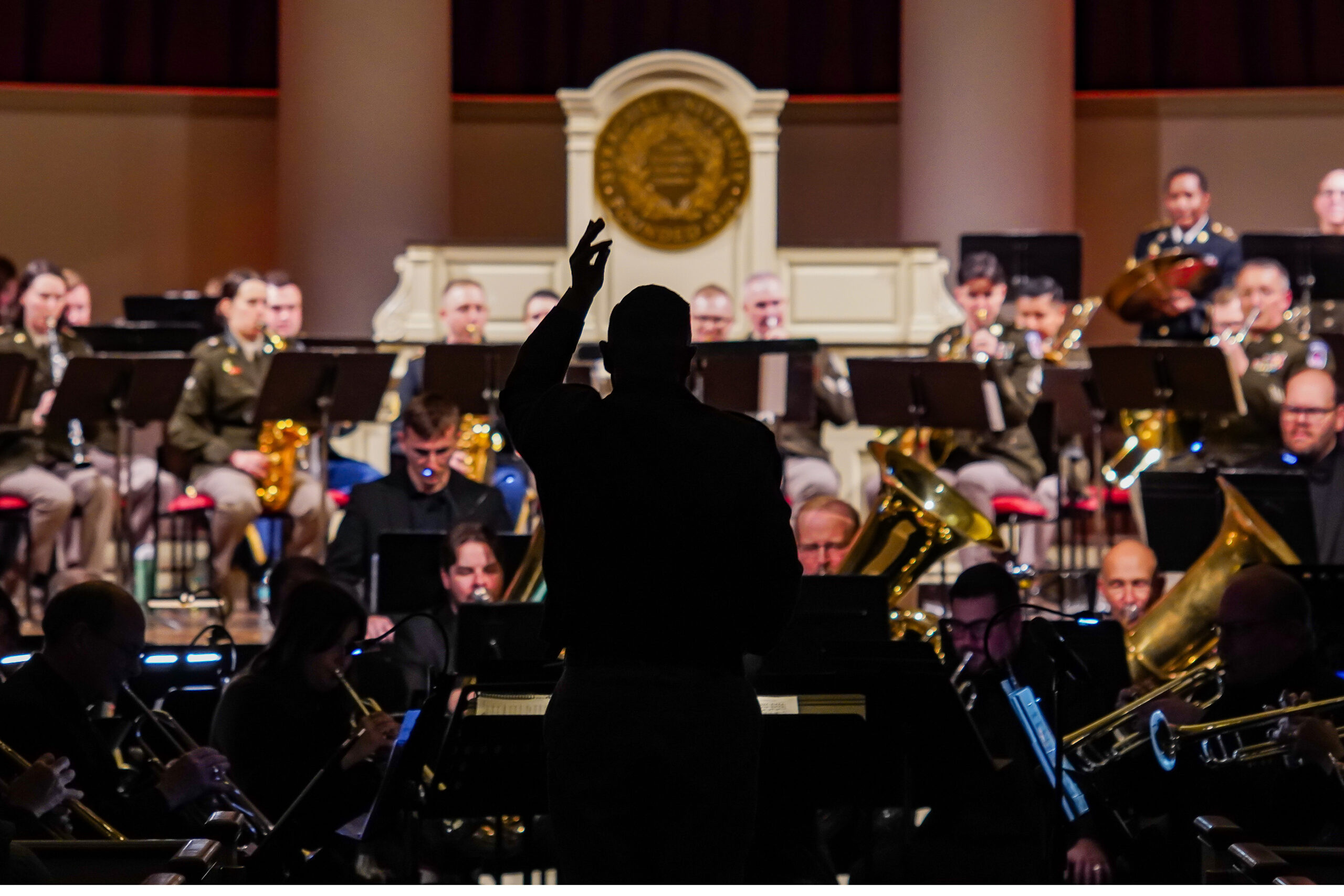
The Syracuse University Brass Ensemble and the 10th Mountain Division Band perform together during the finale of the America 250 Concert. The ensembles joined to play “Services Medley” and “The Stars and Stripes Forever.” Logan Weyant | Contributing Photographer
The concert’s timing with this year’s midterm elections felt appropriate for Kasprzyk.
“The theme of the songs, which is all about our country, and we just had the election, so people are kind of feeling it,” Kasprzyk said.
The collaboration between musical groups also connected those from different generations and experiences. Before the concert, high school, college and local musicians were invited to learn musical techniques from members of the 10th Mountain Division Band in a masterclass. Masterclass students were also invited to join both bands to perform the finale songs.
Corey Riley, principal euphonium player and associate director of the SU Brass Ensemble, encouraged his high school students to participate in the masterclass. Riley, who’s also the band director at Westhill High School, said the performance offered an opportunity for his students to reflect on the freedoms that allow people to express themselves.
“If you think of every celebration in life, no matter what it is, it involves music somehow,” Riley said. “Music has a way of expressing an event, a moment of feeling, that words fall short. Music takes off.”
That relationship between music and the country’s history was especially present throughout the concert, Riley said. He connected the performance to the tradition of military music and composer John Philip Sousa, whose work helped shape the country’s musical identity.
One of Sousa’s works, “The Stars and Stripes Forever” is the National March of the U.S., and Riley said playing it felt like a celebration of the country.
Army bands have been part of the military since its early years, when drums and bugles were used to communicate on the battlefield, 1st Sgt. Andrew Smicker, commander of the 10th Mountain Division Band, said. Performances offer another way for military musicians to connect with civilian communities.
For some audience members, like David Champlin, the evening went beyond the concert’s music. During one of the final songs, “Services Medley,” veterans were invited to stand while their respective military branch sections of the song played, bringing a personal connection to the performances.
Champlin, a Syracuse resident and U.S. Army veteran, attended the concert with his family. Military service has been a tradition in his family — he, his father and his grandfather all served. He said Friday’s performance was “very encouraging and uplifting.”
“It’s our family tradition, and we love the U.S.,” Champlin said.
The concert represented months of preparation and coordination. Passetti, who helped organize outreach for the event, said getting people to attend was one of the biggest challenges amid the many competing events and activities.
WHAT YOU SHOULD READ NEXT
SU Symphony Orchestra launches new era with ‘Together We Are Stronger’
Syracuse University’s Setnor School of Music and the SU Symphony Orchestra hosted Diego Barbosa-Vásquez’s inaugural SU concert Tuesday.
Still, the audience’s response made the effort worthwhile. Smicker described the standing ovation as a particularly meaningful moment for the musicians.
“Just because you do a performance doesn’t mean you get (a standing ovation). You have to earn one,” Smicker said. “When that happens, it is an incredibly emotional event.”
Passetti hopes audience responses like the one Smicker saw will encourage more people to attend live performances. While getting audiences to come to concerts can be difficult, he said experiencing live music can leave a lasting impression.
“When you go to a concert like that, and you get that feeling in your chest, (those) goosebumps, I think that’s a contagious thing,” Passetti said.